




When MIA Design Studio was established in Ho Chi Minh in 2003, Vietnam’s architecture industry was still in an “early stage of integration” with the global design community, says founder and principal architect Nguyen Hoang Manh.
“Most projects were strongly driven by rapid urbanisation and economic development, and the focus was often on speed and efficiency rather than long-term environmental or cultural considerations,” Nguyen tells City & Country.
Over the past two decades, however, the industry has evolved significantly.
Vietnamese clients have become more sophisticated, says Nguyen. “Developers now understand that architecture is not only about construction but also about brand identity, user experience and long-term value creation.”

There has also been a growing awareness of sustainability and environmental responsibility, adds Nguyen. “With the challenges of tropical climate, urban density and climate change, architects in Vietnam are increasingly exploring passive design strategies, green spaces and climate-responsive architecture.”
Vietnam’s architecture scene has become more internationally visible, says Nguyen, a Master of Architecture graduate from KU Leuven in Belgium. “Many young Vietnamese firms have gained recognition in international awards and publications, showing that local architects are capable of producing work with strong global relevance while still rooted in local context.”
See also: YTL Cement balances business, sustainability and ecosystem-building
Above all, the “most positive change” is that architecture in Vietnam is gradually shifting from “object-based design” to “experience-based design”, adds Nguyen, who has more than three decades of experience in the field.
Hospitality focus
MIA Design Studio has emerged as a pioneering force in master planning, architecture, interior and landscape design. With a three-pronged philosophy around modern living, sustainability and respecting culture and context, the firm has developed strong expertise in hospitality design, particularly in resorts, boutique hotels and wellness retreats.
See also: Transforming Singapore’s construction industry through mindsets, innovation and value creation
“Many of our projects are located in tropical environments across Vietnam and Southeast Asia, where the relationship between architecture, climate and landscape becomes the core design driver,” says Nguyen. “Our unique perspective is to approach hospitality architecture as an experience of nature rather than simply a built product. Instead of separating buildings from the landscape, we try to dissolve the boundary between indoor and outdoor spaces.”
The Wyndham Garden Phu Quoc, opened in 2018, was a hospitality project by MIA Design Studio. Other developments in the pipeline include a Hyatt Regency hotel in Ha Long and a Marriott International hotel in the southern port city of Vung Tau.
According to Nguyen, an “important advantage” enjoyed by MIA Design Studio is the firm’s insistence on integrating architecture with landscaping “from the earliest conceptual stage”. “For us, landscape is not decoration; it is part of the spatial structure. Guests should feel that they are living within the landscape rather than merely looking at it.”
With landscape architecture at the centre of the design process, Nguyen’s team also prioritises “passive design strategies, local materials and climate-responsive architecture”. “In tropical hospitality projects, reducing energy consumption and improving thermal comfort through natural ventilation, shading and vegetation can significantly enhance both sustainability and the guest experience.”
Vietnam’s design perspective
MIA Design Studio’s modus operandi reflects the country’s design perspective.
Owing to the tropical climate, courtyards, gardens and shaded outdoor spaces are “highly relevant spatial strategies”, explains Nguyen.
Another important aspect is the creative use of local materials and craftsmanship. “Vietnam has a long tradition of using materials such as brick, stone, timber and bamboo in expressive and innovative ways. Contemporary architects are reinterpreting these materials to create modern architecture that still feels connected to local culture,” he adds.
Finally, Vietnamese architecture often emphasises “human scale and spatial intimacy”, says Nguyen. “Rather than focusing only on iconic forms, many projects aim to create quiet, contemplative spaces that support everyday life and emotional well-being.”
He adds: “Ultimately, our goal is to create spaces that allow visitors to reconnect with nature, culture and a slower rhythm of life… In a rapidly urbanising region, these values can help balance development with cultural identity and environmental sensitivity.”
About The Park
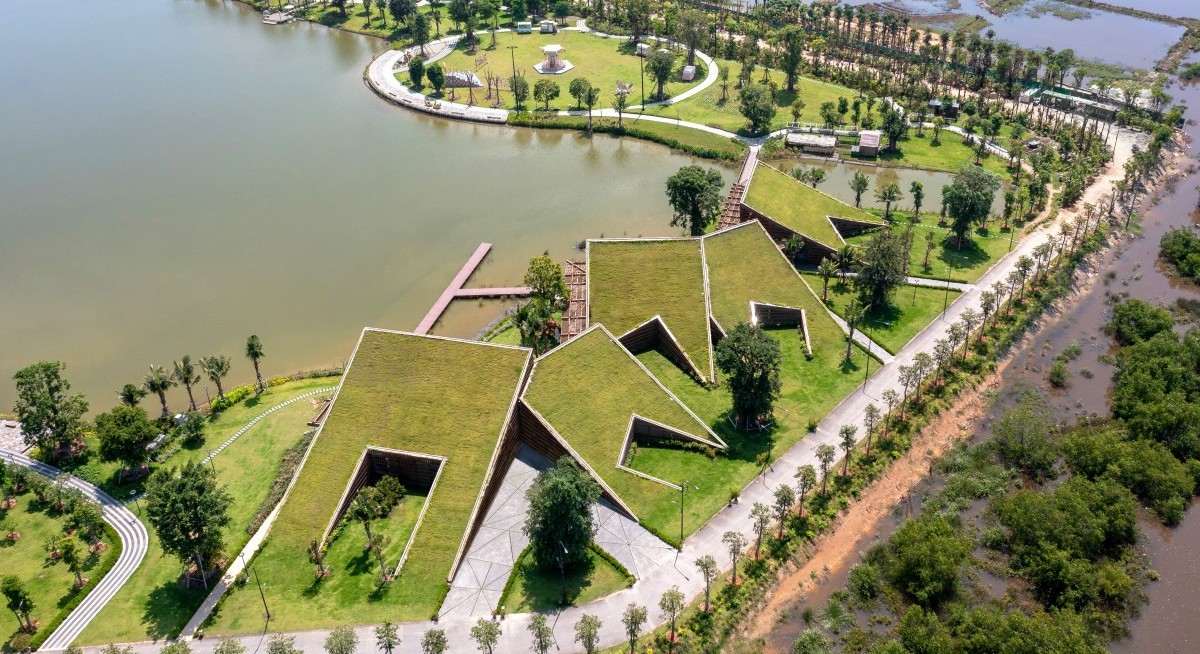
In 2025, MIA Design Studio racked up a handful of awards for The Park, a quintet of community centre buildings that emerge from rice fields in Vietnam’s Nghe An Province. This project will be the focus of Nguyen’s showcase presentation at the Sustainable Construction Symposium 2026, a half-day conference organised by The Edge Singapore and YTL Cement, happening April 29 at Pan Pacific Orchard.

“The Park in Vinh was designed with a simple intention: the architecture should feel like part of the landscape rather than an object placed on it,” says Nguyen. “From the beginning, we approached the project as an extension of the terrain and greenery surrounding the lake. Instead of emphasising architectural presence, the design allows the building to merge quietly into its environment.”
Indeed, the grass-covered facade of the development visually connects the architecture with the surrounding gardens. This allows the building to almost disappear into the landscape when seen from a distance. At the same time, the green roof helps reduce heat gain and creates a cooler microclimate for the public spaces below.

Material choices also reinforce this relationship with nature, says Nguyen. Wood is used extensively on both exterior and interior surfaces, creating warmth and continuity between indoor and outdoor spaces. Open circulation areas, views toward the water and layers of vegetation allow light, wind and landscape to flow naturally through the project, he adds.

The same ethos of designing for a harmonious blend with the surroundings is also observed in the more recent Lotus Clubhouse, another project by MIA Design Studio.

Completed in 2025, the project is located within the Eco Retreat project in Long An and has a usable area of approximately 2,000 sqm. Lotus Clubhouse combines green landscape surfaces, concrete roof structures and transparent glass facades to create a building that is “both environmentally responsive and visually connected to its surroundings”, says Nguyen.

The planted roofs form a “continuous ecological layer” above the architecture, acting as thermal buffers that reduce surface temperatures while blending the building into the surrounding greenery, notes Ngyuen — much like The Park.
“Across both projects, the intention is similar: architecture should not dominate its environment, but belong naturally to it,” he adds.
Photos: Trieu Chien, MIA Design Studio

For enquiries, contact events@theedgesingapore.com or click here to register your interest




