


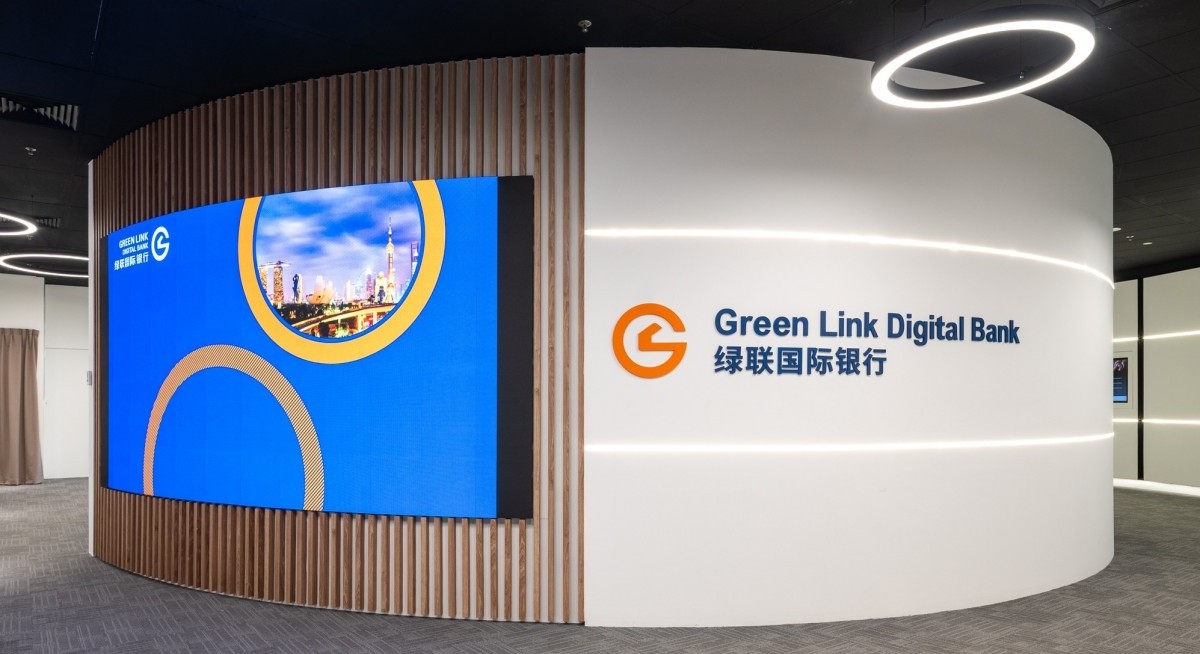


Green Link Digital Bank is a MAS-licensed digital wholesale bank headquartered in Singapore. We support growing businesses by bringing banking, payments, financing and working capital together within a single digital platform to deliver greater financial control. Operating within Singapore's regulated banking framework, GLDB provides a secure and trusted foundation for managing activity with clarity and confidence.
1. As one of Singapore’s two licensed digital wholesale banks, what are some of Green Link Digital Bank’s (GLDB) key business segments?
We launched our banking business in June 2022 to serve micro, small and medium enterprises (MSMEs), with a key focus supply chain financing.
GLDB seeks to leverage our experience in supply chain financing and in innovative, easy-to-use technological solutions to provide accessible commercial banking and supply chain offerings for underserved MSMEs.
Our banking functions are designed to support the day-to-day financial needs of businesses at different stages of growth. From cash management and payments to financing and liquidity planning, we provide practical tools and services that help businesses manage complexity and operate more efficiently.

2. How does a new player like GLDB differentiate itself from other digital, traditional banks or fintech platforms to acquire and retain customers?
We serve the underserved and provide practical tools and services that help businesses manage complexity and operate more efficiently.
See also: Serial Achieva: From traditional IT distribution to technology infrastructure and solutions
Due to the bank’s digital nature, we do not incur the brick-and-mortar costs associated with traditional banks and their branch networks, enabling us to potentially pass these cost efficiencies on to our customers in more favourable terms.
Unlike many traditional banks, which tend to favour more established business models and segments, we are sector-agnostic and serve newer segments, such as high-tech. Our deposit offerings also provide more flexibility for clients to manage their cash, including innovative structures such as current and multi-currency accounts that do not charge a minimum balance fee and allow customers to earn credit interest — features typically not offered by traditional banks.
Last but not least, our leaner, flatter organisational structure, with experienced banking professionals, enables us to rapidly scale new solutions.
See also: GXS Bank: The strategy behind a digital-first bank
3. How does GLDB leverage its shareholders’ technologies and ecosystem to drive business growth?
The bank’s two shareholders come together to deliver a unique value proposition.
Greenland Group is a Fortune Global 500 enterprise with extensive experience across real estate, infrastructure, and large-scale business operations, while Linklogis is a leading provider of supply chain finance technology solutions.
Greenland Group’s extensive supplier and distributor network provides high-quality origination, while Linklogis’ digital supply chain financing platform enables seamless, data-driven assessment of trade financing loans.
4. Who are GLDB’s main clients, and is it looking to expand its existing markets or into new markets? Are there any regions or sectors being prioritised?
Our customers come from diverse industries, including financial services, trade and distribution, and tech.
By region, the largest proportion of our clients is in Singapore. Still, we also have a significant proportion of customers outside the country, including Singaporean entities with international businesses across Asia Pacific and in other regions such as the Middle East and Europe.
We are open to new segments and regions and assess them on a case-by-case basis as they arise.
One notable trend is the growing trade flows between China and Southeast Asia. GLDB is well-positioned to act as a bridge between China and Asean, offering a meaningful opportunity to support cross-border trade flows and deepen our presence in Southeast Asian trade corridors.
5. GLDB had an operating profit in 2024 and was profitable last year. Could you elaborate on how the group is driving sustained business growth while managing costs?
Overall, as we grow our business, we bring together two complementary mindsets: a disciplined test‑then‑scale approach and a constant focus on innovation. We continuously pilot new products and initiatives, then scale only when product-market fit, commercial viability and control readiness are evidenced. This pairing helps us quickly identify growth and cost‑saving opportunities, scale what works at pace, and decisively retire ideas that do not.
For more stories about where money flows, click here for Capital Section
We have also diversified our revenue across products, including lending, payments and foreign exchange.
We also optimise lending margin yields through risk-adjusted pricing, active portfolio management and disciplined underwriting, while maintaining prudent credit performance. In addition, we selectively target underserved segments where our capabilities command risk‑appropriate pricing, helping to offset margin and fee compression.
This has enabled the bank to scale its operating income by over eight times between 2023 and 2025 and turn profitable in 2025.
This year, we have identified several initiatives to potentially improve our offerings and capabilities, such as leveraging AI in various aspects of the bank’s operations, which we will test robustly before rolling them out progressively.
6. With a focus on the SME market, how does GLDB manage credit risks?
The bank manages risks through a combination of stringent pre-screening and ongoing monitoring.
At origination, we apply clear eligibility criteria and documentation requirements, supported by robust onboarding procedures. These include credit bureau checks (CBS), bankruptcy searches and personal guarantees.
We also use advanced credit assessment frameworks such as scorecards and psychometric models to enhance borrower profiling.
Post-disbursement, our risk team continuously monitors customer and portfolio risk. Risk management policies are reviewed regularly to ensure alignment with market conditions and regulatory standards.
7. With profitability already achieved, what are GLDB’s expectations and goals for growth in FY2026? How is it planning to achieve it?
For FY2026, our goal is to deliver double‑digit y-o-y growth while maintaining prudent risk and capital buffers.
We will pursue this by launching innovative products, scaling digital and AI‑enabled automation to improve efficiency and experience, and enhancing our risk management models. This will enable us to expand into new markets and offer customers more ways to bank with us, strengthening our reach and deepening customer retention and engagement.
8. As a digital bank, does GLDB face any unique challenges so far, and how has it managed to overcome these challenges?
At GLDB, we are capital‑disciplined. This is why we prioritise building and refining our offerings manually, proving their value before allocating more resources to scale and automate.
For example, rather than relying entirely on credit models to automate lending, the bank overlays them with manual review. We have also implemented psychometric testing to evaluate character traits associated with creditworthiness as part of our credit assessment. This enables us to make credit decisions fairer, more accessible, and more predictive, particularly for thin-file or new-to-credit borrowers. After the model has demonstrated a consistent track record, we will assess opportunities to integrate further and automate it, and progressively scale it across a wider set of customers.
This mindset helps us to identify growth and efficiency opportunities quickly while avoiding excess cost and risk, enabling the bank to become profitable within its third full year of operations.
9. With competition and challenges revolving around speed, cost, transparency and security of transactions in the banking space, what strategies and technologies are being used by GLDB to maximise its value proposition?
We have maintained a lean, flat organisational model that enables us to execute business decisions quickly.
At the same time, we maintain strict compliance with the latest regulatory requirements for all transactions conducted by the bank.
Additionally, we are actively exploring the latest solutions, such as blockchain and AI, to enhance our products and capabilities across functions.
10. As the bank matures from an early-stage company to a commercially viable entity, what are its capital raising needs in the mid-to-longer term?
Now that the bank is profitable, we can fund growth through retained earnings while maintaining prudent capital buffers and robust risk management and monitoring.
We are evaluating a future IPO, subject to market conditions and regulatory approvals, and may complement retained earnings with selective capital actions where appropriate.
New capital would be used to grow our loan book and to build new capabilities for the bank through technologies such as AI.
10 in 10 – 10 Questions in 10 Minutes with Leading Companies
Designed to be a short read, 10 in 10 provides insights into leading companies through a series of 10 Q&As with management. Through these Q&As, management will discuss current business objectives, key revenue drivers, and the industry landscape. Expect to find wide-ranging topics that go beyond usual company financials. For more, visit sgx.com/research. For more company information, visit https://www.glbank.com/
GLDB is currently a non-listed company.
Raphael Lim is an associate director of the capital market development team at SGX Group




