


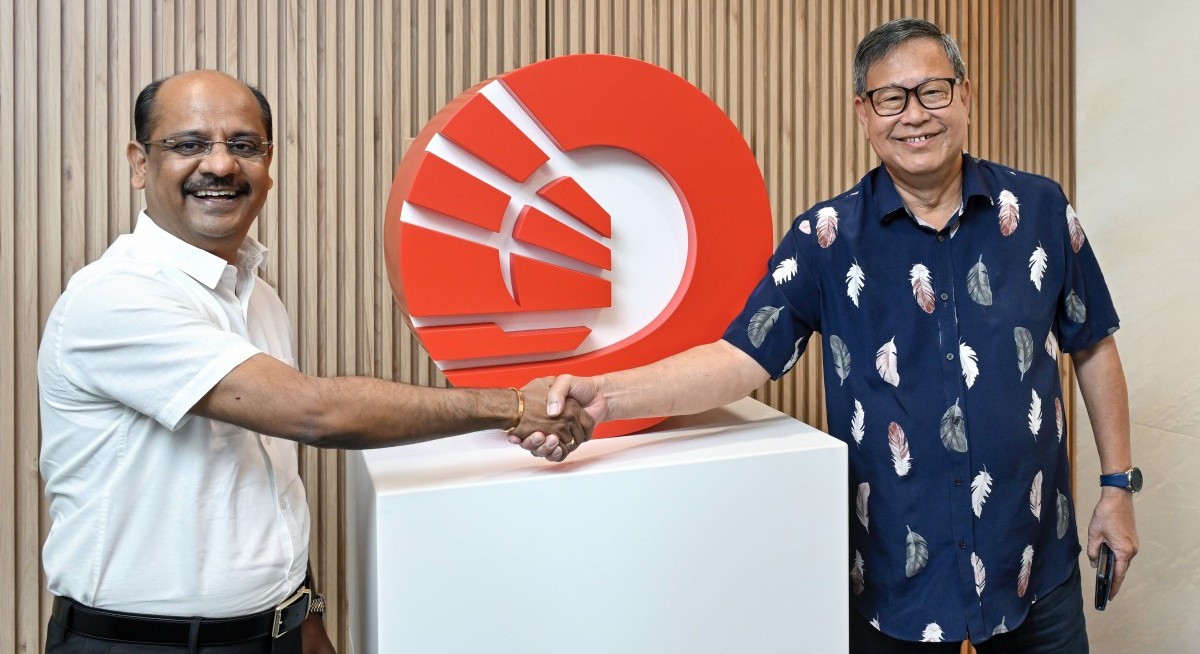


The 90-minute briefing also featured talks from Nordic Group’s (SGX:MR7 ) executive chairman Chang Yeh Hong and Info-Tech Systems (SGX:ITS) CEO Babu Dilip. Also in attendance were Astro Chang, CEO of Nordic Group subsidiary Starburst, and Juan Chow Yee, CFO of Info-Tech Systems.
Lim highlighted three reasons why OCBC is overweight on local equities: their defensive nature, resilience and attractive dividend yields. She also noted that the stability of the Singapore dollar helps protect investor returns, and ongoing equity market reforms are providing further support to SMID stocks.
Lim and Wong recapped the initiatives that the Monetary Authority of Singapore (MAS)’s Equities Market Review Group has implemented to support the local bourse. These include the $6.5 billion Equity Market Development Programme (EQDP) fund, which channels capital into the market via private fund managers, and the $30 million ‘Value Unlock’ programme, aimed at strengthening investor relations, corporate strategy and capital optimisation for locally listed companies.
Those efforts have already started to produce results. According to data from the Singapore Exchange (SGX), SMID stocks, excluding REITs, drew close to $470 million in net institutional inflow in the first quarter of 2026. This marks a shift in fortunes for SMID stocks, which “for the longest period of time were an unloved and forgotten segment of the market,” says Lim, who likened the segment’s sudden rise to an origin story of a superhero.
See also: Don’t miss out on the tech rally because of the war in Iran: Dan Ives
“Oftentimes, superheroes have a very tragic backstory, and that galvanises them to eventually become superheroes. There are many ways for them to rise to the top. Some of them are born with these superpowers naturally, and then others actually go through a period where they train really hard in order to become superheroes,” Lim adds.
“Now I see them going through a sort of training phase whereby these reforms are giving them the gadgets that they need. Whether they really become the superheroes of tomorrow remains to be seen, but all we can say is that the early signs are actually quite promising.”
‘Small base effect’
See also: EQDP fund manager AR Capital’s new AR Majulah SG Fund is on the hunt for growth
The re-rating of SMID stocks has been brewing for some time. Lim says both the FTSE ST Mid-Cap and FTSE ST Small-Cap Indices have been rising since policymakers introduced measures to revitalise the local market, including the EQDP fund, alongside improvements in trading liquidity.
“Mid-cap stocks led the fore in liquidity improvement immediately after the Equities Market Review Group was established, but when we look at it from a grander scheme of things, we realise that small-cap stocks actually saw the overall greatest improvement,” Lim says, noting that the outsized improvement might have stemmed from a “small base effect” in play.
Notably, the improvement in average daily turnover of SMID stocks was the most pronounced after MAS announced the first tranche of asset managers for the EQDP in July 2025. The first batch of asset managers includes Avanda Investment Management, Fullerton Fund Management and JP Morgan Asset Management.
Lim says the muted liquidity performance after the second tranche of asset managers was announced in November might have been due to seasonality, as trading activities tend to wind down at the end of the year. The second batch includes Amova Asset Management, AR Capital, BlackRock, Eastspring Investments, Lion Global Investors and Manulife Investment Management.
To date, $3.95 billion has been allocated to the nine asset managers under the EQDP, with the remaining $2.55 billion expected to be allocated to the next batch of managers mid-year. “We think this should help to support the liquidity conditions going into 2027,” Lim says.
Even though SMID stocks have already re-rated, OCBC’s Wong believes that there are further opportunities down the line for companies that are able to ramp up their earnings and return on equity (ROE).
“If you can generate high ROE over time, investors are willing to pay a higher book value or price to book multiple for your stock,” Wong says. “We believe that the next stage of re-rating for small- and mid-cap stocks will be driven, probably less by PE multiple expansion, but more by earnings and cashflow growth. This will also translate into higher book value per share over time and higher price-to-book multiples that’s been ascribed by the market.”
For more stories about where money flows, click here for Capital Section
For stock picks, OCBC preferred counters are generally within the REITs and industrial sectors and are made up of companies with a market capitalisation of below $3 billion. They include: Boustead Singapore (target price: $2.45), CapitaLand India Trust (target price: $1.37), China Aviation Oil (target price: $2.48), Hong Leong Asia (target price: $4.20), Info-Tech Systems (target price: $1.30), Nordic Group (target price: 60 cents), OUE REIT (target price: 40 cents), Parkway Life REIT (target price: $4.83), Stoneweg Europe Stapled Trust (target price: $1.88).
Preference for bank loans
During the briefing, Nordic Group’s Chang said the company’s expansion into areas beyond the marine offshore industry was driven by feedback from analysts.
“We realised that analysts prefer to see profits and income moving in tandem, steadily, rather than the volatility of profits and income,” adds Chang. “We decided that if this is the case, the best way to do this is to diversify from the existing core business and move into something that can give you this recurring income.”
This eventually led Nordic Group to diversify into the maintenance business, reducing its reliance on the cyclical marine offshore industry. Today, the company’s revenue comes from multiple streams, including electronics manufacturing systems, analytical instrumentation, medical equipment, pharmaceuticals, aerospace, semiconductors, law enforcement, optical imaging and green energy.
Although listed, Chang prefers borrowing from banks over tapping the capital markets for acquisitions. “If I could borrow a dollar loan from a bank, even at the highest at 5%, why would I want to go to the capital market to raise money at valuation [instead of] paying 5%?” he adds. “It just doesn’t make sense. Unless your balance sheet is so poor and bad that the banks don’t lend you money, then you have no choice.”
“When you use the borrowed money of 5%, even at the highest, versus a 25% dilution in the capital market, which would you choose? So, the answer is clear.”
Debt-free position
Info-Tech Systems’ trading debut last July was notable at the time for being the first one to take place on the SGX Mainboard in nearly two years.
CEO Babu Dilip told reporters that the company’s debt-free position stemmed from its business model as a software provider. As at Dec 31, 2025, Info-Tech Systems has a cash balance of $67.3 million.
“How do we have such a high cash balance? Ours is [a] cash generative business and [is] asset-light. That means once the customer buys the system or when they renew all their purchases on a one-year subscription basis, the customer must pay one year in advance, not monthly. So, cash balance is always high,” Babu says.
AI has been a huge driver for Info-Tech Systems, both in their training business, where they offer AI-related courses for individuals and corporates, and in their workflows, where they integrate AI into their software development process and customer support services.”
“The AI boom is our friend. In a sense, we are the beneficiaries of AI booming,” adds Babu.
Meanwhile, the local stock market has remained relatively resilient amid the war in Iran. Market watchers have warned of the inflation that could come with the Iranian blockade of the Strait of Hormuz. Roughly 20% of the world’s oil and gas passes through the strait, and a chokehold on those flows has already sent oil prices skyrocketing.
However, investors should not assume that things will play out just like in 2022 when Russia’s war on Ukraine drove a surge in oil prices as well. “The current setup is actually very different from 2022,” OCBC’s Lim says. “Back then, when the Russia-Ukraine war first started, the global economy faced quite a significant inflation problem with the annualised US CPI reading above 7%.”
Lim says inflation in 2022 was a mix of demand-pull inflation due to the release of pent-up demand as the world’s economies began to open up again following the Covid-19 pandemic, as well as cost-push inflation due to supply shock caused by the Russia-Ukraine war. “Back then, policy rates were anchored near zero, and so central banks were forced into this aggressive rate hike cycle.”
Investors who are expecting rates to go up should think again, Lim adds. OCBC says it still expects the Federal Reserve to cut interest rates by 25 basis points this year, though it now expects the cut to occur in 3Q2026 instead of 2Q2026.
“Policy rates today are also a lot higher, and what this means is that there is basically less room for central banks to hike rates,” Lim says. “Rate hikes also tend to be more effective when the nature of inflation is demand-pull rather than cost-push in nature.”




