


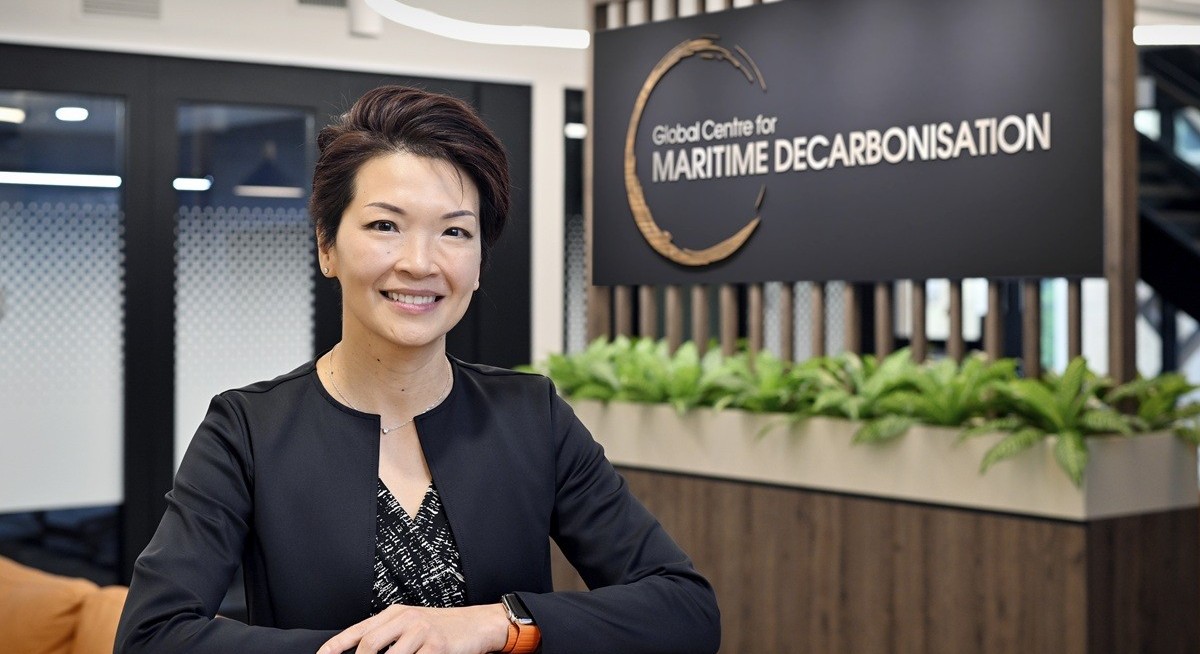


The Centre was founded by six industry partners, namely BHP, BW Group, Eastern Pacific Shipping, Foundation Det Norske Veritas, Ocean Network Express and Seatrium, with bp, Hanwha Ocean, Hapag-Lloyd, NYK Line and PSA International joining later as “strategic partners”. According to Loo, the setting up of GCMD also received “strong backing” from the Maritime and Port Authority of Singapore (MPA).
The global shipping industry helps move 80% of total cargo volume but accounts for just 3% of total emissions. Yet, given how global warming is a real and ticking issue, any reduction is welcomed.
Penetrating a US$20 bil market via Feet
One practical way GCMD does its job is to pull certain financial levers. Together with collaborators, GCMD has launched the Fund for Energy Efficient Technologies (Feet), an investment fund to support vessel retrofitting and the installation of EET, such as wind-assisted propulsion and air lubrication.
See also: Local firms powering Singapore’s strong green revenues
GCMD says the market for vessel retrofits is worth around US$20 billion ($25.8 billion), while shipyard Seatrium estimates the market for fuel-efficiency and emissions-reduction retrofits to be US$90 billion through 2040.
Loo claims that Feet is the first of its kind to offer 100% upfront financing for vessels to be retrofitted with EET while introducing a pay-as-you-save repayment feature linked directly to verified fuel and regulatory savings. Thus far, Feet has attracted US$35 million in funding and is drawing “strong interest” from across the sector, including equipment manufacturers, shipowners, and investors.
Specifically, Feet will help pay equipment manufacturers the upfront cost of energy-efficient technologies. Retrofitted vessels will then be leased to shipowners to deploy. The shipowner makes fixed quarterly payments and an annual pay-as-you-save payment based on the yearly verified energy and regulatory savings. These repayments are distributed to Feet’s funders. At the end of the lease, ownership of the EET will be transferred to the shipowner for a nominal fee.
See also: ‘Generational’ investment opportunity in green economy: LSEG
To illustrate the scale of the lack of vessel uptake for such projects, Loo shares that out of 60,000 vessels in operation, only around 270, or less than 0.5%, are installed with either wind-assisted propulsion or air lubrication technologies. This means Feet has a very large addressable market as it helps deal with “long-standing” hurdles hampering the uptake of sustainable retrofits for vessels.
Many shipowners now recognise the need to be green. However, they are less certain about potential savings and the impact of EET, if any. This is because ships are subject to variable operating and environmental conditions, such as routing and weather.
To strengthen the case, vessels with installed EET will be equipped with sensors to collect precise, frequent data, which will then be rigorously analysed to provide a clearer picture of efficiency and savings. As the dataset grows, GCMD can make more accurate predictions across different scenarios.
Secondly, because shipowners bear the costs of such retrofits while the benefits accrue to charterers, this creates a split-incentive problem that discourages widespread adoption.
With Feet’s pay-as-you-save repayment mechanism, repayments are linked to quantified and verified fuel and regulatory savings, reducing the payback uncertainty of installing EETs for owners and potentially encouraging the uptake of EET retrofits for vessels.
Thirdly, as the cost of EET is small relative to the vessel’s value, it is not practical for shipowners or the existing secured financiers to provide vessel security to prospective retrofit financiers. Feet provides upfront capital to fund retrofits without requiring the vessel to be used as collateral, directly addressing the financing challenge.
Feet’s capital structure has four funding layers, each supported by a different entity. Firstly, GCMD provides catalytic equity. The next layer of funding, commercial equity, is held by shareholders of AIM Horizon Investments. Development Bank of Japan (DBJ) holds the third layer, the preferred equity position. Last but not least, DBS Bank and ING (which also served as the coordinating bank) have, in principle, agreed to provide senior debt financing.
For more stories about where money flows, click here for Capital Section
GCMD says that the blended financing model keeps financing costs competitive while mitigating financial risk. Feet will invest in diverse projects across technologies, manufacturers, vessel owners and types, spreading investment exposure across its portfolio.
The Centre has been running four pilots to measure energy savings from EET in 2025. Based on the report on the pilot for an oil tanker, the mean instantaneous power savings from valid on-off tests over a four-month period were 7.2%, with a 95% confidence interval of 6.2%–8.2%. The study noted that savings could be higher if the vessel — owned by GCMD founding partner Eastern Pacific Shipping — had experienced more favourable wind conditions.
As the fund’s appointed technical advisor, GCMD states that Feet seeks projects that “make good business sense”, without specifying criteria for vessel type, route or location. It seeks to collaborate with shipowners and EET manufacturers to develop tailored solutions that optimise savings.
When asked which technology vendors, shipowners and shipyards could benefit from the fund, Loo says there is no preference, although the fund avoids technology risk for solution providers to maximise success.
The fund presumably invests in projects involving established companies with proven technology and capabilities. Established companies in this space include Seatrium, which in 2023 completed 46 retrofits to boost energy efficiency.
For now, GCMD is focused on deploying the US$35 million in initial funding to demonstrate EET’s viability. And once the viability is more established, there will be a more “compelling story” to recruit more investors and scale up the fund to US$500 million by 2030, which could fund around 200 projects. Feet is currently only open to institutional and accredited investors due to regulatory requirements.
Marrying the maritime decarbonisation voyage with academia
GCMD estimates that the average emissions avoided per project range from 1,000 to 5,000 metric tonnes of CO2-equivalent (CO2e) per year, depending on variables, such as vessel type, route and weather conditions.
According to Loo, while CO2e savings from reducing fossil fuel use are critical, energy efficiency technologies can also be applied to alternative fuels used in industry, such as ammonia and methanol.
In addition to leading GMCD, Loo continues to devote time to nurturing the next generation of researchers at Princeton. Nonetheless, for Loo, joining GCMD was a good opportunity to put theory into practice. “This is a huge opportunity to work closely with industry to effect change. As a faculty member, you effect change one at a time because you’re training students and advising students. But here at GCMD, the impact is multiple. It’s amplified,” she reasons.
Ever the scholar, Loo says GCMD has opened another chapter in her learning. “I have an incredible team and they are all very committed to the cause,” she shares. “I knew nothing about shipping coming in and I was able to learn from them, and that’s where I picked up a lot of what I know about shipping.” She describes her two concurrent roles as a “good marriage”.
“Working with industry has taught me about the urgency with which things need to get done. It’s taught me to look at things through a pragmatic lens,” she explains. “I think I have become a better teacher, a better researcher because of this experience, and my experience at Princeton has made us [GCMD] more rigorous here, more quantitative and more focused on details.”
---
An illustration of the dollars and sense
When asked about the fuel and regulatory savings, and thus the return on investment, from Feet, GCMD declined to provide an estimate due to commercial sensitivities.
As such, The Edge Singapore made an independent calculation of potential savings using data from one of the pilot studies in which the vessel was installed with wind-assisted propulsion technology.
According to the report, there was an instantaneous power saving of 373 kW during one of the measured periods. For simplicity, the following assumptions were made:
1. Uniform instantaneous power savings of 373 kW
2. The vessel operates 24/7, 330 days per year
3. The vessel experiences power savings on 80% of operational time as the route is optimised
4. Price of Very Low Sulfur Fuel Oil (VLSFO) is US$450 ($579) per metric tonne (MT)
5. Emission factor of VLSFO is 3.2
6. Price of carbon tax is US$100 per MT of CO2
Based on the above assumptions, the ship will save on around 390 MT of VLSFO and avoid approximately 1,248 MT of CO2-equivalent (CO2e). These translate to fuel and regulatory savings of slightly more than US$300,000 annually. If an average vessel retrofit costs US$2.5 million, the breakeven timeline is less than nine years. In real life, the power and cost savings would vary due to the many factors, including ship type, engine efficiency, operational requirements and weather conditions.




