




For now, the Federal Reserve, under its new chair, Kevin Warsh, has left rates unchanged at a range of 3.50% to 3.75%. Since taking office, the new chair has focused on reforming the institution. He has set up five task forces covering areas including balance sheet policy, communications strategy, data collection, labour market and productivity trends, and the models used to track inflation.
During his press conference on June 17, Warsh suggested he may be more tolerant of inflation running higher. “On the 2 per cent inflation objective, that is the Federal Reserve’s long-held objective of 2 per cent,” he says. “You’ve heard me say before, I tend to focus on the left of the decimal point. Well, the two is to the left of the decimal point. For now, zero is to the right.”
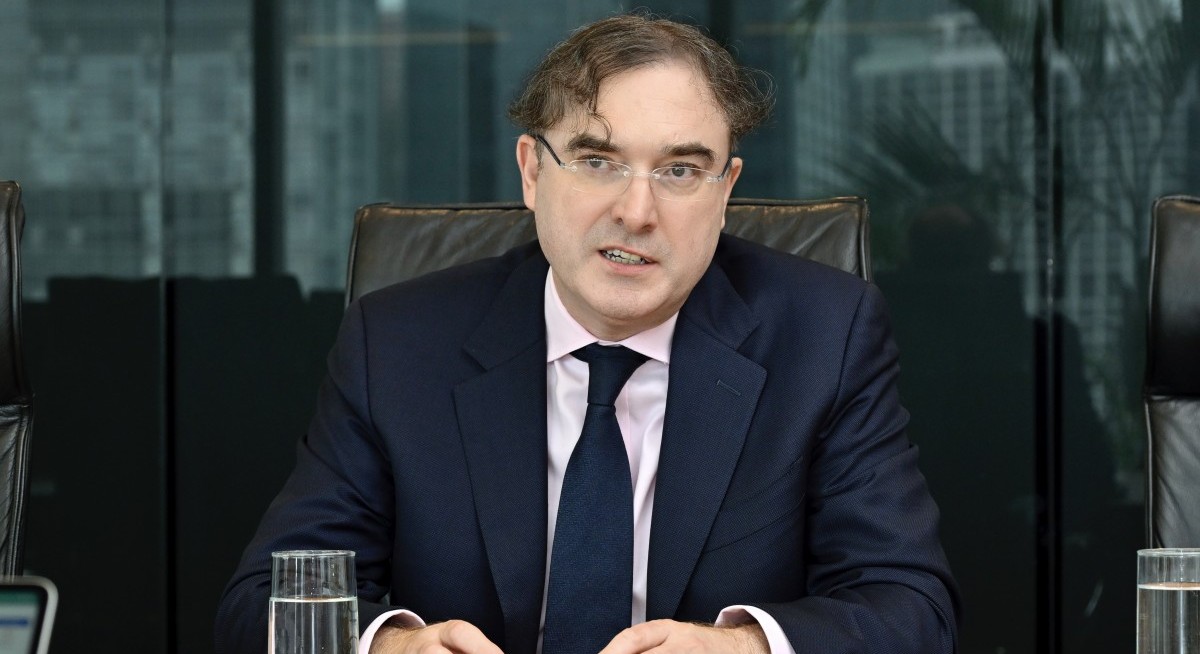
Separately, Schroders’ head of multi-asset income, Dorian Carrell, tells The Edge
Singapore that his desk does not expect any rate changes for now. “At least in the short term, until the task forces have reported, we don’t expect them to raise rates,” he adds. “But we also think that the market might be focusing on a different gauge of inflation that eventually becomes the Fed’s definition.”
Carrell joined Schroders in December 2003 and has been with the British asset manager for more than 20 years. He started as an equity analyst before helping to set up its convertible business. He was based in the Singapore office from 2011 to 2016 before moving to London, where he was appointed head of multi-asset income in March 2025.
Don’t be passive
On the market side, it is hard to escape AI these days. If you are invested in broad market indices such as the S&P 500, you are already heavily exposed. The Magnificent Seven account for more than a third of the index and comprise Alphabet, Amazon, Apple, Meta, Microsoft, Nvidia and Tesla, all of which are at the forefront of the AI boom.
SpaceX, which made its trading debut on June 12, has also secured rapid entry into several indices, including the Nasdaq-100, which it is due to join on July 7. Following its acquisition of xAI in February, the company has effectively become an AI play as well.
See also: Waking up from a ‘pleasant fiction’ to invest in an era of scarcity
“If you’re invested in indices, we’d strongly suggest that you don’t take a passive approach in this environment,” says Carrell. “If the OpenAI and Anthropic IPOs all go ahead, you could have around 48% tech in US equity universes. From our perspective, it is building on what is already very high levels of concentration.”
That is before accounting for the risks inherent in the AI industry itself. “What’s different about this cycle is that revenues are flowing between the different parts of the concentration,” Carrell says. “There are revenues expected by some of the hyperscalers from some of the companies that are due to list, and so there is a circularity there.”
“There’s a huge source of potential growth at risk if something goes wrong, basically,” he adds. “The source of a lot of the earnings growth projected for the next couple of years in the US is pretty concentrated.”
Companies such as Meta and the newly listed SpaceX have issued billions of dollars in debt to finance their AI projects. The rapid build-up of debt, together with the circularity of revenues, concerns Carrell, who argues that much has to go right if these companies’ AI investments are to bear fruit.
“How is it going to be recouped by these companies? How much are they going to charge? Can the underlying clients really afford it? Are they going to opt for cheaper models? Is the differentiation in AI sharp enough to justify the pricing differential between the very expensive and the very cheap? These are all big questions, but they are not necessarily reflected in market valuations.”
Carrell recommends investors take an active approach by looking outside of the direct beneficiaries of AI. Investors should instead focus on companies that might have been overlooked or have productivity enhancements that are not priced in.
“This is one of the worst times we think to take a passive approach,” he adds. “Your starting point is very concentrated. It’s about to get more concentrated, and the concentrated part of the universe [has] earnings expectations [that] look quite optimistic. The way around that is to take an active approach and look at areas that have been ignored.”
For more stories about where money flows, click here for Capital Section
Consider convertible bonds
AI is a key driver of that concentration, though Carrell is not suggesting investors avoid it entirely. AI has enormous potential and will transform the productivity and growth prospects of economies. The challenge lies in the timing, as it is difficult to know when these benefits will materialise.
“The thing about AI is that there’s clearly a huge amount of growth and potential, but it’s unlikely to be a straight line,” he says, adding that convertible bonds might be a sensible way for investors who want to take advantage of the volatility coming from AI.
By buying convertible bonds instead of equities, investors will essentially be holding long-dated call options on AI. “They benefit from volatility, and they take away the timing risk of trying to time AI,” notes Carrell. “The idea that we, or anyone else, can time the vagaries and the ups and downs of AI is unrealistic.”
He recommends investors include convertible bonds in their portfolio, given current macroeconomic conditions. Besides benefiting from volatility and offering an attractive risk-return, Carrell says convertible bonds will do well in an inflationary environment.
“We would suggest Asian convertibles and global convertibles,” he adds. “As equity markets rise, convertibles lose interest rate sensitivity and duration, which is a feature that would be very attractive if inflation persists. They also have a very low correlation with high-quality credit, so they are a good diversifier.”
Low cash holdings a ‘rotation signal’
According to Bank of America’s (BofA) Global Fund Manager Survey published on May 19, fund managers have reduced their cash levels from 4.3% in April to 3.9% in May, the biggest monthly drop recorded since February 2024. Having a cash level below 4% can be read as a sell signal, notes BofA, whose survey involved 200 panellists with US$517 billion in assets under management.
Carrell disagrees with BofA’s analysis. For him, low cash holdings are “probably a rotation signal rather than a sell signal,” he adds. Fund managers have a heavy allocation to equities at the moment, so it will make sense for them to adjust their exposures.
Signs of rotation are starting to show in South Korea’s market. Earlier this year, memory chip giants Samsung Electronics and SK Hynix looked unstoppable, with year-to-date gains of 455% and 828% as of June 30. But look closer, and momentum is fading. On July 1, Samsung Electronics dropped over 7% while SK Hynix fell more than 9%.
“Anything that has very optimistic earnings expectations or very high multiples in an unproven area is very vulnerable at the moment,” he adds. “In terms of the overall market, from a three to six-month view, we think there’s going to be a period of choppy rotation. There will be moves day-to-day that are pretty volatile. It’s quite hard to stay 100% in equities when that happens.”
Carrell expects capital to shift from growth stocks to value stocks as investors become increasingly aware of the concentration of mega-cap technology companies in the US market. While these companies continue to enjoy high earnings expectations, many are also changing their business models.
“They’re going from high profit margin, asset-light businesses to asset-heavy businesses, where supply chain bottlenecks are already affecting payback periods, and the uncertainty of earnings is very high,” adds Carrell.
“The problem we see at the moment is that it’s not really a multiple bubble, but in certain areas of the US market, in particular, you have an earnings bubble. It’s a subtle distinction, but we think certain areas have too much optimism on earnings. If we’re right, that means the multiples will rise as earnings contract, so if you put everything together, we would suggest that people diversify.”




