


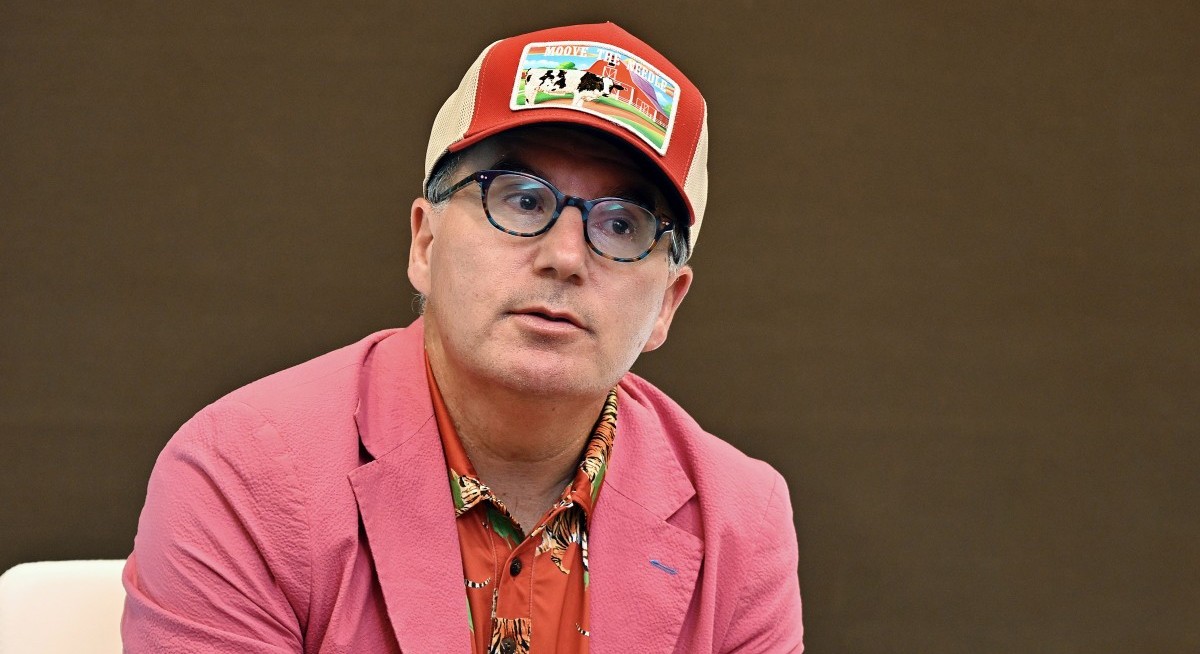


For Ives, dressing brightly isn’t so much a way to stand out from the crowd. After all, it’s the accuracy of his calls that shapes his credibility and reputation.
“If my stock calls over the decades didn’t work out, no one would care less about the fashion,” Ives says. “I have talked to many other analysts and I try to convey to them, ‘Everyone has to have their own personality, their own style, their own way that they call stocks.’ So don’t be afraid because the haters hate, right? If you listen to the haters, you will never know.”
Ives was speaking to The Edge Singapore ahead of a panel organised by Maybank Securities Singapore on April 7 titled “AI Bubble or Market Reset? What's Next for US & Singapore Stocks”. Ives was accompanied by his colleague, Seth Basham, managing director and director of research at Wedbush Securities. The pair’s visit to Singapore was part of a two-week trip across the region, which included stops at cities such as Kuala Lumpur and Seoul.
“It’s great being in Asia again,” Ives says. “We are here a few times a year, meeting investors and companies. It’s a white-knuckle environment, but that just creates the opportunities if you can see the forest through the trees, especially when it comes to a fourth industrial revolution like AI.”
See also: Local firms powering Singapore’s strong green revenues
Iran will not halt tech’s rise
The past few weeks have been a fog for the markets, as investors try to process the odds of an end to the hostilities in Iran. The on-off nature of the negotiations between the US, Israel and Iran has only made that harder. Ives and Basham, however, say that investors should not let these bearish sentiments get the better of them.
“If you focus just on geopolitical issues, you have missed every tech trade that worked the last 20 years,” Ives says of the Iran war’s impact on tech stocks. “If this is just a matter of weeks or a month, it’s a blip on the radar of the tech trade.”
See also: ‘Generational’ investment opportunity in green economy: LSEG
One major source of concern weighing on investors’ minds has been the closure of the Strait of Hormuz by the Iranians. Blocking the strait, which sees roughly 20% of the world’s oil and gas supply pass through it, has created a chokehold on global energy flows, fuelling fears of inflation and even recession.
Some market watchers have sought to draw comparisons to the oil crisis of the 1970s. That is not the predicament that awaits the US economy, says Basham.
“It’s a very different situation now than the 1970s, which people like to compare to,” Basham adds. “We are starting at a place, from an energy consumption standpoint, where the consumer is spending 3% of income on energy, including gasoline, versus back then it was 8%, so [there’s] a lot more cushion to absorb it.”
This is on top of the tax refunds that mid- to low-income consumers are getting. According to the US Internal Revenue Service, the average tax refund this year is US$3,521 ($4,487) and is up by 11% y-o-y. “The overall inflation environment, beyond oil, while it’s elevated around 3% [per the] PCE (Personal Consumption Expenditures) [price index], it’s not nearly as elevated as it was back then.”
Even though the price of Brent crude has gone up to as much as US$140 a barrel in recent weeks, Basham expects prices to fall back to around US$75 a barrel. While that is admittedly higher than before the crisis, it should not disrupt the overall supply and demand picture for the AI boom.
“You do have a constraint and that will be an incremental drag on the US economy as it relates to infrastructure build-out with data centres,” Basham says. “But that is not going to be a big factor.”
This means there’s ample room for traders to notch a profit on AI plays like the “Magnificent Seven,” which includes Alphabet, Amazon, Apple, Meta, Microsoft, Nvidia and Tesla.
For more stories about where money flows, click here for Capital Section
“Look, this is not moving the needle on the long term,” Ives says. “Ultimately, the bark will be a lot worse than the bite in terms of the fears. Right now, tech stocks are pricing a lot of bad news that I believe will create major opportunities during the winters for the coming years.”
In terms of stocks, Ives says the defence software company Palantir’s performance has exceeded his expectations thus far. Palantir shares closed at US$140.76 on April 8. The company’s shares are up by over 58% in the past year, though they have fallen from their peak of US$207.52.
“They have become really one of the leaders in the whole tech space and I think everything that Karp and Palantir are doing is really redefining how enterprises view AI,” Ives says while referencing the company’s CEO and co-founder, Alex Karp.
Aside from Palantir, Ives is bullish on Nvidia and Tesla, which he says are the “two best physical AI plays in the market” right now. For Ives, the rise of autonomous vehicles will be one of the lynchpins of the AI trade. This is despite the slower-than-anticipated pace of development for self-driving technology.
“Now it started off slow, but I think if you have an eight-year-old today, they are not going to need a driver’s license when they are 16. You are going to see autonomous across the board, from Tesla to Google to Grab throughout Asia,” Ives says. “It’s the start of a new age in mobility.”
Basham, on the other hand, believes that the rise of autonomous vehicles will pose a threat to companies operating in the ridesharing space.
“What we see developing here is a concentration of supply in the rideshare market. Historically, in other parallel markets such as online travel, concentration in supply means the profit pool shifts to suppliers and away from middlemen. You can see that with the airlines through online travel relative to hotels,” Basham says.
“So that’s likely where we are going. Tesla is likely to be a leader. Waymo is likely to be a leader and Uber is likely to see some pressure over time.”
Rate cuts or hikes unlikely
Market watchers were initially forecasting one to two rate cuts this year. That was before the military strike on Iran upended those predictions entirely. Basham says that while Wedbush has not ruled out the possibility of a rate cut taking place within the year, their baseline view is that there will be no changes to rates in 2026.
“Historically, the Fed has looked at oil price shocks as transitory issues and they look at it as a tax on the consumer, so that makes them less likely to raise rates. If you look at what they have done in the past around these things, they haven’t raised rates typically,” Basham says.
Crypto’s a risk asset now
One of the more unexpected developments this year has been the decline in both Bitcoin and gold amid the geopolitical uncertainty. Bitcoin has fallen by more than 20% in the first quarter of this year to around US$70,000. In March, gold recorded its steepest monthly decline since 2008 when it fell by over 13% to around US$4,600.
“From my perspective, it’s become more of a risk asset than not over the last year. We saw it start moving down a little bit ahead of the concern around the AI bubble and it has followed that path down,” Basham says of the decline in Bitcoin.
“We have also seen gold trade off over the last month or two after getting overextended. So I think it’s those two things combined for Bitcoin.”
Instead, Basham sees opportunity in Halo (heavy assets, low obsolescence) companies. On March 18, Ives and Basham co-authored a report with other Wedbush analysts that flagged the potential upside of betting on companies in the power generation and fuel supply space.
Wedbush’s “Ives Power 30” list includes counters such as energy company Constellation Energy and digital infrastructure provider Vertiv. “It’s definitely worth going into,” Basham says of Halo companies, adding that there’s a “multi-year opportunity” for investing in the theme of AI power infrastructure.

Ives: Tesla-SpaceX merger in 2027
One of the most hotly anticipated IPOs this year is Elon Musk’s SpaceX. The rocket company is reportedly targeting a US$2 trillion valuation, making it the largest-ever initial public offering of all time.
Earlier, in February, SpaceX acquired Musk’s AI company, xAI. Ives believes that it won’t be the last time Musk tries to consolidate his companies. “This is a huge part of his vision. The merger of xAI and SpaceX. I ultimately believe that SpaceX and Tesla will merge in 2027 because it’s going to be all around AI, technology and data under one roof.”
“SpaceX is really going to create a whole other category in the market. Over the coming years, space will become a category with SpaceX being the trojan horse and stalwart,” Ives says. “It’s going to be a watershed event for the market.”




