


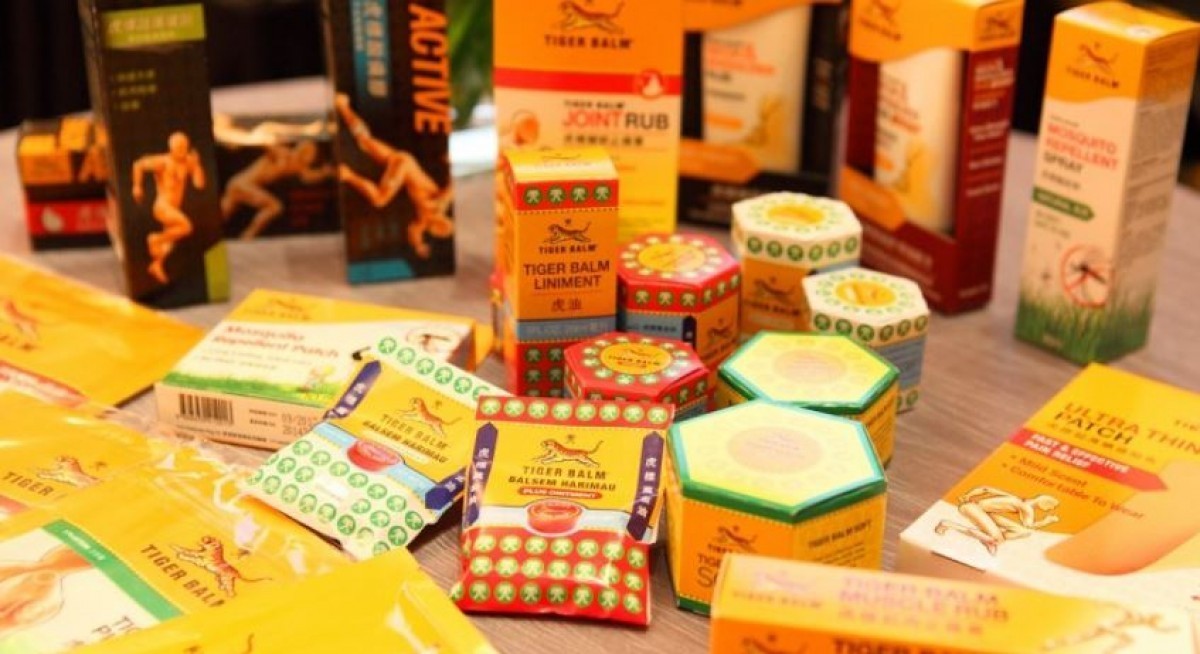


Despite mass familiarity with Tiger Balm, little else is known about Haw Par, which operates without much fanfare and receives muted recognition from the investing community. But this seems to be changing as Macquarie Equity Research initiates coverage of Haw Par.
In its March 19 initiation report, Macquarie analysts Jayden Vantarakis and Hanel Tan put forth the case for investing in Haw Par, rating the counter “outperform” at a target price of $20.6.
At the heart of their investment thesis is Haw Par’s “treasure chest” of cash-generating assets — the Tiger Balm product line, real estate, the leisure business and shareholdings in United Overseas Bank (UOB) and United Overseas Land (UOL). In addition, the company's long-term sustainability is fortified by its “robust” financial position — a net cash position of $790 million that buttresses Haw Par against black swan events.
Treasure 1 — Tiger Balm
See also: It’s a hit for MIS specialist Intuitive Surgical
On a segmental basis, Vantarakis and Tan observe that healthcare core operations, spearheaded by Tiger Balm, account for 51%–55% of the gross profit margin and 18%–23% of the earnings before interest margin over the last three years. They also note that revenue has been growing “steadily” by 4%–7%.
With Asia’s ageing population, the analysts believe the regional demand for Har Par’s Tiger Balm products will increase. They also posit that the company’s new plant in Malaysia positions the company for growth and helps meet increasing demand while improving operational efficiency.
However, they note that with 86.5% of healthcare revenue coming from exports, this division is exposed to foreign trade policies, currency fluctuations and economic volatility. Competition and geopolitical tensions may also exert downward pressure on the division's performance.
See also: Singtel’s Thai associate is its new divestment tap to fund capex, dividends and buybacks
Including the real estate and leisure business as part of the core business, Macquarie believes core operations to be worth 16% of the company’s net asset value (NAV), with healthcare valued at 16 times estimated FY2027 earnings per share and real estate at book value.
Treasure 2 — Investments
From the investment side, as at Dec 31, 2025, Haw Par held around 74.85 million UOB shares and just over 72 million UOL shares, which together make up approximately 97% of Haw Par’s “strong” investment portfolio, providing a regular dividend income stream. Believing that UOB and UOL hold “strong” market positions in the banking and real estate sectors, respectively, Macquarie estimates 66% of Haw Par’s net asset value to comprise these two investments.
Based on the declared and proposed dividends of UOB and UOL for FY2025, Haw Par stands to reap around $130 million in dividend income from these two investments. Vantarakis and Tan also point out that, on average, Haw Par’s shareholder dividends are covered 1.8 times by dividends from UOB and UOL.
Despite the annual earnings from UOB and UOL, Vantarakis and Tan note Haw Par’s “high dependence” on the two companies, with 95% of total assets and 74% of ebit linked to the long-term performance of the investments in UOB and UOL. They point out that Har Par’s holdings are too small to influence UOB and UOL’s operating performance and flag concerns about the commonality of the board of directors among all three companies.
With Haw Par’s $790 million net cash position worth 14%, while the remaining 3% in other equity and debt securities, Vantarakis and Tan calculate Haw Par’s NAV per share to be $25.64 based on the sum-of-the-parts valuation, providing a 20% discount for a fair value and target price of $20.60.
Diagram of Wee family's holdings in Haw Par, UOB and UOL (Source: Macquarie Equity Research)




