


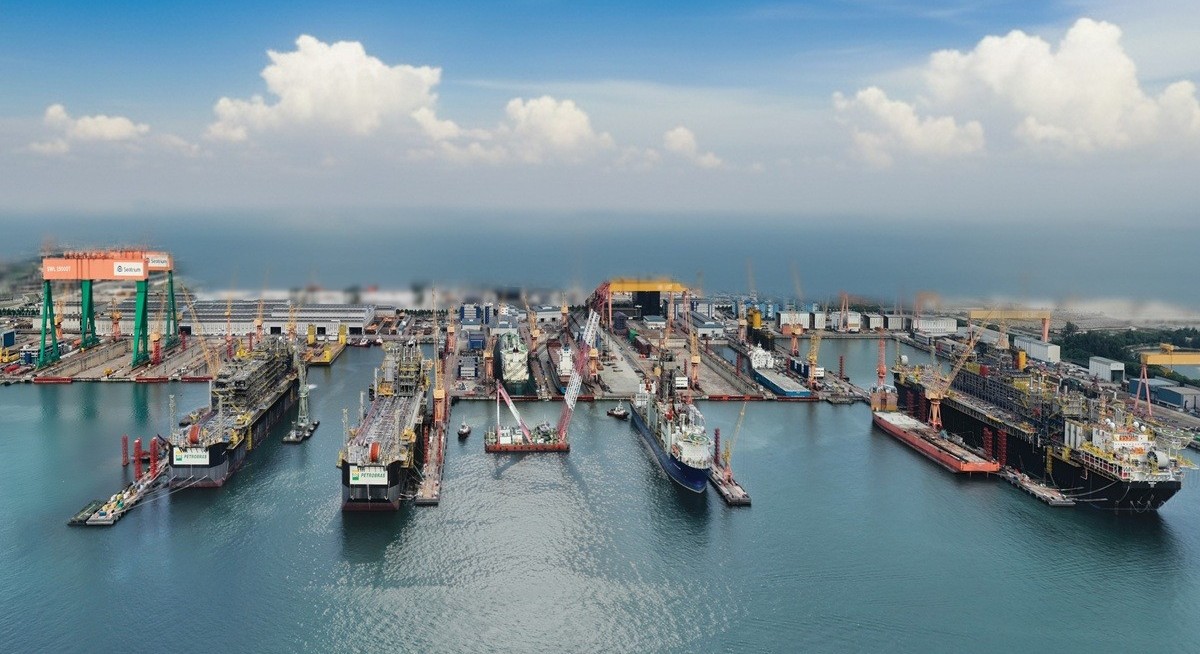


“We continued to carry the momentum gained in FY2025 into the new financial year with steady project execution and margin improvements,” says CEO Chris Ong. “With the completion of our announced divestments, we are well-positioned to deliver further gross margin improvements,” he adds.
UOB Kay Hian (UOBKH) analyst Adrian Loh maintains his “buy” rating and $3.15 target price in his June 2 report. Describing Seatrium’s 1QFY2026 as “solid”, Loh notes management’s guidance for higher gross margins due to a better project mix and completion of non-core divestments.
He sees room for growth in the earlier gross margin estimate of 7.5%. He expects the current energy shock to reinforce energy security concerns and longer-term offshore energy investment, which could benefit Seatrium.
To Loh, Seatrium is a contender for major offshore energy projects. “Seatrium’s four TenneT offshore platform projects and the heavy-lift vessel for Penta-Ocean are strong proof points that the company should be in the conversation for any major offshore wind tender in the EU.”
For Maybank’s Hussaini Saifee, while large project awards remain lumpy, he sees a bright spot in Seatrium’s repairs and upgrades, which could throw a positive surprise. Repeat business remains strong, defence-related work is meaningful, and rig refurbishment remains active across Brazil, Singapore and Asia Pacific, Hussaini notes in a June 1 report.
He also thinks that conversions of floating storage and regasification units and floating liquefied natural gas (LNG) vessels appear to be gaining strategic relevance, supported by energy security, faster time-to-market and LNG infrastructure needs.
Similar to Hussaini, Ho Pei Hwa from DBS Group Research is positive on the repairs and upgrades segment in her May 29 report. She believes that the company is reinforcing its position in LNG and gas infrastructure conversion solutions with Seatrium securing its eighth FSRU conversion project from Karpowership.
See also: Singtel maintains prospects of higher dividends; ramps up bid to capture AI growth
Contract wins are emerging as a common price catalyst for the counter across most analyst reports. Ho, for one, writes that contract flows remain the key catalyst, and the absence of major projects during the first five months of the year suggests they have been relatively slow.
Despite slower contract wins, Ho maintains a constructive outlook, as Seatrium could benefit from the emerging global offshore reinvestment cycle. Ho values Seatrium at unchanged $3 and reiterates her “buy” call in her May 29 report.
Meanwhile, Hussaini sees customers still exercising discipline on capex and the timing of final investment decisions (FIDs), which are outside Seatrium’s control. As such, material order conversion will likely be more visible only in 2HFY2026 and FY2027. He maintains both his “buy” call and $3.10 target price.
Similarly, CGS International’s Lim Siew Khee and Meghana Kande believe that orderbook replenishment is crucial to meeting 2028 “steady-state” targets of $10 billion to $12 billion in revenue, an ebitda of over $1 billion, a return on equity (ROE) of over 8% and a net debt to ebitda of two to three times.
Lim and Kande note that Seatrium has lowered its tender pipeline to $28 billion from $32 billion on a q-o-q basis. This is due to Petrobras awarding the SEAP 1 floating production, storage and offloading (FPSO) project to SBM Offshore under a build, operate, and transfer (BOT) model, rather than leveraging Seatrium’s strengths in engineering, procurement, construction and commissioning (EPCC).
With five months passed in 2026 and no major contract wins, Lim and Kande reduced their order-win forecast from $6 billion to $4.3 billion for FY2026 and trimmed their FY2027–FY2028 earnings-per-share forecasts by 2%–3%. They maintain their “add” rating at a lower target price of $2.52 (down from $2.84 previously), valuing the company at 1.2 times forecast FY2026 P/B in their May 29 note.




