


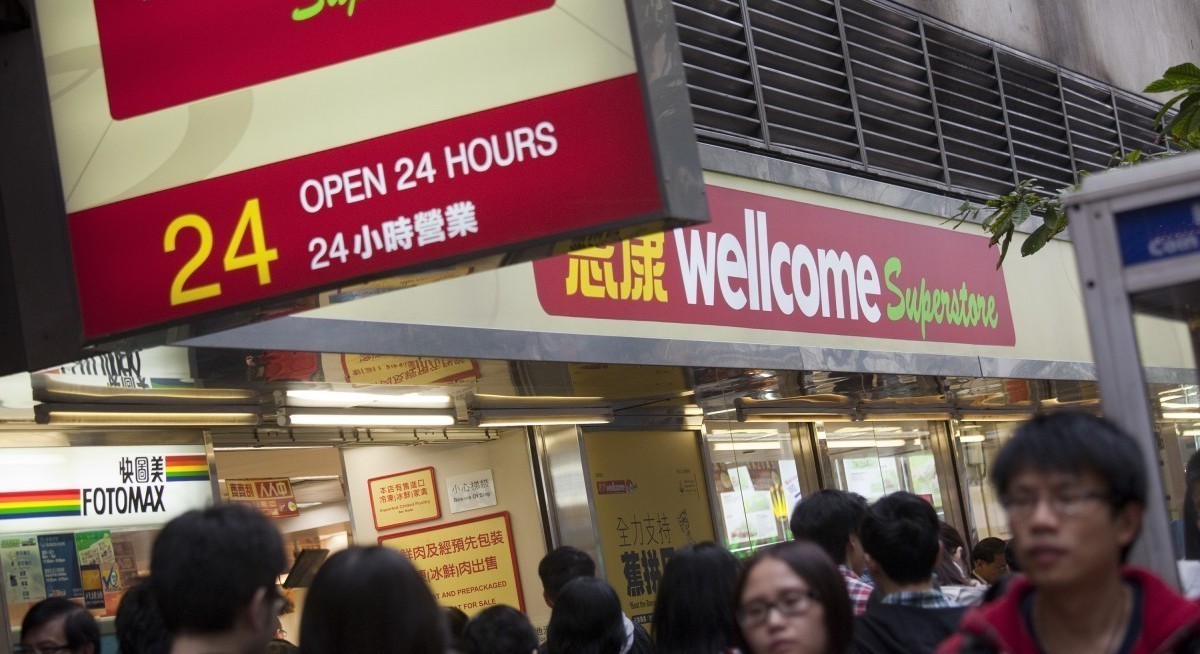


According to Chee, if the supermarket business could double its revenue with this merger, the expansion in scale could “reasonably” translate into a gross margin uplift of 50 to 100 basis points.
Merger talks?
On April 17, The Financial Times reported that DFI, which runs the Wellcome chain of supermarkets, is in merger talks with Li Ka-shing’s conglomerate CK Hutchison, which runs ParknShop. Wellcome and ParknShop are the largest and second-largest supermarket chains in Hong Kong.
On May 21, Dominic Lai Kai-ming, co-managing director of CK Hutchison, maintains there are no plans to sell ParknShop.
Following the recent Investors’ Day on June 16 organised by DFI’s parent company, Jardine Matheson, CGS International analysts Meghana Kande and Lim Siew Khee are of the view that, if DFI makes any acquisitions, they will be to scale up its high-margin retail media platform, DFIQ, rather than ParknShop.
See also: Record STI reflects strong economy and value-driven corporate activity
Chee acknowledges that, initially, he was not so sure whether such a deal would materialise. For one, when ParknShop was last up for sale back in 2013, the sticker price was from US$3 billion to US$4 billion ($3.9 billion to $5.14 billion).
However, upon deeper analysis, he now believes that potentially significant synergies could be extracted at a sensible valuation, supporting DFI’s M&A and medium-term return on capital employed target of at least 15%.
Chee is seeing two primary sources of synergies. First, combining the two chains will nearly double the revenue base to around US$4 billion, enhancing procurement scale and bargaining power.
See also: Justifying JustCo with an intrinsic value of 69 cents
“A doubling of scale would strengthen procurement economics and enable pricing that is closer to levels seen in the Greater Bay Area and wet markets, thereby supporting industry growth and gross margin expansion,” says Chee.
He notes that NTUC FairPrice, the largest supermarket operator in Singapore, achieved an expansion in gross margin of 40 basis points (bps), while revenue grew 26% y-o-y in 2020. Chee believes that a near-doubling of revenue could reasonably translate into a gross margin uplift of 50 bps to 100 bps.
Next, he sees “meaningful” cost savings from store and manpower rationalisation. Chee, having mapped the locations of all 554 stores, estimates that 94 of them are within 200m of one another.
“This implies potential for at least a 17% reduction in store count and associated manpower, which could translate into 300 bps to 400 bps of operating cost savings, primarily from lower rental and staff expenses,” says Chee, noting that rental accounts for 4%–6% of revenue while staff costs account for 15%–17%.
“Overall, we see potential for 370 bps to 480 bps of margin uplift, with a portion of this likely to be reinvested into more competitive pricing to drive volume growth,” says Chee.
DFI has set a medium-term target of 15% return on capital employed. Using this as the peg and assuming potential margin uplift, Chee calculated that DFI will be willing to pay between US$341 million and US$491 million, which is between 23 and 34 times EV/Ebitda.
At this range, the price tag may seem low compared with the up to US$4 billion sought back in 2013. However, this valuation range is more attractive to CK Hutchison than the estimated 21–27 times EV/Ebitda implied in 2013, says Chee.
For more stories about where money flows, click here for Capital Section
On the other hand, Chee says that CK Hutchison is open to selling because of ParknShop’s ongoing operational challenges as a loss-making standalone entity. While deemed a “prize asset”, in the medium term, “consensus view is the operations will continue to struggle,” says Chee.
Yet, Chee says there is a “very limited” pool of potential buyers willing to pay a premium. “Our view is that DFI is likely one of the few, if not the only, companies well-positioned to acquire ParknShop at a premium to the market given the potential synergies with existing operations,” he adds.
Chee says DFI could fund the deal with debt, but assuming the transaction will be at US$491 million, the higher end of the valuation, the company’s net debt to capital will increase to 0.6 times, which will be higher than the 0.25 times guided.
Possible plan involving Maxim’s
According to the analyst, one way for DFI to keep leverage low is to fund the deal with a partial divestment in its 50% stake in Maxim’s, held in an equal stake with the founding Wu family. “Such a move could help recycle capital and mitigate balance sheet pressure, while preserving financial flexibility to support future growth initiatives,” says Chee, who estimates that DFI’s stake in Maxim’s is worth US$823 million and US$959 million.
DFI — despite having Maxim’s as a key earnings contributor — may be inclined to reduce its stake. First, operational control remains with the Wu family, in contrast to DFI’s overarching guidance to be an owner-operator, says Chee. Despite a 50% stake, Maxim’s is still categorised as an associate. Next, top-line growth has remained muted, at below 1% in FY2025. While margins have picked up in 2025, it has been on the back of cost efficiencies, with limited headroom down the road. Also, ROCE has trended around 8%–9% over the last few years, which is below DFI’s 15% target.
Chee believes that the Wu family is the “most structurally logical” buyer given their inclination to maintain control and their understanding of the business.
“However, as synergies are realised, and assuming the company achieves the midpoint of its 2028 guidance of US$330 million without the acquisition, we estimate around 9% upside, translating to core earnings of US$360 million,” he says. “Overall, we believe this transaction is sensible from both DFI’s and CK Hutchison’s perspectives at the right value,” says Chee, who has kept his “buy” call and US$5 target price on DFI.
With their target price of US$5.50, the analysts at CGSI are more bullish. They see the recent 20% pullback as a “good buying opportunity”. “We remain confident in DFI’s ability to deliver towards the higher end of its FY2026 net profit guidance of US$270 to 300 million,” add Kande and Lim.




