


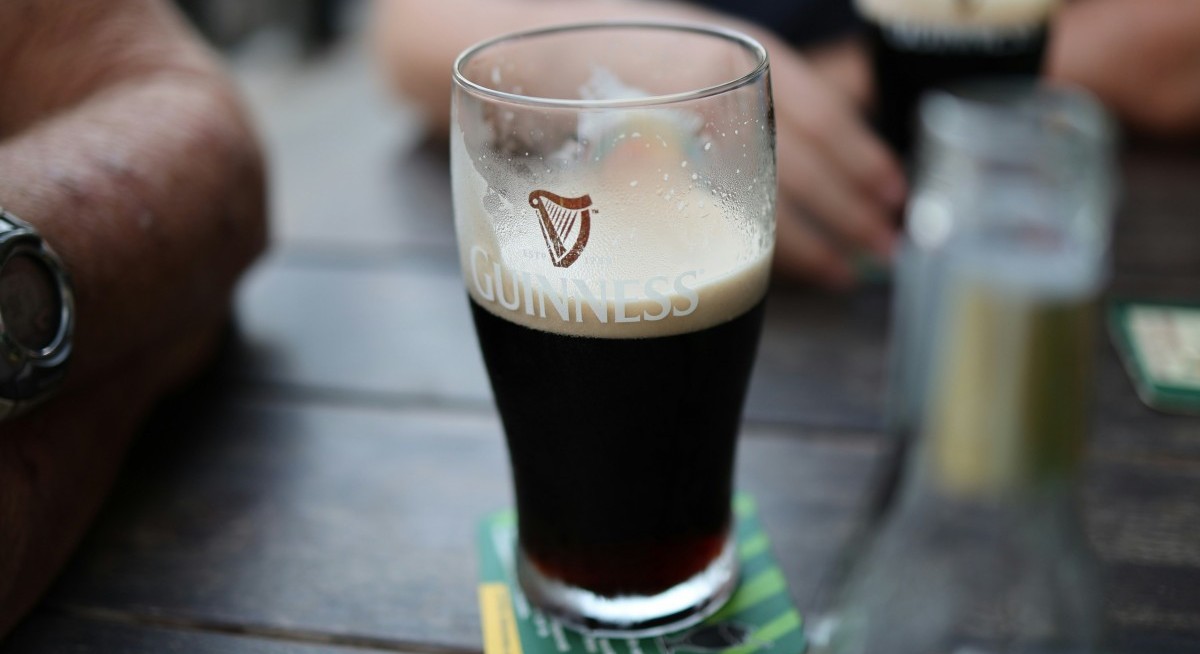


The punctiliousness doesn’t stop at the factory gates. Guinness’s protocols recommend that bars that carry the beer wash their pint glasses separately from other dishware, lest grease transfer and ruin what is called the “schtick,” the distinctive lines of foam left behind on the glass as the creamy head drops with each sip.
Satisfied that this glass is sufficiently immaculate, Wafer positions it precisely at a 45-degree angle and pulls the tap toward her for the initial part of the pour. When the liquid, which is carbonated with a mix of nitrogen and carbon dioxide, reaches the top of the harp emblem, she places the glass on the counter and waits until it settles — the mesmerising moment when the bubbles rise from the body of the beer to the head, turning the stout from tan-coloured to a deep brown.
She then places the glass back under the tap and, this time, pushes the handle away, which slows the flow of gas and allows for greater control when pouring the domed head.
This entire process takes almost two minutes, which is, needless to say, a lot longer than it takes a bartender to pour a regular pint. “Some of the great advertising campaigns are all based around that idea of the anticipation,” says Wafer, 56. “We basically took what was a bit of a brand challenge — that you have to wait longer for a pint of Guinness — and turned it into a brand strength.” The resultant slogan: “Good things come to those who wait.”
See also: Starbucks said to weigh Japan unit options including stake sale — Bloomberg

Caption: Since Wafer began leading the brand in 2019, Guinness has gone from frequently lagging Diageo’s overall performance to posting a double-digit compound annual growth rate, starting with a 27% spike in the second half of 2021 / Photo: Bloomberg Businessweek
Bucking the trend
Wafer’s gentle meticulousness and evangelical belief in the product have helped Guinness become the toast of Diageo, where she serves as global category director of beer, vodka, liqueurs and convenience.
See also: Jollibee is said to mull moving US listing to booming Hong Kong — Bloomberg
Like many of its peers, the wider company has endured four years of falling sales as alcohol consumption dropped following the pandemic. The percentage of Americans who drink fell 13 points from 2022 through 2025, according to a Gallup Poll; in the third quarter for Diageo that ended March 31, Diageo’s North American sales slid 9.4%.
Guinness has bucked the trend. Since Wafer began leading the brand in 2019, Guinness has gone from frequently lagging Diageo’s overall performance to posting a double-digit compound annual growth rate, starting with a 27% spike in the second half of 2021.
Ireland and Britain are still its biggest markets, but Guinness is also today the most-sold draft beer in New York and Boston. A bottled, higher-alcohol variant called Foreign Extra Stout has made Nigeria the world’s fourth-largest consumer of Guinness, and Guinness 0.0 is the number one non-alcoholic beer in the UK. “It’s a 267-year-old overnight success,” Wafer says of the brand.
To meet surging demand for Guinness, including its 0.0 variant, Diageo recently opened a new brewery in Littleconnell, County Kildare, the hometown of founder Arthur Guinness. A second facility, due to begin construction this year, will more than double the brewery’s capacity.
Wafer has worked at Diageo for 29 years, but her attachment to the Guinness brand goes back much longer. Her father owned a pub right outside the original brewery gates called Hannan’s, and Guinness employees frequented it after their shifts; gratis beer was not an employee perk.
However, the company did provide housing for its workers, earning a reputation as an employer who “looked after you from cradle to grave,” she says. Wafer was not allowed in the pub, which her father sold in the 1980s. “He didn’t really approve of women being in bars,” she says. Still, when Guinness recruited Wafer from the public-relations firm where she was working after earning a master’s degree in modern American and English literature, her father was elated.
“That was, for him, just the proudest moment,” Wafer adds. “Working for Guinness in Ireland is like …” She pauses as she summons the correct words to describe what it’s like promoting an iconic brand that’s omnipresent in Dublin — almost every bar displays a Guinness sign in the window or outside.
For more stories about where money flows, click here for Capital Section
Refreshing the brand
During my two-day trip to the city this spring, I passed by innumerable people drinking the unmistakable stout, and on the plane ride back to the US, I counted 10 passengers wearing Guinness-branded merch.
“It’s such a big part of the Irish psyche and legacy, and it’s contributed so much to Dublin and to its people,” Wafer says. “You are very conscious that you are just a moment in that journey,” she concludes, which seems like an understatement considering we are on a property where its namesake founder signed a 9,000-year lease in 1759.
That kind of ubiquity has its downsides. By the time Wafer was put in charge of Guinness the year before the pandemic began, the brand had become pigeonholed. “It’s drunk by older guys in a traditional bar in winter,” she imagined consumers thinking. “Well, Guinness isn’t for me if I’m not that.” So she and her team introduced the “A Lovely Day for a Guinness” campaign, which nodded to the famous 1935 toucan ad and highlighted younger people drinking beer in warmer months.
The company also emphasised that despite its dark colour and creaminess, Guinness is actually lighter in calories (210 for a 20 ounce pint) and lower in alcohol content (4.2%) than many rival beers.
Guinness also started making the beer more widely available at warm-weather events, including music festivals and sporting matches. Although the company says it can’t validate the numbers, Wafer is proud to report that “Guinness is now as big in Ireland in summer as it is at Christmas, which is a phenomenal turnaround.”
The next reimagining of what a Guinness could be came during Covid-19, when the company introduced more drinkers to the canned product, which was already available, though less widely consumed. Because the drink is nitrogenated, the canning process is different from that of regular beer. Every container holds a widget that looks like a small ping-pong ball with a tiny hole in it. It’s activated when the tab is popped open and releases the nitrogen in the widget as it careens through the can, creating the same texture as in the draft version.
Around the same time, in October 2020, Guinness introduced its 0.0 product. Most non-alcoholic beers are made either by boiling the alcohol off normally brewed beer or by brewing it without alcohol from the start.
Both processes tend to affect flavour, Wafer says. Guinness uses cold filtration to remove the alcohol from the stout, providing an almost imperceptible effect on the flavour (to my palate, Guinness 0.0 is ever-so-slightly sweeter than regular Guinness, though the brand claims they taste the same).
Creative inspiration
During Covid-19, Guinness also found a new font of creative inspiration in people stuck at home and longing to go out for a pint, who began seeing Guinness’s dark-bottom, white-top aesthetic in unrelated objects.
One person shared a photo of a white cat on a black sofa. “Another guy posted a picture of his girlfriend, whose peroxide-blonde hair contrasted with her black turtleneck,” Wafer recalls.
“Am I really weird that when I look at my girlfriend, all I can see is Guinness?” The brand reached out and asked if it could purchase the images to use as advertising; it was another opportunity to nudge itself away from the “old man drinking in a bar” association.
Guinness is having more viral moments lately: People have recently started posting TikTok videos of themselves “splitting the G” — that’s taking a first sip so big that the schtik hits the middle of the G in the Guinness logo on the pint glass. It’s a trend that doesn’t quite square with what Diageo calls “our commitment to positive drinking.”
Still, Wafer is fairly sanguine about the immoderate gulp. “Whereas we wouldn’t encourage ‘splitting the G,’ that’s one of the things that people are doing,” she says. “People are playing with the brand or with the product.”
Now that Wafer has delivered for Guinness, Diageo is hoping she’ll work the same magic on the rest of the expanded portfolio that’s been part of her remit since 2024: vodkas, liqueurs, non-Guinness beers and convenience, a category that includes canned cocktails. Her plans once again include co-opting social media trends and having uniform, rigorous quality standards.
Still in the private taproom, she’s finished pouring her beer, but it’s not time to drink yet. To certify that the pint is truly up to standard, Wafer performs the “tilt test,” during which drinkers slope their Guinness as far as possible to see how far the cream will tip over the lip without spilling.
Any other beer would pour out at the precarious angle at which she’s holding the glass, but the head keeps the Guinness in place. Then she asks me to try my hand at the multistep pour. Wafer supervises through the painstaking process, which requires a second try when I commit the unforgivable sin of overpouring, allowing a tiny rivulet of beer to drip down the side.
Finally, I manage Guinness-level excellence. “That’s perfectly domed,” Wafer says approvingly. “Stunning. Nice edge.”
But I’m not out of the woods yet; drinking the pint also has a codified procedure, and when I take a sip, my ratio of beer-to-foam is tilted too heavily toward the latter.
Wafer corrects my technique, and I’m happy to take direction to refine the simple act of drinking a beer. As I’ve learned during my time there, with Guinness, there’s always a proper way of doing things. — Bloomberg Businessweek




