


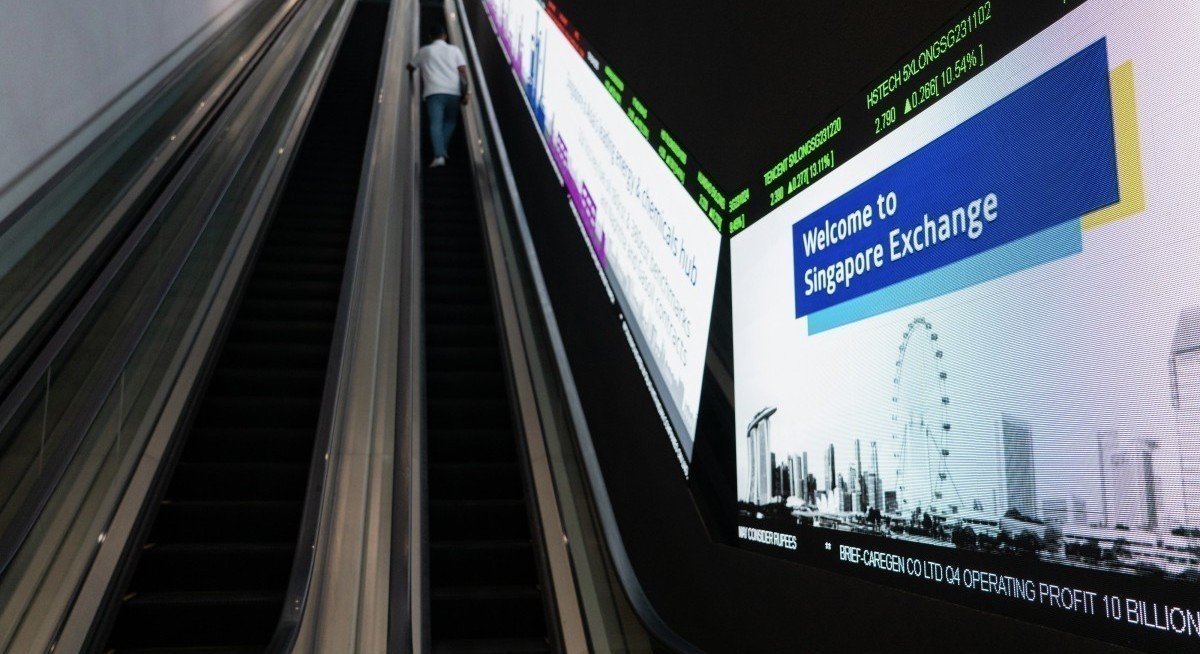


“[The] SDAV is a key driver of SGX’s stock price,” says DBS analyst Lim Rui Wen, who has a “buy” call and a higher target price of $26.40, up from $22.50 previously.
The SGX, Singapore’s sole exchange operator, is set to benefit from several catalysts, including the EQDP, which is only in its early stages.
“The resurgence in Singapore equities has been notable, with stronger retail and institutional participation, improving liquidity, unprecedented government support and a coordinated ecosystem-wide effort lifting SDAV from its long-term through-cycle average of $1.2 billion to over $2 billion currently,” she says. “In our view, these early signs of success strengthen rather than diminish the case for further policy support.”
Of the $6.5 billion EQDP, only one-third has been deployed into the market so far from the first two rounds of disbursements. This excludes any additional private capital raised alongside the programme, Lim adds.
See also: Citi’s top picks in the real estate world are CICT, MPACT, CLAR, CDL and UOL
The third round of asset managers is tipped to be announced by mid-2026.
“We believe that a vibrant and liquid domestic equity market is a critical pillar of Singapore's ambitions to reinforce its position as Asia's leading wealth and financial hub, attracting both capital inflows and new listings,” says Lim, who adds that further expansion of the EQDP is a “distinct possibility”.
SGX’s derivatives arm is also doing well, with derivatives traded volume increasing by 20% y-o-y to 30.5 million contracts in May. Derivatives daily average volume (DDAV) gained 27% y-o-y to 1.6 million, the third-largest on record.
See also: Ng of uSmart downgrades HPH Trust to 'hold' on 'structural leakage'
Lim believes the exchange will continue to benefit from the current volatility and Singapore dollar (SGD) safe-haven inflows, which she sees as “structural” in nature. Given this, the analyst foresees continued flows into Singapore, especially into yield stocks given the lowered confidence in the US dollar (USD) amid ongoing de-dollarisation trends and the re-evaluation of US credit and policy credibility.
Amid these trends, Lim believes the SGX stands to be a “key beneficiary”, especially in the current low-interest rate environment.
Demand for risk management tools will also continue to be high amid the uncertainties stemming from the Iran war, she adds.
In addition to her target price lift, Lim has also increased her FY2026 - FY2027 earnings per share (EPS) estimates by 1% - 4% to 68.68 cents and 77.42 cents respectively. Her new target price is based on an FY2027 P/E of around 34 times, or 2 standard deviations (s.d.) above SGX’s historical foward P/E.
“We believe the structural changes and Singapore market inflows will continue to fuel SGX's multiple and EPS rerating, amidst strong derivatives business growth,” she reiterates.
“We believe that the premium P/E to peers is justified with 8% - 13% net profit growth expected across FY2027 - FY2028 as SGX enters a new stage of growth. Further capital management initiatives may represent additional catalysts,” she adds.
Meanwhile, RHB analyst Shekhar Jaiswal has increased his target price to $22.20 from $20.90 as he raises his SDAV estimates “meaningfully”. “Our model now reflects 10% and 14% jumps in SDAV assumptions for FY2027 and FY2028, reflecting our confidence in the durability of the current elevated trading environment,” he writes in his June 26 report.
For more stories about where money flows, click here for Capital Section
The analyst’s report comes after a meeting with SGX’s management, in which he has also raised his profit forecasts by 6.2% and 7.6% for FY2027 and FY2028. His forecasts, which now stand at $883 million and $968 million for both years respectively, follows the higher SDAV estimates. In a June 12 report issued after SGX’s May statistics, Jaiswal noted SGX’s “stretched” valuations. To him, the counter’s “elevated” multiple “adequately reflects the structural improvements in market activity”. The stock will have to see a “sustained upward revision cycle” in consensus earnings or a “meaningful correction” in its share price for RHB to adopt a more constructive stance.
In his latest report, Jaiswal, like Lim, believes the EQDP will continue to anchor SDAV. There will also be a “genuine broadening” of investor participation in stocks beyond the benchmark Straits Times Index’s (STI) constituents, as reflected in the index’s share of total value traded declining to 74% from 85% a year ago. Jaiswal also points out that retail activity has reached 13-year highs while institutional investors have been net buyers of small and mid-cap (SMID) stocks for five consecutive months. Net new listings and secondary market capital raising have also picked up.
The positive volume impact is, however, partly offset by a higher tax rate and cost growth tracking the upper end of its guidance range. Jaiswal notes that SGX’s capital expenditure (capex) could also remain elevated in the near term. “SGX indicated that the tax rate for 2HFY2026 and beyond would be 18%, up from our previous 17% assumption”.
“We adjusted our cost assumptions higher, with FY2026 expense growth now modelled towards the upper end of the 4% - 6% guidance range. Together with elevated capex in the near term, these factors temper the earnings benefit from higher SDAV assumptions, particularly in FY2026, where the net profit uplift is a modest 1.5%,” he says.
Jaiswal’s new target price, which still represents a downside of 5.18% to SGX’s last-closed share price of $24.15 as at June 28, is still based on an FY2027 P/E of 26 times. It also includes an environmental, social and governance (ESG) premium of 4%. The target P/E remains elevated at 2 s.d. above SGX’s 12-year forward P/E average.
“SGX trades at a premium to the ex-India regional peers’ weighted average P/E. The premium extends to P/BV, despite SGX’s ROE (return on equity) being broadly in line with peers. The dividend yield also trails the peer average, though this gap should narrow as payout expands over the next few years,” says Jaiswal. “The premium is defensible on scarcity value and franchise quality, but the current share price already capitalises the structural reform narrative.”
Despite the target price increase, Jaiswal still sees “limited scope” for further rerating as his estimates already sit above consensus’ estimates.
“Our FY2027 and FY2028 net profit forecasts are 8.5% and 10% above consensus respectively,” he says. “We would turn more constructive only if consensus earnings move materially higher, or if the share price corrects enough to restore positive expected returns on our unchanged valuation framework.”
As at 3.04pm, shares in SGX are trading 4 cents lower or 0.17% down at $24.11.




