


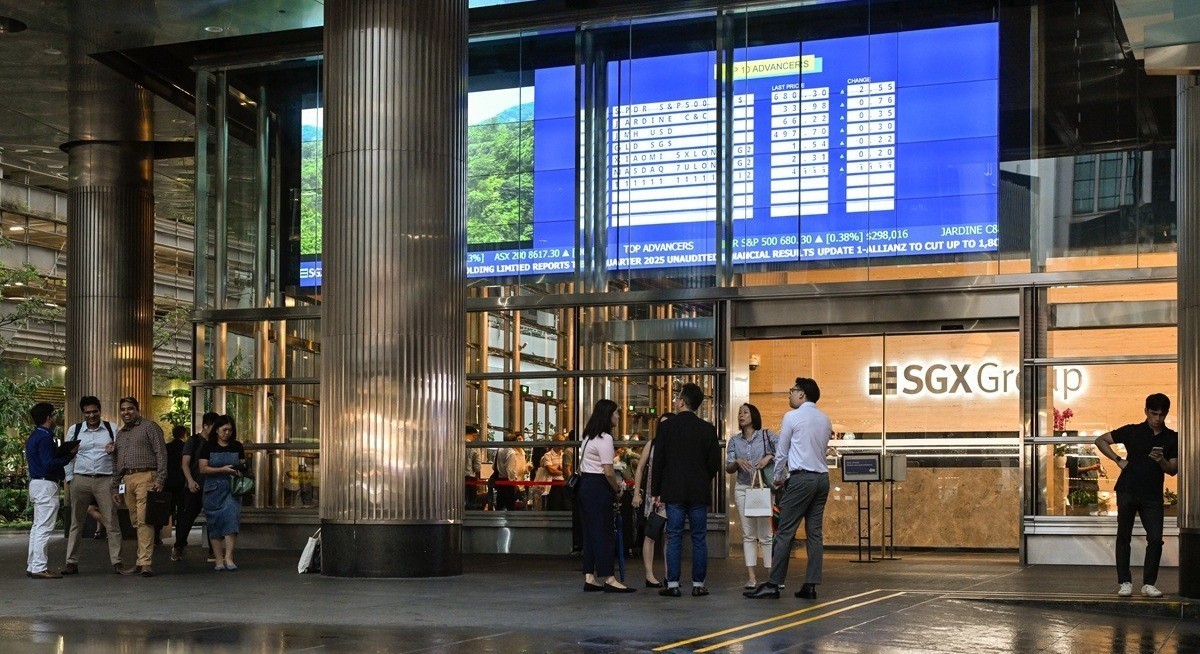


Derivatives traded volume was also up by 20% y-o-y to 30.5 million contracts while daily average volume grew by 27% to 1.6 million contracts, the third-highest on reocrd.
Maybank Securities’ Thilan Wickramasinghe was the most optimistic with a “buy” call and a higher target price of $25.25, from $20.37 previously. His target price factors in rolled forecasts to FY2027, a lower weighted average cost of capital (WACC) to 5.9% from 6.6%, a terminal rate of 1% and a lowered P/E multiple of 21 times. The lower WACC was due to lower market risk premium.
“SGX’s May equity market turnover shows an accelerating trend towards a higher baseline velocity. This should drive structurally higher SDAV in the medium term,” he writes in his June 12 report.
Mainboard velocity stood at 56%, which shows that large-cap institutional participation remains strong. Catalist velocity was 73%, compared to the 21% reported just a year ago.
See also: Koh of UOBKH maintains 'buy' on UIBREIT with growing presence in 'high value' aerospace industry
“This indicates higher retail participation, given the board’s smaller cap listings,” says Wickramasinghe. “While there is no breakdown of institutional versus retail shareholders in the Mainboard, we extrapolate that retail liquidity is shifting up to a higher base.”
The analyst adds that flows due to Singapore’s status as a safe haven, market reforms, as well as corporate restructuring and value unlocking are a “self-reinforcing trifecta” that should drive market average daily value (ADV) further. Given this, Wickramasinghe has upgraded his FY2026 to FY2028 ADV estimates by 10% to 18% to over $2 billion.
In May, SGX’s deriatives also saw “strong growth”, which reflects “broad demand” for managing risk across asset classes.
See also: SpaceX’s shares ‘significantly overvalued’, says Morningstar analyst
With elevated global volatility such as the recent re-escalation between the US and Iran, Wickramasinghe believes SGX’s multi-asset platform is a “structural beneficiary”.
The continued market momentum leading to SGX’s 2HFY2026 results - slated to be released on Aug 6 - may lead to consensus upgrades, he adds.
A key risk, he notes, are recent IPOs trading below their opening price, which may affect IPO momentum and liquidity availability going forward. This, he adds, may also seep through to secondary market velocity. Of the total IPOs launched in 2025 and 2026, 66% of them are trading below their opening price year to date.
UOB Kay Hian’s Roy Chen has maintained a “hold” call but with a higher target price of $21.70 from $19.16 previously as SGX’s cumulative trading statistics for the past 11 months ended May beat expectations.
Chen expects trading activities to sustain in the rest of FY2026 and FY2027 with the initiatives from the Monetary Authority of Singapore and SGX expected to continue driving investor participation and market liquidity for the rest of the year and beyond.
On derivatives, the global uncertainties will sustain risk management demand through trading, Chen adds.
For its FY2026 results, Chen expects SGX’s core earnings to grow by 21.2% y-o-y to $739 million. Headline net profit is expected to grow by 11.8% y-o-y to $724 million, he says. Core earnings would be driven by top-line growth of 13.5% y-o-y and operating margin expansion of 2.5 percentage points y-o-y due to favourable opearting leverage.
For more stories about where money flows, click here for Capital Section
Chen’s new target price is based on an FY2028 P/E estimate of 27.1 times, pegged to 2 standard deviations (s.d.) above SGX’s historical mean P/E of 22.3 times.
“The +2 s.d. peg reflects SGX’s upbeat earnings growth outlook and its unique valuation proposition being a beneficiary of both Singapore’s equity market development initiatives and heightened macro and geopolitical uncertainties,” he writes.
“While we see no de-rating catalyst for SGX in the near term, we think positives for the company should have been well digested by the market and hence likely been priced in. In addition, SGX’s FY2028 P/E of 27.1 times is also a premium over its global peers which are mostly trading at 18 times - 24 times,” he adds. “As such, we will seek a better entry point to invest in SGX.”
RHB Bank Singapore’s Shekhar Jaiswal remains “neutral” on SGX with an unchanged target price of $20.90. Despite the strong data, which is now trading 8.1% and 5.7% ahead of his estimates for securities and deriatives respectively, Jaiswal believes SGX’s valuations are “stretched”.
His target price, which continues to be based on an FY2027 earnings per share (EPS) estimate of 26 times and at 2 s.d. above SGX’s 12-year foward P/E average, remains “elevated”. This, to Jaiswal, “adequately reflects the structural improvements in market activity”.
That said, the analyst sees upside risk to his FY2026 net profit forecast of $734 million. “We maintain that while the improvements in market breadth and trading intensity are encouraging, the elevated valuation probably reflects much of this positive momentum.”
Morningstar analyst Roy Van Keulen has also left his “two star” rating unchanged on SGX. He has, however, lifted his fair value estimate for the “wide-moat” SGX by 5% to $16.80 after the exchange has continued to perform above expectations.
At its share price of $21.70 as at Van Keulen’s report on June 10 and at $23.25 as at June 15, the analyst believes SGX’s shares are “materially overvalued”.
“Our slight upgrade comes from our growing conviction that the exchange is not merely benefiting from one-off cyclical factors, but that elevated volatility is a structural growth driver for volumes and earnings,” he explains.
Shares in SGX closed 67 cents higher or 2.97% up at $23.25 on June 15.




