




 Home
Home 


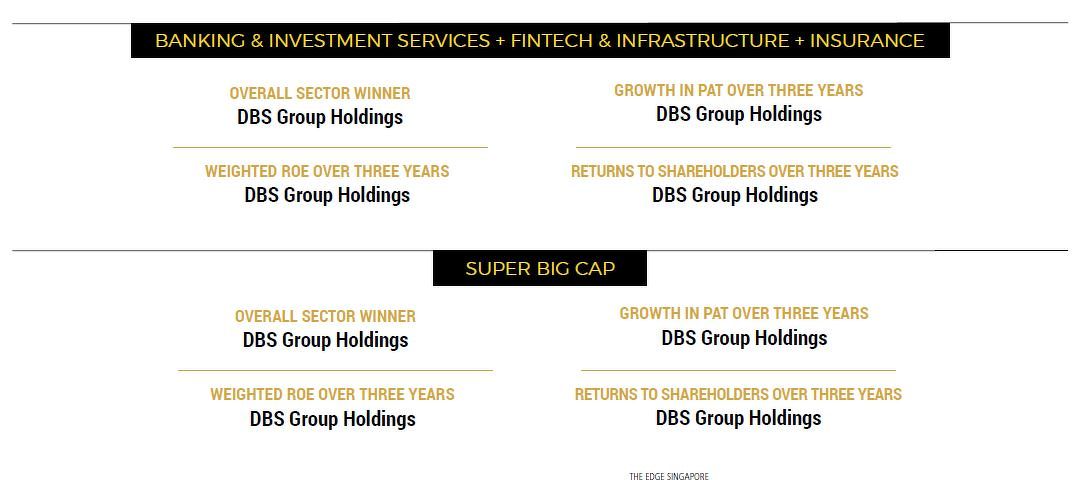 DBS Group Holdings, the only Singapore-listed company to report a net profit of $10 billion, the first to reach a market capitalisation of $100 billion, and whose shares have gained some 40% year to date, has been named the overall sector winner for the Banking & Investment Services +Fintech & Infrastructure + Insurance category. Along the way, it came out tops in all three metrics: profit growth, return to shareholders, and weighted return on equity (ROE).
For its all-round showing this year, DBS has been named Company of the Year at this year’s Billion Dollar Club (BDC).
DBS Group Holdings, the only Singapore-listed company to report a net profit of $10 billion, the first to reach a market capitalisation of $100 billion, and whose shares have gained some 40% year to date, has been named the overall sector winner for the Banking & Investment Services +Fintech & Infrastructure + Insurance category. Along the way, it came out tops in all three metrics: profit growth, return to shareholders, and weighted return on equity (ROE).
For its all-round showing this year, DBS has been named Company of the Year at this year’s Billion Dollar Club (BDC).
See also: PropNex soars, capturing greater market share amid challenging real estate climate


See also: Shaping the future of sustainable mobility
U11 (UOB).
In terms of shareholder returns, DBS notched up a 13.1% CAGR over the three years, compared with 9.8% for OCBC and 9.1% for UOB. Similarly, DBS recorded a CAGR of 15.2% for weighted ROE over the three-year period compared with 12% for OCBC and 11.5% for UOB.
Analysts remain upbeat on all three banks, but particularly on DBS. For instance, Rena Kwok, a credit analyst at Bloomberg Intelligence, believes all three Singapore banks are moving to lock in asset yields.
“Singapore banks could intensify efforts to grow their fixed-rate mortgages with reasonable loan-to-value ratios in the secondary market from 2H2024 onwards, given their favourable risk-returns and to bolster net interest income growth in anticipation of interest rate cuts,” says Kwok in a recent report.
“Still, we expect the banks to keep price discipline, as they aim to expand mortgage market share despite stiff competition,” she says, adding that pre-emptive asset-liability management can keep earnings momentum healthy ahead of interest rate cuts while further aided by robust non-interest income.
In a recent update, JP Morgan mentioned the possibility of DBS raising its dividends. “Our understanding of management comments is that capital management would be likely in 3Q2024 and 4Q2024. In 2Q2024, CEO Piyush Gupta mentioned he had something in mind on capital return, which he will discuss with incoming CEO Tan Su Shan,” JP Morgan says.
DBS has managed its assets and liabilities over the years such that its sensitivity to interest rates is lower and less impacted by falling interest rates. “Net interest margin sensitivity has come off to $4 million per basis point due to shifts in the current account savings account [Casa] ratio and asset mix. The bank expects the cost-to-income ratio to be in its low 40s and 15% to 17% ROE over the medium-term,” JP Morgan notes. In the meantime, its full cycle-specific provisions are likely to remain at 17 basis points to 20 basis points (bps).