SINGAPORE (June 18): Navigating choppy waters is literally part and parcel of Dr Mark Erdmann’s work, having previously spent 23 years of his career living and working in Indonesia as a coral reef ecologist. Though he is now based in Auckland, New Zealand, his underwater adventures are far from over. Aside from playing an active role on the boards of Indonesian non-governmental organisations (NGOs) within the Coral Triangle, he also serves as Conservation International’s (CI) vice-president for Asia-Pacific marine programmes through which he continues to come face-to-face with various species of sharks, rays and other wild marine animals — many of which were, up until recently, unknown to science. It was therefore a pleasant change of environment for Erdmann when he and a team of scientists were invited to take their research expedition to the Raja Ampat Islands on board Rascal, a 31m luxury phinisi, a traditional Indonesian two-masted sailing ship mainly built by the Konjo tribe of South Sulawesi.
Together with ichthyologist Gerry Allen as well as scientists from CI Indonesia and NGO Manta Trust, Erdmann embarked on a mission to study the Raja Ampat manta ray population and migration patterns along with coral reef fish biodiversity. Over the course of seven days, they were taken by Rascal to the south coast of Batanta, up to Dayan, around Wayag, and even to the lesser-known waters of Ayau — an area off the beaten path where Erdmann, who has more than two decades of diving experience in the region, says he discovered overwhelming biodiversity.
The week-long adventure earned Erdmann and his crew the discoveries of 32 new manta ray individuals, at least two potential new species of fish, and seven species of reef fish not previously known to inhabit the Bird’s Head Seascape. It was also over the course of this trip that they managed to tag a total of seven rays for satellite tracking, and even discovered new cleaning stations thanks to the deployment of drones.
“Raja Ampat has a number of very well-known manta sites or cleaning stations where they come in on a daily basis to get cleaned. We currently have a lot of tourists visiting these sites [for manta sightings]. In other parts of Raja Ampat, finding those cleaning stations for the first time can be a very difficult thing to do, even if you happen to be quite close to a manta. Recently, we’ve started using drones to do this. This was taken in Ayau,” says Erdmann of the projected image on the white screen: A bird’s eye view of a lone ray whose silhouette can be faintly made out under the turquoise water’s surface.
Conservation International scientists conducting underwater research on manta rays
The ecologist and Rascal’s owner Erik Barreto were presenting their findings at 1880, a new private member’s club along Robertson Quay, on the afternoon of April 12. “It is actually taken from only about 30 or 40m up, but if you send them to about 500m up, you can get a massive view of everything around. Using the drone to locate the mantas this way, we were able to bring our speedboat over and get our people into the water, get some photographs and eventually tag the animals. This was kind of a proof-of-concept to us to show that drones really work that way. And so during this expedition, we were able to document two brand-new cleaning stations that were not known before in Raja Ampat,” Erdmann explains.
He also admits that his stay aboard Rascal was probably the most luxurious he had ever experienced in his field of work. It was, in his words, “the opposite end of the spectrum of what we normally get to do as marine scientists”. Erdmann recalled how, after a hard day’s work, the crew would return to the various comforts offered by Rascal.
These included but were not limited to Hamptons-style interiors with Charles Orchard furniture; five above-deck, air-conditioned cabins with ocean views and en-suite bathrooms; as well as meals and cocktails prepared by a private chef from Bali’s Watercress restaurant and mixologists from Proof & Company, respectively.
All of Rascal’s cabins feature flatscreen TVs with a catalogue of over 1,000 complimentary movies and Sonos interactive music systems
Up until recently, Rascal was a standalone private charter phinisi yacht hand-built by Konjo boat builders in South Sulawesi in Tana Beru, a remote fishing village in Indonesia where phinisi boats have been constructed for hundreds of years. Together with two other co-founders, Barreto set up Rascal Voyages in 2017 to leverage Rascal’s unique format of private yacht charter and operate across Southeast Asia, the Indian Ocean, and beyond. Rascal is available for hire starting from US$8,500 ($11,128) for fullboard service per night.
The company more recently announced plans to expand its fleet size to six yachts, including the maiden Rascal phinisi, by 2021. According to Barreto, the new vessels will be “same, but different”. For one, they will bear similarities to the maiden Rascal in terms of style and standards, he says. Each will have five double en-suite guest cabins and a range of indoor and outdoor recreational spaces combined with the comforts of a contemporary yacht. Yet, their destinations and itineraries are set to be vastly divergent.
Two new yachts are currently under construction, with both scheduled to complete in 2020. While one will serve along the Indonesian waters alongside the original yacht, another will voyage two routes, namely from Thailand to Myanmar, and Singapore to Malaysia. A further three yachts will be completed by 2021 to access the Indian Ocean and Gulf of Thailand with unique itineraries around the Maldives and Cambodia.
As for the new manta ray cleaning stations, which Erdmann and his team most recently discovered during their voyage, the ecologist is choosing to remain mum about where they might be found. “It might be that only Rascal will ever know about them because I’m going to keep quiet as to the exact location… We want to provide some areas [in Raja Ampat] that are exclusive to Rascal visitors. Just know that Erik didn’t pay me to say that,” Erdmann insists with a hearty laugh.
“Raja Ampat has a number of very well-known manta sites or cleaning stations where they come in on a daily basis to get cleaned. We currently have a lot of tourists visiting these sites [for manta sightings]. In other parts of Raja Ampat, finding those cleaning stations for the first time can be a very difficult thing to do, even if you happen to be quite close to a manta. Recently, we’ve started using drones to do this. This was taken in Ayau,” says Erdmann of the projected image on the white screen: A bird’s eye view of a lone ray whose silhouette can be faintly made out under the turquoise water’s surface.

Conservation International scientists conducting underwater research on manta rays
The ecologist and Rascal’s owner Erik Barreto were presenting their findings at 1880, a new private member’s club along Robertson Quay, on the afternoon of April 12. “It is actually taken from only about 30 or 40m up, but if you send them to about 500m up, you can get a massive view of everything around. Using the drone to locate the mantas this way, we were able to bring our speedboat over and get our people into the water, get some photographs and eventually tag the animals. This was kind of a proof-of-concept to us to show that drones really work that way. And so during this expedition, we were able to document two brand-new cleaning stations that were not known before in Raja Ampat,” Erdmann explains.
He also admits that his stay aboard Rascal was probably the most luxurious he had ever experienced in his field of work. It was, in his words, “the opposite end of the spectrum of what we normally get to do as marine scientists”. Erdmann recalled how, after a hard day’s work, the crew would return to the various comforts offered by Rascal.
These included but were not limited to Hamptons-style interiors with Charles Orchard furniture; five above-deck, air-conditioned cabins with ocean views and en-suite bathrooms; as well as meals and cocktails prepared by a private chef from Bali’s Watercress restaurant and mixologists from Proof & Company, respectively.
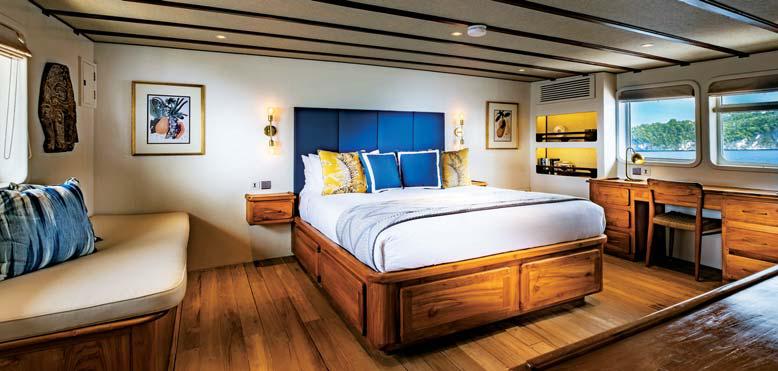
All of Rascal’s cabins feature flatscreen TVs with a catalogue of over 1,000 complimentary movies and Sonos interactive music systems
Up until recently, Rascal was a standalone private charter phinisi yacht hand-built by Konjo boat builders in South Sulawesi in Tana Beru, a remote fishing village in Indonesia where phinisi boats have been constructed for hundreds of years. Together with two other co-founders, Barreto set up Rascal Voyages in 2017 to leverage Rascal’s unique format of private yacht charter and operate across Southeast Asia, the Indian Ocean, and beyond. Rascal is available for hire starting from US$8,500 ($11,128) for fullboard service per night.
The company more recently announced plans to expand its fleet size to six yachts, including the maiden Rascal phinisi, by 2021. According to Barreto, the new vessels will be “same, but different”. For one, they will bear similarities to the maiden Rascal in terms of style and standards, he says. Each will have five double en-suite guest cabins and a range of indoor and outdoor recreational spaces combined with the comforts of a contemporary yacht. Yet, their destinations and itineraries are set to be vastly divergent.
Two new yachts are currently under construction, with both scheduled to complete in 2020. While one will serve along the Indonesian waters alongside the original yacht, another will voyage two routes, namely from Thailand to Myanmar, and Singapore to Malaysia. A further three yachts will be completed by 2021 to access the Indian Ocean and Gulf of Thailand with unique itineraries around the Maldives and Cambodia.
As for the new manta ray cleaning stations, which Erdmann and his team most recently discovered during their voyage, the ecologist is choosing to remain mum about where they might be found. “It might be that only Rascal will ever know about them because I’m going to keep quiet as to the exact location… We want to provide some areas [in Raja Ampat] that are exclusive to Rascal visitors. Just know that Erik didn’t pay me to say that,” Erdmann insists with a hearty laugh.
This article appeared in Issue 835 (June 18) of The Edge Singapore.
Subscribe to The Edge now