


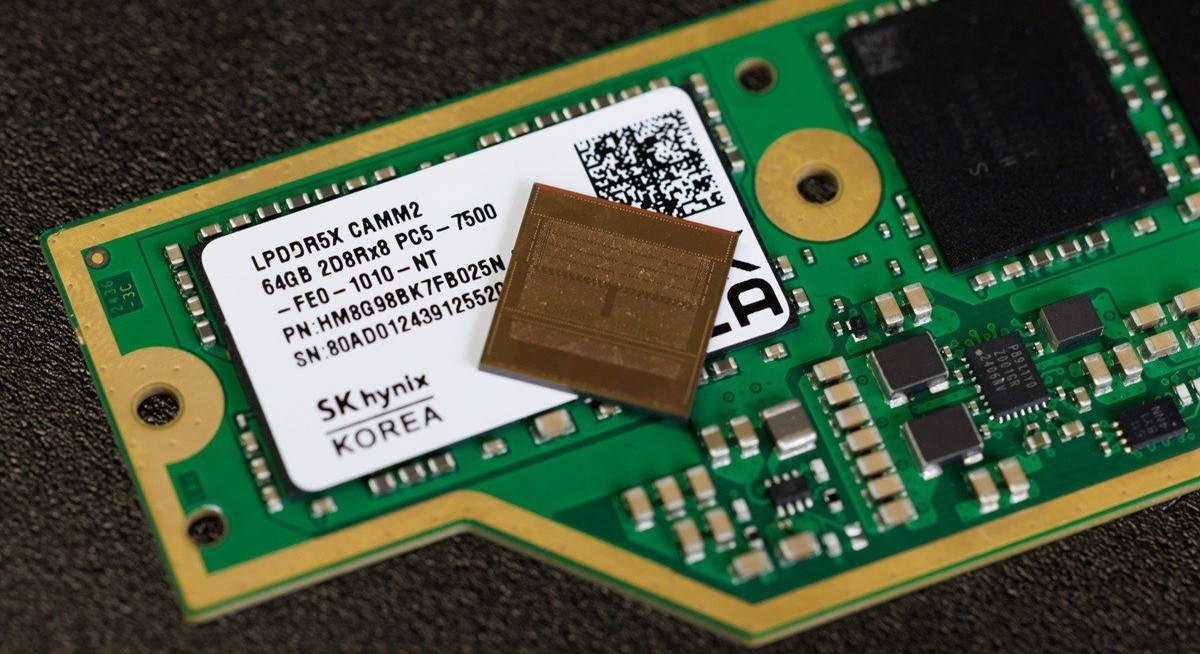


(April 23): SK Hynix Inc reported a five-fold jump in quarterly profit and reiterated plans to ratchet up its capex “significantly” this year, underscoring surging prices of memory chips that underpin global artificial intelligence development.
The Korean chipmaker is riding an AI spending boom that’s reshaping the memory sector and offsetting fears around supply chain disruptions stemming from war in the Middle East. The outperformance comes as investors debate whether the advent of AI is igniting a super-cycle of demand that will help SK Hynix and its rivals break a decades-old cycle of boom and bust.
Favorable prices will continue for both memory and storage, the company said Thursday. Operating profit for the March quarter jumped to 37.61 trillion won (US$25.4 billion), a record high that compares with the average estimate by analysts for 35.7 trillion won. Sales nearly tripled to 52.58 trillion won. Its shares rose around 0.5% during premarket trade on Nextrade.
“Robust profit growth will continue over the next several quarters” due to customers’ low memory inventories and limited supply growth, said Sanjeev Rana, head of research at CLSA Securities Korea, which forecasts a 45% rise in SK Hynix’s capex this year. “There’s so much demand, and the companies are trying to increase capacity whatever ways they can.”

See also: TSMC says ASML’s latest chipmaking gear is too pricey to use


See also: SoftBank seeks US$10 bil margin loan backed by OpenAI shares — Bloomberg

Hyperscalers from Meta Platforms Inc to Amazon.com Inc are spending hundreds of billions of dollars on AI hardware. That’s fuelling earnings at SK Hynix, which is benefitting from its lead in high-bandwidth memory, critical for training and running AI models alongside Nvidia Corp accelerators.
SK Hynix and its competitors Samsung Electronics Co and Micron Technology Inc are also allocating more production capacity to lucrative HBM, spurring shortages and price spikes in conventional memory. That’s further boosting revenue for memory makers.
In response to the demand, Hynix said in January that its capital expenditure in 2026 will rise significantly from 30.2 trillion won in 2025. Last month, it announced a plan to spend the equivalent of US$8 billion on cutting-edge extreme ultraviolet lithography chipmaking tools from ASML Holding NV. Larger rival Samsung plans to spend more than 110 trillion won on chip capacity expansion and research this year, devoting a record amount of capital toward an effort to seize the lead in AI semiconductors.
Shares of SK Hynix have climbed around 90% this year after more than tripling in 2025, outrunning Samsung. Samsung appears to be pulling ahead in the next-generation HBM4 arena, however. It was first to commercially ship HBM4 chips and it showcased its cutting-edge HBM4E at Nvidia’s GTC event.
“Memory is becoming less of a commodity subject to boom and bust cycles because it is now co-designed and tied directly to AI accelerator roadmaps,” said Dave Mazza, chief executive officer at Roundhill Investments in New York ahead of the results. “Increasingly, memory companies are signing long-term contracts with hyperscalers, which fundamentally changes the cyclicality of the business.”
The memory makers’ stocks are still trading at a fraction of the valuation multiples of other top AI chip names including Nvidia and leading global foundry Taiwan Semiconductor Manufacturing Co, however. Skeptics say the lower valuation is merited due to the lumpy nature of memory earnings.
To stay ahead of Singapore and the region’s corporate and economic trends, click here for Latest Section
For now, the exponential rise in prices over past months is tough to ignore.
The benchmark contract price for 8 gigabits of DDR4 PC memory has risen for 11 consecutive months, hitting roughly US$13 last month, according to market tracker DRAMeXchange. The steady uptrend has boosted margins across SK Hynix’s core business. Higher NAND flash prices also contributed.
And the average selling price of DRAM climbed 60.8% in the first quarter from the previous quarter, while that of NAND rose 55.3%, according to estimates by Mirae Asset Securities Co. Demand for enterprise solid-state drives has also surged alongside data centre investment.
While pledging to expand capacity, SK chairman Chey Tae-won cautioned in February that losses remain a possibility in the future in an era of rapid technological shifts. He also highlighted mounting infrastructure challenges. He said SK Group is now exploring building power plants alongside AI data centres, as failure to meet energy demand could be “disastrous”. Some investors also point to the rise of Chinese memory chipmakers as a potential threat to the dominant players.
“We are, in a way, in a new paradigm for memory,” Jorry Noeddekaer, London-based head of global emerging markets and Asia at Polar Capital, said before the results. But “this idea that you will never ever see cyclicality in memory — we are not buying that.”
Uploaded by Liza Shireen Koshy




