


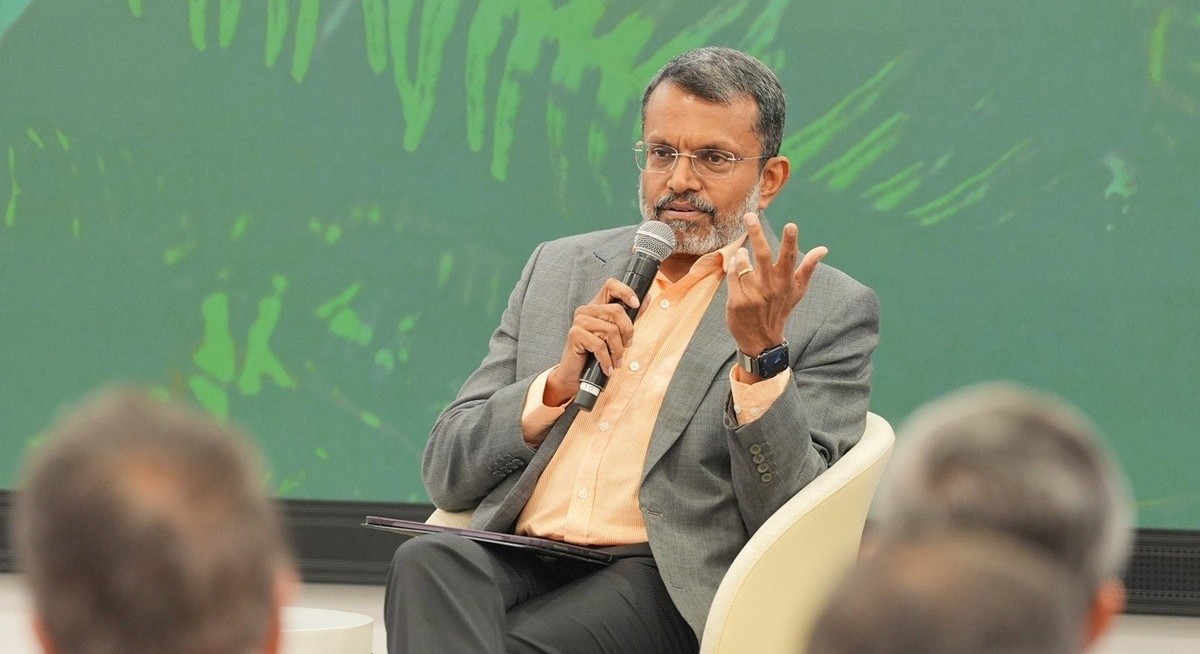


Noting that existing climate transition collaborations are mostly sector-based, Menon, who co-chairs C3T along with SBF CEO Kok Ping Soon, says that C3T is trying to “bring those conversations together” while simultaneously co-creating solutions to support implementation.
Menon elaborates, “We need to bring in various parties and sectors that need to talk to one another. One sector’s emissions are actually another sector’s scope, too, right? So they’re all interlinked.”
Planet Earth does not wait
On the urgency of climate transition, Menon says climate change is not coming to a halt anytime soon and urges companies in Singapore to integrate climate mitigation and adaptation measures into their business operations.
See also: UK apartment owners are getting locked out of money-saving green tech
Menon says, “I think we need to be mindful that even as we are facing challenges on multiple fronts, the planet is not waiting for us to solve our problems. The planet is continuing to heat up. Global temperatures continue to rise. Greenhouse gas emissions are continuing to rise. They are now 50% higher today than pre-industrial revolution.”
For Menon, who served as managing director of the Monetary Authority of Singapore from 2011 to 2023 before his current appointment, the present geopolitical situation underscores the need for businesses to act on the climate transition. “We used to think of energy security and environmental sustainability as two distinct objectives and sometimes contradicting one another,” he says to the audience, which included The Edge Singapore. “But I think what we are seeing now is that increasingly, they’re mutually reinforcing objectives that energy security is environmental sustainability.”
Menon adds that the ongoing crisis is a reminder of the inherent vulnerabilities in the global oil and gas system, specifically high concentration risk in oil and gas (O&G). He elaborates that a large share of O&G production is concentrated in a “small” number of regions and transported through a few choke points, as is the case in the Strait of Hormuz.
Energy security and diversification
Acknowledging the energy crisis that prompted the International Energy Agency to release a record 400 million barrels of emergency oil stocks, Menon recognises that “we have to do all that’s necessary to keep businesses thriving” but also warns of drawbacks, especially the risk of turning to another fossil fuel — coal.
“First, you can burn more coal, cheap, plentiful, no concentration risks,” he explains. “But think hard, if you invest in a coal plant now that’s going to run for 40 years, or if you’re a company drawing electricity from a coal plant for the next few decades, you’re locking yourself into something very risky, because carbon prices will rise and pollution levels are going to get so bad.”
Menon believes that longer-term measures such as renewable energy and energy efficiency are critical to the climate transition. “If you take a medium to long-term view, I think the switch to renewables and improving energy efficiency makes a lot more economic sense, because the other responses are just setting yourself up for problems in the future.”
The early bird catches the worm
Urging firms to start planning for the climate transition, Menon provides business reasons to do so. He says, “The other point I’d like to make is that early movers will get a disproportionate advantage. We’ve seen this in every major economic transformation. Companies that delay options for short-term benefits will eventually face rising costs.”
He suggests that businesses that are slow in the transition may incur higher costs in the future, adding that companies will face “tightening” constraints and have to play catch-up under pressure. “So there is a clear competitive advantage in investing [in climate transition planning],” he says. “In a world of uncertainty, the companies that succeed will be those who manage the present well, but also prepare for the future.”
To stay ahead of Singapore and the region’s corporate and economic trends, click here for Latest Section
To illustrate his point about sustainability as a competitiveness strategy, Menon cites how certain countries, such as Spain, are doing relatively well in the current crisis. He says, “Spain is experiencing the lowest gasoline prices across Europe today, not entirely insulated because of the global market, but because of the investments in solar in the last few years. Companies and countries that prepare in advance and make changes are better placed. And this time, energy security and environmental sustainability are coming together.”
Reinforcing his point about how sustainability is impacting business costs and strategy, he cites the expansion of carbon pricing, from 10% of global emissions being subject to it 10 years ago to 55% today. He refutes reports of policy rollbacks, noting that carbon pricing is expanding across Asia, including Japan, Korea and Malaysia.
“So in many ways, climate risk is business risk. It is a core competitiveness strategy. It is not just about ESG, so I think the case is as strong as ever for persisting and transitioning,” says Menon
Sharing his thoughts on which businesses to start in the climate transition, Menon says firms may begin with “small steps,” such as identifying risks, exposures and opportunities. He adds that measurements should be taken early, before transition plans are developed.
Data, plug and play
Menon identifies data as critical for the climate transition. “There is both a paucity of data and there is an abundance of data,” he says, recognising that it is challenging for many corporates to make sense of and use the information they possess for the climate transition.
“We’ve got to think imaginatively about how we can create platforms or structures or infrastructures where you can plug and play,” explains Menon. “So we need to bridge this gap in terms of what the data and information that needs to be made available within the business community, and what is macro, the macro data that is available in government, and find ways to integrate the tool.”
By making it easier for businesses to interpret data, they are better able to use the information to plan, according to Menon. “And if you can then harness this data together with things like the emissions factor industry, things like the Singapore-Asia taxonomy, those are macro planning tools that you can then use, measure your footprint, know your exposures, know the financial downsides of those exposures, and what the options are.”
Linking climate transition to enterprise value
Another area of focus for C3T is to help connect transition actions that companies take to enterprise value. Recognising that certain investments, such as technology, may only offer payback in the longer term rather than the immediate term, which would be a weaker motivation for taking action, Menon identifies procurement and financing as two areas that could spur immediate action.
“How much can procurement be an incentive to prompt effective transition measures? And of course, the government has a green procurement framework and infrastructure that is coming onstream soon. We can, to the extent possible, align various procurement practices in the country that make them easily understood, easily deployed, and then send a signal or incentive for companies to undertake transition measures, because they will get an enterprise value.”
On financing, Menon notes that many banks offer green financing schemes and mechanisms, but recognises that the information needs to be more accessible and easier to understand. “If every bank has its own unique, very different refinancing schemes, so to the extent possible, not a single standard, but at least an interoperable mechanism, then I think we can start moving,” he shares.
Stagflation risk
“There’s a war going on, there’s an energy crisis and uncertainties on multiple fronts with a real risk of stagflation,” says Menon. When asked by The Edge Singapore on the risk of stagflation and its impact on businesses in the climate transition, Menon says that it is an obvious risk shared by Prime Minister Lawrence Wong and Singapore has to prepare for it in the immediate term but not without neglecting long-term planning, reinforcing his earlier point about managing the present and preparing for the future.
“My main point is that dealing with the challenges of today does not detract us from preparing for the needs of tomorrow,” he says. “And the needs of tomorrow are going to be dictated by several things — technology is one of them; climate is one of the big ones; and so even as we deal with the current challenges and manage them, I think it’s very important that businesses keep an eye to the future and start preparing for that future.”
Rounding off his thoughts, Menon offers an alternative perspective on the climate transition. “It’s not about compliance. It’s a competitiveness issue and it’s not about transitioning alone. It’s about transitioning together.”




