


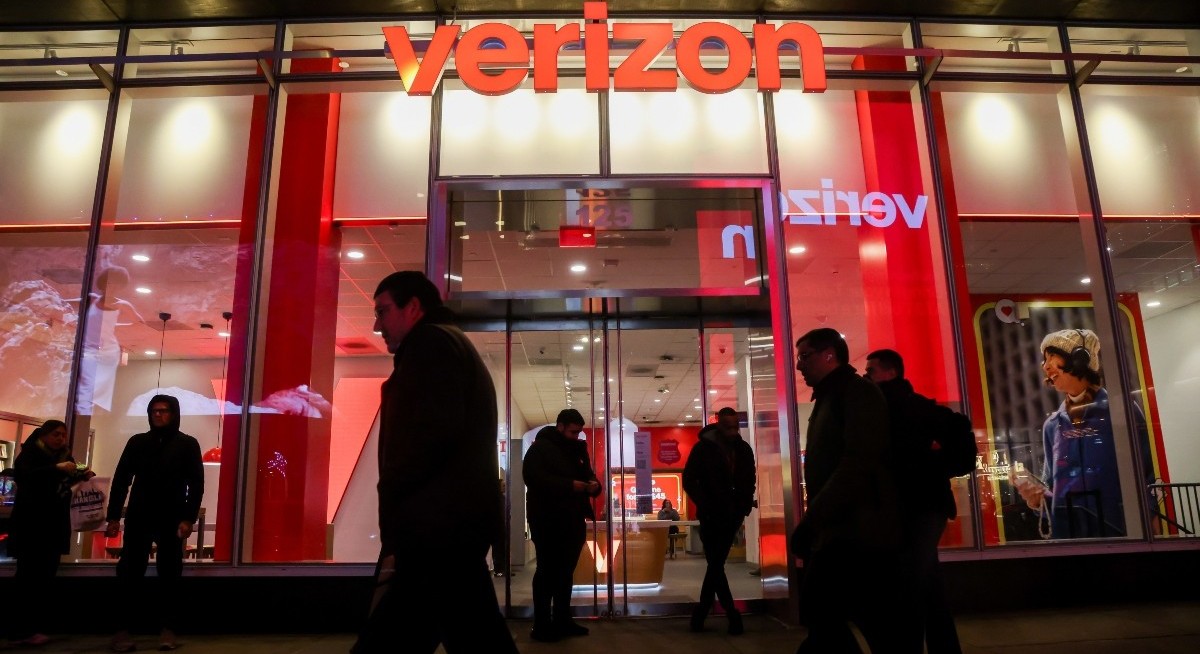


Verizon is a New York-listed telecommunications company with a US$200 billion ($255 billion) market cap that operates both consumer- and business-focused segments. The consumer segment accounts for over three-quarters of overall revenue and provides wireless and wireline communications services and products, including broadband and fibre-optic services. The business segment covers products and services such as corporate networking solutions, security and managed services, fixed wireless access for businesses, public-sector customers, and wireless and wireline carriers, mainly in the US.
The case for Verizon is that it is a good dividend stock to purchase. Although headwinds and tailwinds for the company offset one another, the primary focus is on whether the business can pay attractive, consistent dividends. Given the current US risk-free rate of 4.18%, Verizon’s trailing and forward dividend yields of 5.81% and 6.01% are attractive to dividend-based investors. The strategy investors can follow is to sell if Verizon’s share price continues to rise and the dividend yield falls below the risk-free rate. Conversely, if Verizon’s share price falls and the dividend yields improve, they can accumulate the stock to benefit from the volatility.
Chart 1 shows Verizon’s historical dividend yield over a 10-year period, paid consistently every quarter. The company has maintained a relatively high average dividend yield of 5.25% throughout this period. Also, the range of dividend yields has been narrower, reflecting that dividend payouts are more predictable and less one-off. The lowest dividend yield over these 10 years was 3.90%, which is very healthy, while the highest was 8.55%. To additionally support this, the disparity between price-only returns and dividend-reinvested returns is substantial for Verizon over the same 10-year period. Firstly, the price-only return is negative 7.59%, while the dividend-reinvested return is positive 56.77%. Dividends sometimes play a significant role in determining investor returns: over five years, the price-only return is negative 14.86%, while the dividend-reinvested return is positive 15.76%.

See also: Large caps lead active value realisation in February
Financially, Verizon has performed well over a 10-year period, as reflected in its consistent revenue, net income, operating cash flow, and free cash flow. This is illustrated in Chart 2 and is a key reason the company can continue to pay attractive dividends. The forecasts are also good and within expectations for the next two financial years. If a company generates consistent cash flow, it can pay attractive dividends. The company’s competitive advantage over peers, as reflected in its margins, has also been consistent over the same period. Currently, Verizon’s gross margin, operating margin, and net margin stand at 58.9%, 21.2% and 12.4%, respectively. 10 years ago, these figures were 60.7%, 15.4% and 21.7% respectively.

In terms of financial safety, Verizon’s current health is okay, but not great. However, the company has significantly improved its financial health over the past 10 years, which should, again, strengthen its ability to pay dividends without resorting to high-risk alternatives such as borrowing. 10 years ago, the company’s liquidity, represented by its current ratio, was 0.64 times. Now, it is at 0.91, although still below the benchmark of 1. The company’s solvency, measured by its net debt-to-equity ratio, was a whopping 588% 10 years ago, and it has since fallen to 154%, which, although still above 100%, shows tremendous improvement. Lastly, Verizon‘s interest coverage ratio is healthy at 4.4 times, well above the benchmark of two times.
See also: An ‘Irrational’ Year of the Fire Horse and ‘DBS at $80’
Verizon trades cheaply compared to regional peers, with 29%, 14%, 28% and 9% discounts to its forward P/E, forward EV/Ebitda, forward EV/Ebit and forward P/B ratios, respectively. This indicates that the company is a more lucrative pick than its peers in the same industry, based on yields.
Sentiment-wise, analysts have 12 “buy” calls, 18 “hold” calls, and 2 “sell” calls on Verizon, with an average target price about 5% above its current trading price of US$47.10 over the next 12 months. Based on a methodology that uses multiple valuation methods (see Charts 3a and 3b), the company’s fair value, including dividend reinvestments, is US$54.45, which is over 15% above its current trading price. Singapore investors seeking to purchase this stock can do so without much hassle through their international trading account, as the company is listed on the New York Stock Exchange.




