


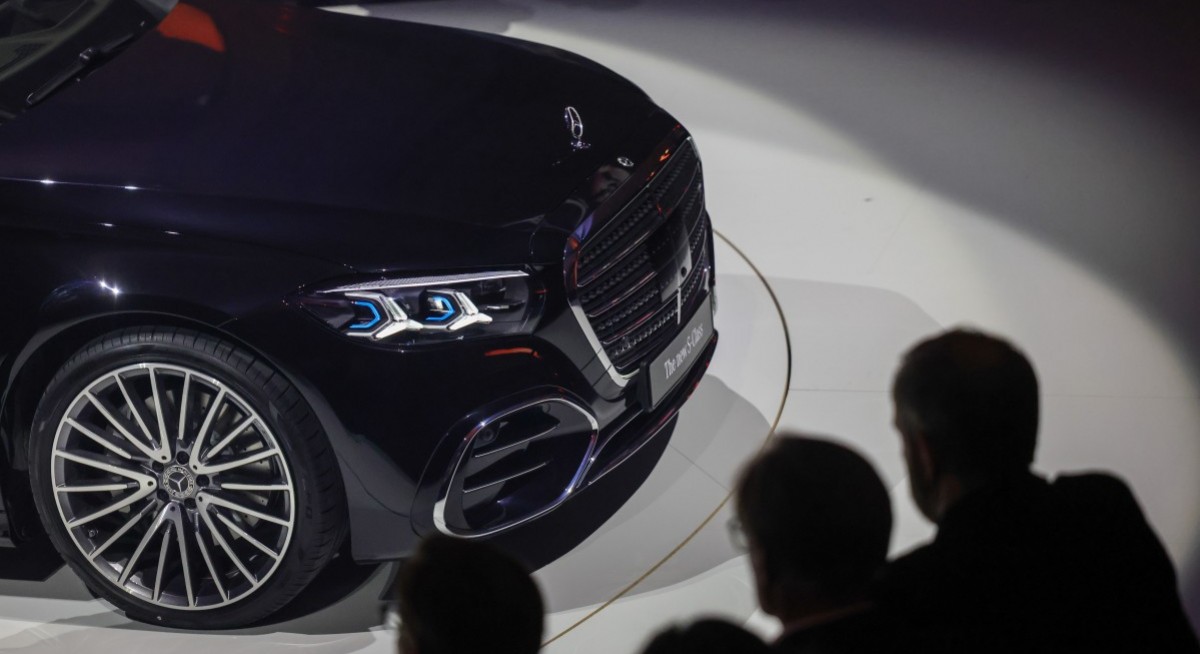


Mercedes-Benz, formerly known as Daimler, is a German Xetra-listed global automotive company with a market capitalisation of EUR57 billion ($86 billion). The company operates three main segments, which are cars, vans, and mobility, which collectively make up the Mercedes-Benz Group. The cars segment contributes the most to the group’s revenue, accounting for over 70%, and includes entry-level, core, top-end, and electric vehicles. The vans segment accounts for over 10% of total revenue and includes commercial, private, and EV vans. The mobility segment accounts for the remaining revenue and includes financial services such as leasing and insurance, as well as sales support and mobility solutions.
The case for investing in Mercedes-Benz is that it is a strong dividend play, with the company making a strong effort to grow its business profitably. This, in turn, should increase shareholder value through improved cash flow, which can be used to pay attractive dividends. Given the current German risk-free rate of 2.84%, Mercedes-Benz’s trailing and forward dividend yields of 7.32% are very attractive to an investor focused on dividends. One strategy for the dividend-based investor is to accumulate shares in the company if its share price drops. Conversely, if the company’s share price appreciates to the point where the dividend yield is no longer attractive relative to the risk-free rate, the investor should consider selling or reducing their position in the stock. Specifically for Mercedes-Benz, given the recently announced share buyback plan, dividend-based investors should account for this type of shareholder return in their dividend strategy, as accumulating shares in the company could also be a profitable option.

Chart 1 shows Mercedes-Benz’s historical dividend yield over the past 10 years, paid annually. Despite the Covid-related slowdown, the company still paid dividends during 2021 to 2022, although the dividend yield was substantially lower. The lowest dividend yield was 1.41% in March 2021, while the highest was 17.7% just over a year earlier. The average dividend yield over this period, including the brief low-yield period, remains a substantial 6.69%. This figure remains below the three-year average of 8.19% in more recent periods, and given the forecasts, dividends are expected to be maintained, resulting in attractive dividend yields.
See also: Large caps lead active value realisation in February
Additionally, the disparity between price-only returns and dividend-reinvested returns is substantial for Mercedes-Benz over the same 10-year period, indicating that dividends are what make this company a worthwhile investment. The price-only return is –14.66%, while the dividend-reinvested return is over seven times that at 103.17%. Over a shorter five-year period, the price-only return is a measly 4.90% while the dividend-reinvested return is a strong 45.59%.
Financially, Mercedes-Benz has performed consistently since becoming cash-flow negative in 2017. Overall, since 2018, the company has had positive net income, operating cash flow, and free cash flow, and is forecast to continue this performance over the next two years. With consistent cash flow, Mercedes-Benz can afford to pay its attractive dividends more reliably. The profitability ratios are decent, with a return on equity of 11.1%, while the company’s margins have been maintained over the past 10 years. Currently, the gross margin, operating margin and net income margin are at 19.6%, 8.6%, and 7.0%, respectively.
The company’s financial safety is excellent. Mercedes-Benz’s liquidity, measured by its current ratio, is well above the 1 time benchmark at 1.32 times. In terms of solvency, the company is net cash, so debt is unlikely to compromise the company’s ability to pay consistent dividends. Also, the company’s interest coverage ratio is over 60%, further supporting the view that debt will unlikely be a concern in the short and long term and reinforcing the company’s ability to direct its cash flow towards dividend payments.
See also: An ‘Irrational’ Year of the Fire Horse and ‘DBS at $80’
In terms of relative global peer valuation, Mercedes-Benz trades at a deep 18%, 70%, 83% and 33% discount to its forward P/E, forward EV/Ebitda, forward EV/Revenue, and forward P/B ratios, respectively. Regionally, it also trades at discounts across all forward metrics: 24%, 63%, 91%, and 4%, respectively. This indicates that, from a yield perspective, the company is a strong pick compared to regional and global peers.
Sentiment-wise, there are 12 “buy” calls, 14 “hold” calls and five “sell” calls for Mercedes-Benz from analysts, with an average target price of slightly less than 10% above its current trading price of EUR58.99 over the next 12 months. Based on a methodology that uses multiple valuation methods (see Charts 3a and 3b), the company’s fair value, including dividend reinvestments, is EUR64.92, about 10% above its current trading price. Singapore investors seeking to purchase this stock may need to find brokers that offer trading in European markets, as the company is a German stock listed on the Xetra exchange.




