




AvePoint’s financials for 3QFY2025 ended Sept 31, 2025, reflected this dynamic. Software-as-a-Service (SaaS) revenue rose 38% y-o-y to US$84 million ($107 million), despite a slowdown in broader technology spending. Net income increased 345% to US$13 million, and operating margins reached a record 22%. These results indicate that AvePoint is benefiting more from enterprise demand than from investor enthusiasm for AI.
However, the stock has not escaped the sector-wide sell-off. Despite exceeding third-quarter expectations, AvePoint’s shares have traded well below their $19.50 debut since listing on the SGX in September 2025 and well below the $28 target price accorded by DBS Group Research last November.
That disconnect between improving fundamentals and a weaker share price brings the company’s growth drivers into focus.
One growth area is Microsoft Copilot readiness. Gartner reports that only 6% of enterprises have scaled Microsoft Copilot beyond pilot, and 40% have delayed deployments due to concerns about data oversharing. Nearly half of IT leaders also lack confidence in managing Copilot’s security risks. With Microsoft reporting over 450 million Microsoft 365 commercial paid seats in its latest earnings and industry analysts estimating Copilot penetration at roughly 3%, the addressable market remains largely untapped.
See also: Large caps lead active value realisation in February
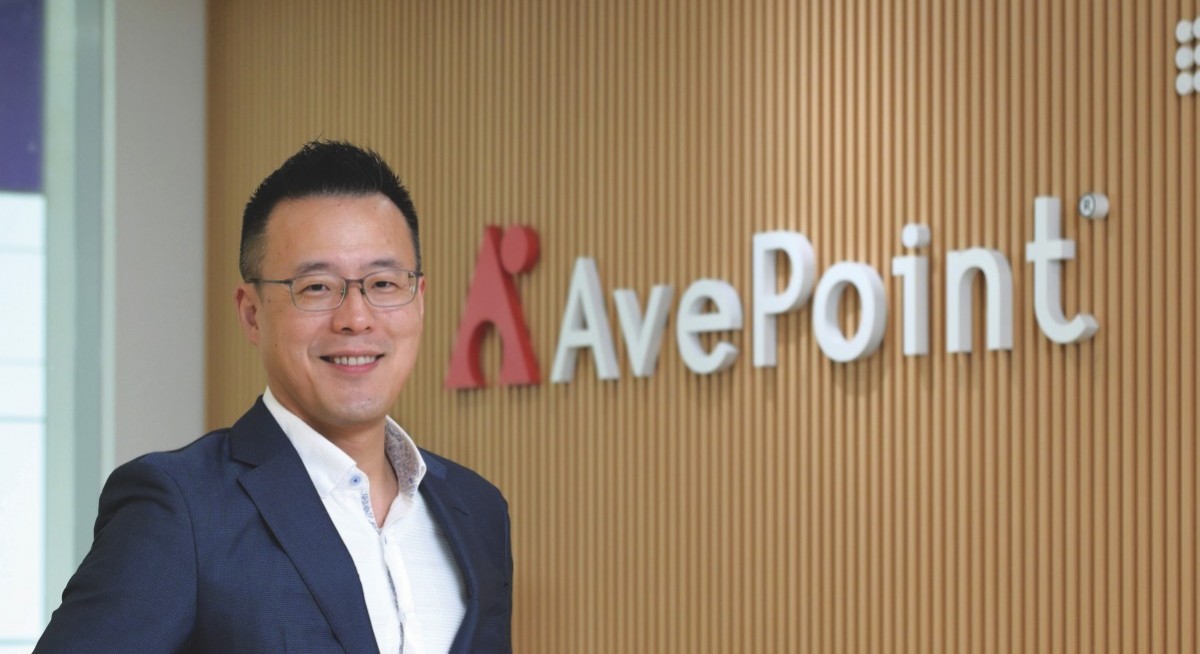
A second growth driver is the regulated industries sector, where governance and compliance are increasingly crucial in AI deployments. AvePoint has contributed to Singapore’s Cosmic platform, launched by the Monetary Authority of Singapore in collaboration with six banks, to enable secure information sharing on suspected money laundering and terrorism financing. Now in its second phase, the platform has attracted interest from other governments, according to AvePoint’s CEO and co-founder Jiang Tianyi.
Multi-cloud governance represents a further opportunity. Gartner estimates that 90% of organisations will adopt hybrid cloud architectures by 2027. Hyperscalers have little incentive to provide deep visibility across competing platforms, as they focus on retaining customers within their own ecosystems. AvePoint’s Confidence Platform spans Microsoft, Google, Salesforce and other cloud environments, including Okta and DocuSign, positioning it to address governance gaps across multiple cloud environments.
AvePoint is also preparing for the next phase of AI complexity: autonomous AI agents. In November, the company launched its AgentPulse Command Center, which provides visibility into the most active AI agents, their users, and the sensitive data they can access. This launch aligns with Gartner’s forecast that over 40% of agentic AI projects will be cancelled by 2027, mainly due to inadequate governance and risk controls.
See also: An ‘Irrational’ Year of the Fire Horse and ‘DBS at $80’
Operating metrics reinforce the growth narrative. AvePoint’s Rule-of-40 score (which combines revenue growth and profitability) has risen to 46, surpassing the 40% benchmark for leading SaaS businesses. Channel partners contribute 56% of annual recurring revenue (ARR), and 762 enterprise customers now generate over US$100,000 in ARR, up 21% y-o-y.
Even so, execution strength does not eliminate broader market and competitive risks. Microsoft could choose to build rather than partner, while technology sentiment may continue to weigh on AI-linked valuations. However, with a strong balance sheet, improving operating metrics, and exposure to governance demand that remains underdeveloped, AvePoint’s fundamentals appear to be outpacing its share price.




