


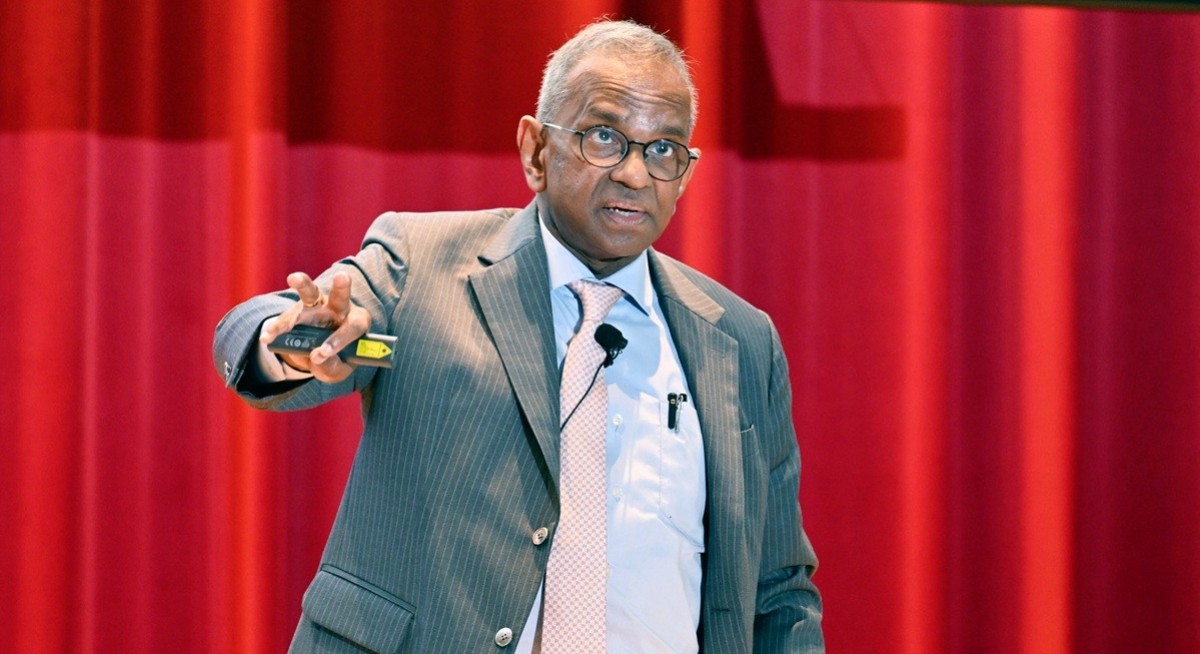


In Investing with Greater Clarity in a Fragmented World, an OCBC Securities Investment Forum organised by The Edge Singapore and sponsored by OCBC Securities, Manu Bhaskaran, CEO, Centennial Asia Advisors, kicked off the forum with a presentation titled Geopolitics and Megatrends: A New Asset Pricing Regime.
It wasn’t so long ago that wealth flows and digitalisation were megatrends CEOs had to contend with. But the global order, in place for 80 years and which has benefited Singapore and the region, is over. US President Donald Trump’s geopolitical disruption by design has led to a more fragmented backdrop. At the same time, his protectionist trade policies and scepticism of multilateral institutions accelerate the decline of globalisation and cooperation.
Geopolitics will have a direct effect on markets because the various implications of the Iran crisis, the contestation between the US and China, and its implications for governments’ fiscal position will feed back into the bond market, causing many ructions, notes Bhaskaran.
In the US, the 10-year Treasury yield topped 4.6%, while the 30-year Treasury yield rose to a 10-year high. The 10-year Treasury yield is the risk-free rate from which assets are priced in many valuation models. The higher the risk-free rate, the more challenged equity valuations are likely to be.
Increasing unpredictability
“We also have a trade war, and in it we have two shocks: one is what Mr Trump is doing with tariffs, which is bad enough, but on the other hand, you’ve also got this extraordinary surge in Chinese competitiveness, which is leading to exports growing, trade deficits growing in other countries, and there’s a backlash to that as well,” says Bhaskaran.
With technological advances, the pace of innovation in renewable energy, materials science and biopharmaceuticals continues to gain momentum.
See also: More Singapore residents target more than $1 mil and retirement in their 40s: CIMB-NTU study
Meanwhile, technology leadership is shifting. “China is emerging as a great innovation powerhouse, and that also has tremendous effects,” he adds.
Geopolitical risks are also intensifying. Trump has walked into a war with Iran that nobody really wants, least of all himself, because it risks complicating the midterm elections in the US. Oil prices have risen, while the chokepoint in the Strait of Hormuz has pushed up the cost of products such as helium, urea, fertiliser and lithium. During a recent Singapore Airlines briefing, management was asked whether a jet fuel shortage is on the horizon. So far, jet fuel is still available, albeit at a cost.
“If there are shortages of fertiliser, then food shortages will emerge, food prices will go up, inflation will go up,” says Bhaskaran. He is hoping calm returns so that shipping through the Strait of Hormuz resumes, oil and gas supplies improve, and oil prices fall. Even then, oil prices are likely to remain elevated at least for the rest of the year.
See also: Global fragmentation drives flows to Asean
In Bhaskaran’s view, the bigger issue is really the competition between the US and China. The contestation is going to continue in trade, in the military, in diplomacy, in technology. The world reacts by de-risking. Trade alliances are being diversified to reduce dependence on either China or the US.
On security, defence spending is likely to continue to rise. “You’re going to see new alliances, all kinds of bilateral deals that avoid dealing with the US or China. These are big changes. In this kind of contestation, I think you’ll see China come back with a new version of the Belt and Road, which could be very positive for this part of the world, because infrastructure spending can be boosted. Things that were not possible before could become possible. For instance, a land bridge across the Kra Isthmus,” says Bhaskaran. Defence spending is going to rise, so anyone who owns ST Engineering is probably feeling very happy, he jokes.
Imbalances and the trade war
Bhaskaran cites three big imbalances that are the root of the problem between the US and China. The US is over-consuming and not saving enough; China is under-consuming and saving too much, and Europe is somewhere in between. The problem is rooted in policies that drive savings, investment and consumption, and are very difficult to change, he says.
“Protectionism is rising. China is gaining competitiveness across the board, even in low-value items like textiles and garments. That is going to create problems for China’s friends in the Global South, such as Russia, Indonesia, Thailand, Turkey, Brazil and South Africa. They are imposing restrictions on Chinese exports because export growth is displacing local producers. That is going to lead to even more protectionism.”
Technological acceleration, including liquidity flowing into AI, is likely to accelerate AI adaptation and adoption.
Meanwhile, AI will drive the discovery of new compounds that can be used to create new drugs, new therapies and new crystals for composite materials that will enable, for instance, aircraft to fly much longer distances with much less fuel.
AI is encouraging significant new investment and a new capital-spending cycle, but it is also absorbing substantial liquidity in the markets. High oil prices will likely accelerate the energy transition.
“In the next few weeks, we are going to see big challenges for the markets, because SpaceX is coming out with an unbelievable valuation. Other hyperscalers are going to be raising capital that’s going to suck liquidity out of the system,” adds Bhaskaran.
Globalisation and lower interest rates are in the past. In their place, we have rising interest rates, fragmentation and de-globalisation. “The bottom line is that there’s going to be a lot more volatility in markets, and investors will have to be cautious. There are great opportunities, but there will be periods of corrections. We may be coming to a period where the risk of a correction is going to be quite high.”




