


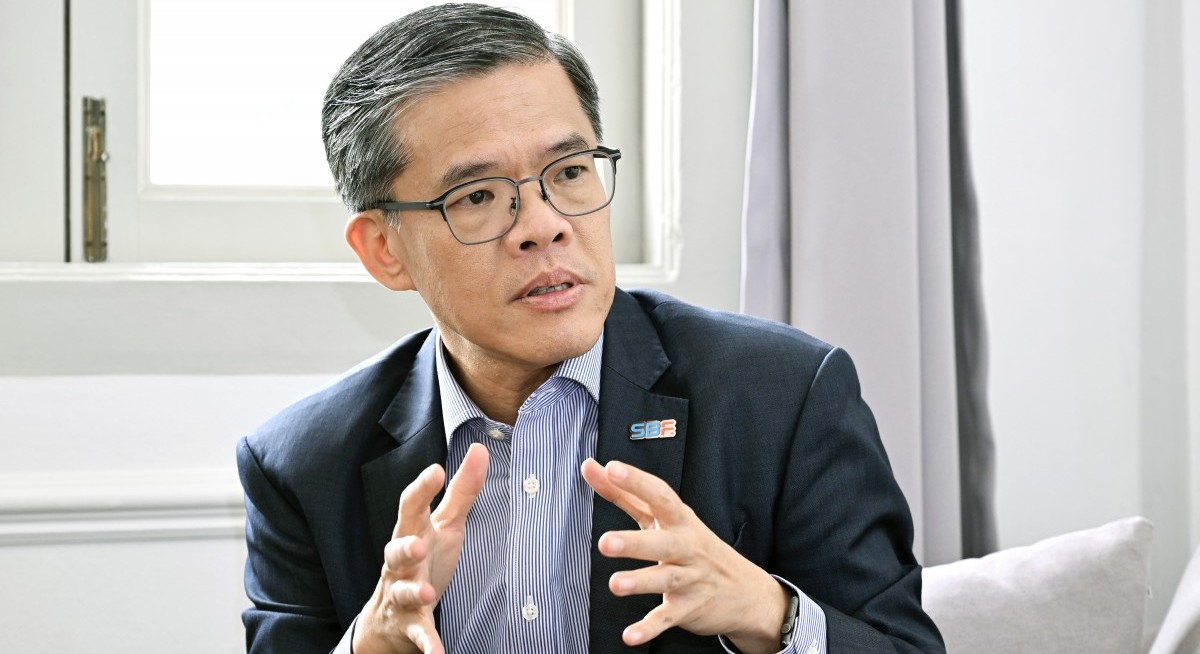


Kok began his career at the Economic Development Board, the nation’s leading investment promotion agency. He later held several leadership roles at the Singapore Tourism Board, the Ministry of Trade and Industry, the National Security Co-ordination Secretariat in the Prime Minister’s Office and the Ministry of Manpower. Before joining SBF, Kok served as the CEO of the Government Technology Agency (GovTech).
“If there’s one constant throughout my public sector career and now is that technology is a key driver across different phases of Singapore’s economic development,” Kok tells The Edge Singapore while citing his experience working in the US at the height of the dot-com bubble in the late 1990s.
“Later, when I moved to the Ministry of Manpower, it was all about finding enough workers for companies. If we cannot find enough local workers, then we need to train them and make sure our companies have access to foreign manpower. That continues to be an important agenda now that I’m in SBF,” he adds.
Kok’s experience spanning economic development and labour policy makes him ideally placed to lead the country’s apex business chamber as AI and geopolitical shifts reshape the business world.
See also: Connecting genuine growth with employment

The SBF includes over 34,000 companies, along with trade associations and chambers. Any locally registered company with a paid-up or authorised share capital of $0.5 million or more qualifies for membership.
Don’t forget the SMEs
See also: Singapore households face record power bills as war impact hits
AI was a major focus of Prime Minister Lawrence Wong’s Budget 2026 speech. Wong says he will be chairing a new National AI Council that will oversee a set of “National AI Missions.” The missions will help drive AI implementation in sectors such as advanced manufacturing, connectivity, finance and healthcare.
“We like the idea of the AI missions. We like the fact that they are taking a sectoral approach with the designation of their formation,” says Kok. “But can we make sure that the diffusion and right of use of the technology permeates downwards to the SMEs? We see potential for SMEs to make better use of that to overcome the manpower challenges that they have.”
Singapore appears well-positioned to supercharge its economy with AI. A Salesforce study ranks it second globally, just behind the US, in AI readiness. However, the reality is more nuanced, notes Kok. “If you look at the individual level, I think AI adoption is already quite widespread. So that’s not an issue now. The issue is really about the deployment of AI in the enterprise setting,” he adds, noting that there’s a significant gap between the deployment of AI in large companies and SMEs.
According to the Infocomm Media Development Authority’s Singapore Digital Economy Report 2025, only 14.5% of SMEs adopted AI in 2024 versus 62.5% of larger businesses. Kok says the pace of adoption differs across sectors as well. For instance, sectors such as finance, advanced manufacturing and logistics are AI adoption leaders because their high-volume, repeatable workflows lend themselves very well to automation.
Sectors such as construction and F&B lag in AI adoption, as their work is less repeatable and they lack sufficient data to train AI systems. “So the question, of course, is, why is that the case? Based on what we hear from the ground and our own surveys, we think there are four key reasons why there’s a gap.”
The first is data readiness. Most SMEs do not have clean, structured or integrated data across their systems. That makes it very hard to deploy AI reliably at the enterprise level.
The second is integration and scaling: Kok says there is a huge difference between using AI at the individual level, where you mainly have to provide good prompts, versus using AI at the enterprise level, where you need it to work with your enterprise resource planning or customer relationship management systems.
To stay ahead of Singapore and the region’s corporate and economic trends, click here for Latest Section
Third, there is a skills gap. Enthusiastic employees may pilot AI, but implementing it across the company is harder alongside normal operations. Finally, risk and governance: while big companies can ensure data security, compliance and accountability, SMEs often lack the resources to do the same.
If left unaddressed, this gap could leave companies disillusioned with AI. There have already been concerns that the benefits of AI may have been exaggerated. In August 2025, MIT published a study of more than 300 publicly reported AI initiatives and found that 95% of organisations were not seeing any financial returns.
“You are getting very high adoption, but very low transformation,” Kok says of the study’s findings. “If you double click into that, the failure is not because the technology doesn’t work. It’s because the pilots are disconnected from real workflows. There’s weak data foundations, and very importantly, the organisation change element isn’t keeping pace with the introduction of technology.”
“I don’t think companies are disappointed yet because the journey is still beginning. But to avoid future disappointment, we are suggesting that they ask themselves, is your data ready? Have you thought through what business problem you want to solve and so on?”
But money alone won’t be enough to solve these problems. “The government has already lowered the cost of adoption,” says Kok. “The problem is the existing capabilities of the team and whether they have the right data structures.”
Businesses should start by thinking in terms of problems, not tools. Once that mindset is set, they can turn their attention to execution. Kok says SBF is partnering with the National University of Singapore’s Institute of Systems Science (NUS-ISS) to train SMEs on how to implement AI effectively.
A shift in mindset is needed when it comes to raising capital, something Kok says many businesses struggle with. They may not be ready to go public, but that does not stop them from exploring other financing options to grow. A broader approach to enterprise financing in the local ecosystem, one that goes beyond relying on traditional assets as collateral, could significantly expand access to capital.
“In Hong Kong and the US, there are many ways you can finance things. There’s IP (intellectual property) financing, where your IP can be used for financing. Or if you are doing shipments, then your accounts receivable can be used for financing,” adds Kok.
Another lever would be to uplift the financial literacy of SMEs and teach them how to package their businesses attractively when pitching to financing companies. “It’s not about dressing the book. It is about making it a bit more friendly to financing companies,” Kok notes. “You will be surprised. Many may not be CFO-trained, so they need to understand that.”
Making AI work for Singapore
When it comes to driving AI adoption, Kok draws on his experience as CEO of GovTech from 2018 to 2023. His approach to training SMEs is shaped by how he introduced new technologies across government agencies.
“It’s not about sending the IT people for a course. It’s not about sending the operations people for a course. It’s about operations and tech coming together,” Kok says, adding that SBF’s partnership with NUS-ISS is focused on training cross-functional teams from SMEs instead of just focusing on their technical staff alone.
Often, it is not technical know-how but securing management buy-in that is critical to implementing new technologies like AI effectively. Kok says this holds in both the public and private sectors.
“We can deliver wonderful projects, but in the end, the adoption rate, even within government agencies, is quite slow because organisational change is difficult,” adds Kok. “So when we ran digital leadership courses, we brought in the permanent secretary, the deputy secretary and so on. That’s what I’m trying to do in SBF here.”
That’s not to say that there won’t be any teething problems as AI becomes a fixture in the workplace. New entrants to the workforce as well as mid-career professionals will be the most vulnerable in this transition period.
“For new entrants, a lot of the curriculum in schools might not have caught up with incorporating AI,” he adds. “What we are concerned about are some of the professions where some rote learning is needed. A kind of white-collar apprenticeship. Now, there’s less opportunity to do so.”
This applies to jobs like law, accounting or consulting, where the early years are often spent on research, creating presentations and crunching data. AI is set to upend that process, thanks to how quickly it can produce slides and spreadsheets.
“This is what we call a possible break in the career ladder. The career ladder has been broken because rote learning has been disintermediated because of AI,” adds Kok. “For fresh grads, there will be a challenge. The bosses will expect them to do things very quickly now because of AI. But are they spending enough time to understand how things are actually being done? They may not have, and so they all skip the steps. I don’t know whether that payback will come later on.”
That shift is why Kok and the SBF have been urging professional services companies, such as accounting firms, not to cut hiring despite AI. Keeping recruitment steady is still vital for firms that want to nurture their future leaders.
Mid-career professionals in their 40s face challenges with AI too. The key hurdle is understanding the technology well enough to create their own agents and tools. Kok says the skills gap is slowly closing, now that coding is no longer a requirement to work with AI.
Kok says: “The question is, how can we retrain that group of senior leaders, the supervisors, and all that to be able to make better use of the tools so as to increase their career longevity?”
According to the Ministry of Education’s latest graduate employment survey published on March 5, the percentage of graduates securing full-time positions in 2025 has fallen to 74.4%, down from 79.4% in 2024.
Kok admits that while hiring has indeed slowed down, it is driven by the macro-environment and geopolitical uncertainty rather than AI. Although companies may not have to expand their headcount as rapidly because of AI, that could end up being a plus for population-scarce Singapore.
“Today, you hear that some of the MNCs’ regional headquarters are not hiring so many people. It’s not a bad idea. It’s simple math. If you have 10 companies, with each one hiring 1,000 people, then that’s all you have. But imagine if each company doesn’t need 1,000 people. They need only 100,” he adds.
“Then I could have more companies in Singapore setting up regional headquarters in Singapore because their manpower footprint is smaller since AI has made their marketing team and finance team more efficient. That’s a win for us. We actually get more companies, and with more companies, there’s greater vibrancy and diversity in the economy.”
AI is not just about raising productivity. It can help address the country’s perennial problem of having a small and limited workforce, says Kok. The city-state has been grappling with a declining birth rate for years. In 2025, the country’s total fertility rate (TFR) fell to a new low of 0.87. The country’s TFR has fallen below 1.0 since 2023.
The alarming numbers have prompted government action. Measures such as generous baby bonuses and pro-immigration policies have been introduced, and more recently, Minister in the Prime Minister’s Office Indranee Rajah was appointed to lead a new work group on marriage and parenthood issues.
“We think there’s a great opportunity for Singapore to exploit humanoid development much faster,” says Kok. “The deployment of these robots in factories could really help address our shortage of workers. We may not need to bring so many foreign workers if all these jobs can indeed be done by robots.”
Tariffs and war
It has been just over a year since Donald Trump took office, and his administration has moved swiftly to upend the global order. From imposing tariffs on trading partners to engaging in outright conflict, businesses must now factor geopolitical risk into their planning if they hope to thrive in this environment.
“Business confidence is in a very fragile state. Our message to companies is that uncertainty is now structural and it’s not episodic. Whether they have built in that capacity is still a question mark,” says Kok.
Scale remains a key challenge for companies managing geopolitical risk, much like AI. Larger firms have deeper resources and a greater capacity to absorb shocks than SMEs. Even so, some disruptions, such as tariffs, pose a challenge for businesses of all sizes.
“The main concern for companies is not so much the rate,” Kok says. “Whatever rate you tell me, I can factor it in and pass it to the consumer. But if the rate is one rate today and then another rate on another day, the uncertainty of the rate is a bigger problem than the rate itself.”
To address this, companies are strengthening their businesses by seeking alternative markets in which to produce and sell their goods and services. “Resilience comes in different forms, and one way of resilience is diversification.”
The Office of the US Trade Representative announced on March 12 that it is investigating 60 economies, including Singapore, under Section 301 of the Trade Act of 1974. The review targets policies and practices linked to imports produced with forced labour. The US is also examining Singapore for alleged structural overcapacity and output in certain manufacturing sectors.
These investigations were started shortly after the US Supreme Court struck down the “Liberation Day” tariffs imposed by Trump in April 2025. Kok believes it’s no coincidence that the investigations are being started now.
“I think the whole attempt by the administration to launch so many of these Section 301 reviews is a way for them to legally reconstruct the tariff war that has been struck down as unlawful by the Supreme Court,” adds Kok.
What’s been troubling Kok these days is the ongoing war in Iran, which has sent oil prices skyrocketing to nearly US$115 ($146.60) a barrel.
A major driver of the surge in oil prices has been the closure of the Strait of Hormuz by Iranian forces. Around 20% of the world’s oil and gas supply passes through the Strait, and any prolonged disruption could ripple across other commodities, including fertilisers and plastics.
“Margins are getting very tight. Cash flow is also getting very tight. So we are watching it very carefully to see whether, from a financing point of view, we need to inject or provide more working capital because inventory time has lengthened,” says Kok.
Still, it is not all bad news. Kok believes that the city-state’s predictable and boring nature may help her command a greater premium in the turbulent world we find ourselves in today.
“We are a safe harbour for many businesses, and because we are not that big, we don’t need a lot to make us full. In fact, if we get too many, our economy may get overheated,” says Kok. “So actually for us, there is an opportunity to be more selective of the type of businesses we bring into Singapore.”
“We just need to make sure that our premium doesn’t run ahead of our ability to deliver productivity, otherwise we will be uncompetitive.”




