


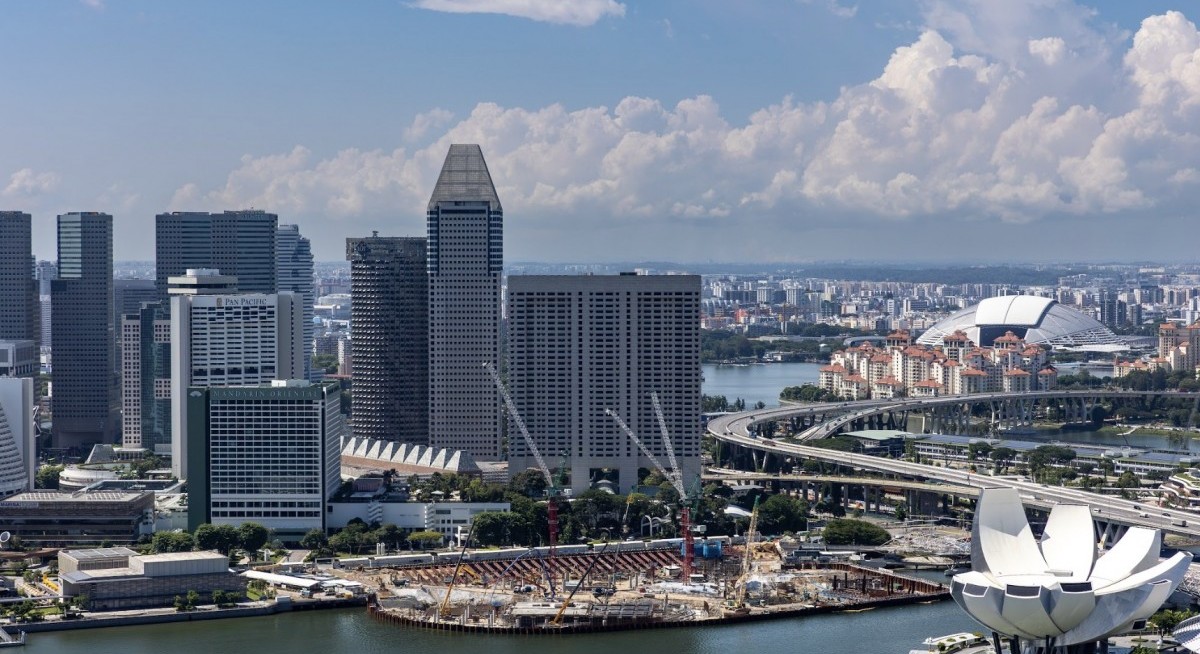


UOL Group’s most exciting project is likely to be subsidiary Singapore Land Group’s (SingLand) plans for the Marina Square complex, where three new components will be rising from the current site.
“It is a very complex project that took us years in getting to where we are. Marina Square is a very strategic location in the heart of the CBD, with great waterfront views. Wth nine hectares right smack in the city, it's got that great transformational contribution that can be availed to the city. This is actually a precinct that has got a lot of attention in terms of real estate, attraction, architecture and architect. It will be a hyper-mixed development, with three new additions,” Liam Wee Sin, group CEO, UOL emphasises.
When asked if UOL and Singland are concerned about an oversupply of hotels in the precinct, Liam says: “There is room to create a hyper-mix there that makes the place much richer, much more compelling as a destination, as to even [catapulting] it to world-class standing.”
Having a residential component at Marina Square is a departure from UOL’s modus operandi of bidding for residential sites near good schools and other amenities (such as Hougang Central). It’s a different offering, Liam suggests, a “hyper-mix”, he repeats.
Unlike some of UOL’s other projects such as Thomson View, Hougang Central and the almost fully sold Skye at Holand, it is going relatively solo on the Marina Square project, with just itself and its subsidiary SingLand.
Sustaining dividends with earnings growth
See also: CDL aims to divest UK development platform within 2026: CEO Sherman Kwek
UOL rewarded its shareholders with an ordinary dividend of 18 cents and a special dividend of seven cents based on its earnings in FY2025. In FY2025, UOL’s Patmi rose by 34% y-o-y to $481.7 million while operating Patmi rose by 49% to $468.7 million.
Group CFO Eric Ng says “we give our investors certainty in a recurring ordinary dividend”, and refers to the green bar in a slide during a results briefing on Feb 26. The green bar depicts an ordinary dividend of 18 cents.
The special dividend, depicted by a brown bar, is to reward shareholders for a strong operating performance in FY2025. "We want to grow the green bar and the brown bar," Ng points out.
See also: Streetscapes: Modernising Lentor
As a developer, Patmi is likely to be volatile depending on completions. However, with its 'buy, sell and hold' strategy, it regularly recycles investment properties as well as turning its capital through residential property development.
For instance, in FY2025, UOL divested Kinex, ParkRoyal Yangon and ParkRoyal Saigon, Vietnam. In addition, it had strong launch performances and higher progressive revenue recognition from ongoing projects. Hence the group is able to reward shareholders. In 2023, following the sale of ParkRoyal Kithchner, UOL announced a special dividend of five cents.
During the results briefing on Feb 26, analysts asked questions around UOL’s equity base, its relatively low gearing, and whether there is an inclination to raise ROE, given that its ROE is around 3%.
“For a developer like us, from a peer comparison point of view, we’re about there (in terms of ROE). A lot of the developers have a big equity base. We distribute about half of [Patmi], the other half of it, we will use to pursue investments that give us a good return. So as long as we continue doing it, we believe we can create value for shareholders and continue to improve on the dividend payout,” Ng explains.
Ng, who joined UOL from Keppel, pointed out that developers are likely to have a higher equity base than asset managers. “If you look into the breakdown of our cash holdings, a big part of it is in residential projects. We are regulated by the regulators to hold these monies until the completion of the project,” he says referring to the requirement to keep cash inflow from progressive payments in escrow accounts.
UOL also has funds from sales in China. In 2025, it invested in a 10% stake in The Puyuan in Shanghai. In Singapore, UOL deployed capital to the Thomson View Condominium site it clinched in a collective sale, in partnership with CapitaLand Development. The new project is likely to be launched in the second half of this year.
UOL also tied up with CapitaLand Development and CapitaLand Integrated Commercial Trust to acquire a site in Hougang Central.
To stay ahead of Singapore and the region’s corporate and economic trends, click here for Latest Section
During the results briefing, UOL was questioned about the potential of a REIT platform. The asset management companies have a different model, Ng indicates.
“They only have a small stake in the investments they are managing and their main business is earning management fee income from those assets that they manage. We are different. We’re a very good developer. You can see our residential and commercial projects. We are very clear about who we are. In terms of future securitisation platforms, these are always options that are available to management,” he elaborates.
How will UOL and SingLand pay for the extensive asset enhancement initiative at Marina Square, analysts asked.
Ng, the CFO, has done his sums. He reasons that since UOL has a $16.6 billion equity base, every $1.6 billion in debt adds around 10% to gearing. Assuming it costs around $3.2 billion to finance the project, the additional debt will move UOL’s gearing towards the 0.4x to 0.5x range.
As at Dec 31, 2025, UOL has around $4.5 billion of total debt, and $1.25 billion in cash. (Around $979 million of debt matures this year, hence the cash.) Excluding its cash, debt/equity would rise to around 0.44x.
“There's no need to borrow. Some of our Singapore peers [D/E] are at 70% 80% 90% in the earlier days or so before they managed to sell assets and pay down debt. So these are all market acceptable ranges,” Ng says.




