




“Mr Kum is a luminary in the maritime world, and his decision to further invest in our company is the strongest possible validation of our strategic direction, operational excellence, and the growth potential we are unlocking in both the offshore oil and gas and renewable energy sectors,” says MPM CEO Sean Lee.
Kum has over 40 years of involvement in the O&M space and is currently the non-executive chairman of Catalist-listed Atlantic Navigation Holdings. He founded Offshore Equipment in 1976, which later evolved into Miclyn Offshore and, subsequently, Miclyn Express Offshore, both of which are listed on the Australian Stock Exchange.
To analysts, the share investment is an endorsement by an “industry veteran”. For instance, UOB Kay Hian’s Heido Mo and John Cheong state in their Feb 24 report: “His [Kum’s] operating pedigree and sector track record enhance shareholder quality and signal confidence in MPM’s growth trajectory.”
For FY2025 ended Sept 30, 2025, MPM reported revenue of $122.8 million and adjusted net profit of $25.3 million. In contrast, for FY2021, when MPM earned a profit for the first time in six years, the firm’s revenue was $46.1 million with $3.0 million in adjusted net profit.
See also: Men with a vision
On a segmental basis, ship chartering delivered $80.2 million in revenue for FY2025, almost double that of the shipbuilding and repair segment’s $42.6 million. For comparison, revenue from ship chartering and shipbuilding and repair totalled $20.1 million and $26 million, respectively, in FY2021.
At a results briefing attended by The Edge Singapore, Lee shares that he sees the repairs and maintenance business undertaken by their Batam shipyard as “recurring” with good margins. “In terms of repairs and maintenance, we target merchant vessels because there are more,” he explains.
Lee adds that their focus expanded from offshore support vessels to include merchant vessels making port calls in Singapore, an entrepot. “We have more than 500 port calls that go through Singapore every day, so these are potential customers for us, and that’s the reason why, strategically, we are in a very good location [Batam].”
See also: Marco Polo Marine to spin off shipyards via $139 mil RTO deal with Fuji Offset Plates Manufacturing
The company also has reasons for optimism for shipbuilding. In November 2025, MPM secured its largest-ever shipbuilding contract of $198 million to design and construct a 4,000-GT oceanographic research vessel for Taiwan’s National Academy of Marine Research.
More importantly for MPM’s growth is the company’s diversification into offshore wind for the shipchartering segment. “Oil and gas is sexy [but] it can also be very scary,” says Lee. “Wind is at a nascent stage and although it may not give the kind of margin we get in oil, it is very stable.”
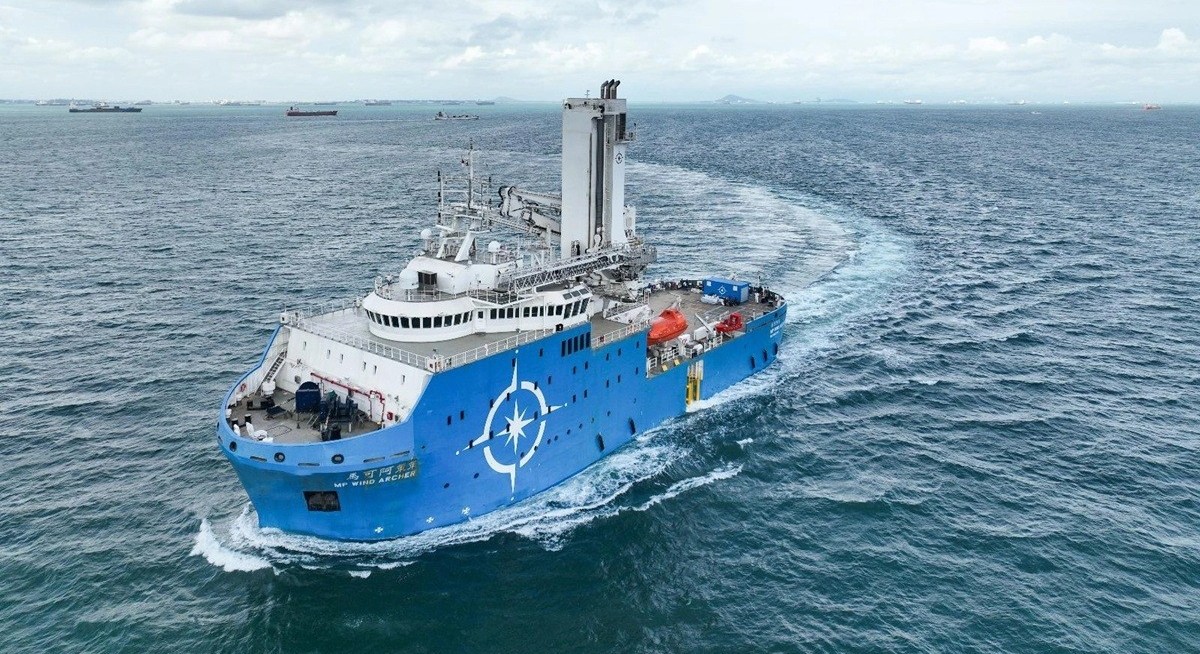
For 1QFY2026 ended Dec 31, 2025, MPM’s fleet utilisation was approximately 76%, up from 71% in 1QFY2025, reflecting sustained demand for its vessels. Revenue was $23.2 million, representing a y-o-y 53% increase from $15.2 million in the previous corresponding period. MPM attributed the stronger performance to fleet expansion, specifically, the deployment of its flagship commissioning service operation vessel, MP Wind Archer, alongside three additional crew transfer vessels.
Besides the growth in ship chartering, another potential catalyst for MPM’s share price is the potential listing of its 49%-owned subsidiary, PRK Offshore, in Taiwan, which supports the burgeoning Taiwanese offshore wind market. According to Lee, the IPO submission is scheduled for September.
In his initiation report issued on April 9, Maybank Research analyst Jarick Seet views MPM as a proxy for energy diversification amid the current Middle East conflict and energy crisis. He believes that as countries transition from fossil fuels to renewables, MPM, with its first-mover advantage, is well-positioned to capture rising demand for offshore wind projects in Asia from 2026 to 2030.
In addition, Seet expects more shipbuilding wins and believes MPM is entering a “rapid” growth phase from FY2026 to FY2030. He values the company at 20 cents per share, based on 20 times FY2026 forecasted P/E.
Since 2022, MPM shares have increased by more than 450%, from 2.8 cents to 16.3 cents as of April 14.




