


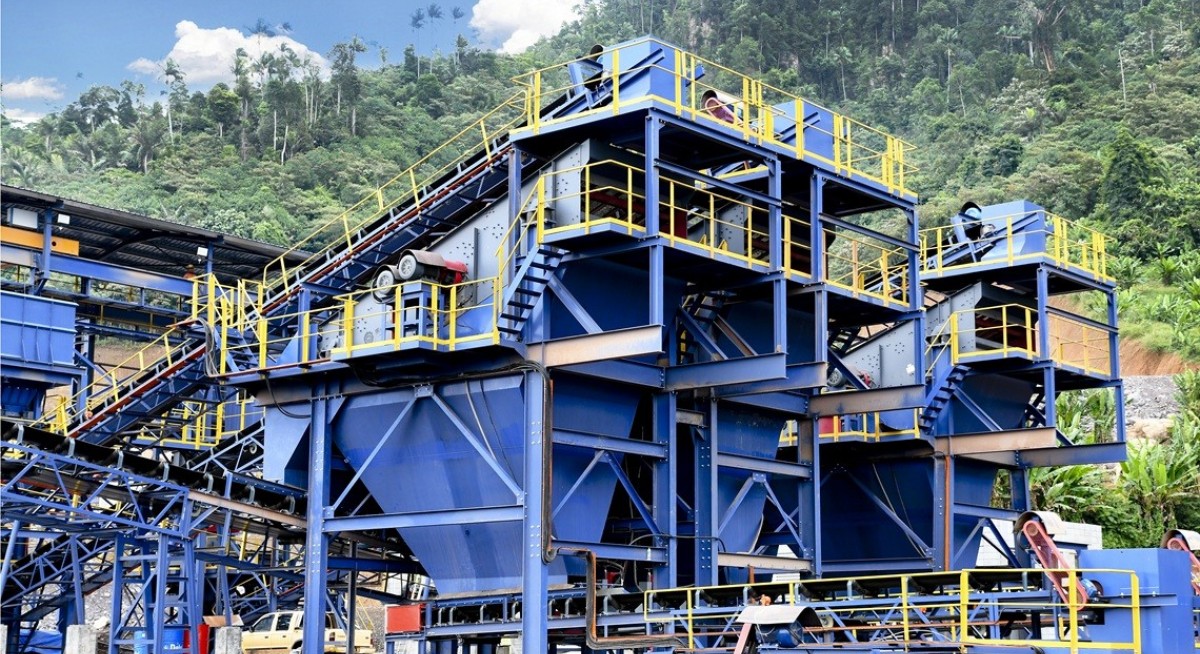


“There are around 22 companies listed worldwide that are involved in the rare earth industry,” says SAM group chief operating officer Lim Wei Hung at a results briefing attended by The Edge Singapore. His presentation shares that of these 22 firms, only three companies, namely Lynas Rare Earths, MP Materials and SAM (through MCRE), are actively extracting and processing minerals from mines and generating revenue at scale (see Figure 1).

Understanding REE
REEs are a set of 17 elements, comprising 15 metallic elements from the lanthanide series and scandium and yttrium (see Figure 2).
See also: Southern Alliance Mining taps Malaysian national agency expertise for gold mining
Relatively plentiful, REEs are labelled “rare” because economically viable concentrations are uncommon and they are seldom found in pure form. Due to their chemical similarities, it is challenging to separate them during extraction. However, in their isolated forms, each element possesses distinct physical and magnetic properties that are essential to various technologies.

According to the International Energy Agency (IEA), permanent magnets represent the “fastest-growing and most strategically important” applications and account for almost 95% of total rare earth consumption by value. The strongest permanent magnets in the industry are neodymium-iron-boron (NdFeB) magnets, which are primarily composed of neodymium, with praseodymium included. Dysprosium and terbium are often included in these magnets to further enhance performance.
See also: Geo Energy takes the high road to recurring income
In its Rare Earth Elements: Pathways to secure and diversified supply chains report, the IEA notes: “Despite their [REEs] comparatively small market size, their role is disproportionately important as they are essential inputs across modern economies, from energy infrastructure and automotive parts to advanced manufacturing, medical equipment, aerospace, defence and digital technologies.”
For context on IEA’s statement, estimates put the current market for REEs at around US$6.4 billion ($8.2 billion) to US$7.2 billion, while the REE downstream market, excluding China, is more than 900 times larger at around US$6.5 trillion.
Riding REE structural tailwinds
REEs used for magnets are expected to face “structural demand growth that outpaces supply” according to SAM, which adds that the widening demand-supply gap, particularly for heavy REEs, is pushing prices upwards (REEs can be categorised into light and heavy according to their atomic weight).
Based on its analysis (see Figure 4), SAM expects the REE market size to grow at a CAGR of 5.8% between 2025 and 2030, with magnet REE prices expected to grow at CAGRs of 8.2% to 16.3%.
This increase in demand for REEs is driven by the green energy transition and defence-related demand, according to SAM (Figure 5). “So we do foresee that moving forward, there will be huge demand, a lot more than the world can supply, because now that China is restricting the export of the rare earths, that actually provides SAM with that opportunity,” says Lim.
The bulk of rare earth deposits have been discovered in China, Australia, India and Vietnam. In addition, the US Geological Survey estimates that some 30,000 metric tonnes of rare-earth ores are found in Peninsular Malaysia, according to MCRE.
To stay ahead of Singapore and the region’s corporate and economic trends, click here for Latest Section
More critically, the supply of REEs and magnets is dominated by China. According to the IEA, the Middle Kingdom accounted for 60% of global magnet REE production and 91% of global refined output in 2024.
Meanwhile, China’s share of sintered magnet production reached 94% in 2024, up from 50% in 2005. “China’s extensive magnet production activity generates substantial economies of scale and provides a strong and stable demand base for upstream raw materials,” notes the IEA.
Notwithstanding the geopolitical implications of China’s control of the REE supply chain and its export controls on magnet REEs since 2025, the REE supply has been unable to keep up with strong demand. Coupled with only two other publicly-listed companies with commercially-viable REE businesses and the challenges experienced by other mining firms to kickstart their REE business, SAM believes that the company is well-positioned to ride the growth tailwinds of the REE sector.
Lim shares that China’s control does not affect SAM because MCRE has a firm agreement with a Chinese state-owned enterprise that will offtake the REEs mined. The agreement allows MCRE to access REE extraction and processing technology that provides a competitive advantage.
In essence, there is a ready buyer for SAM’s REE while SAM enjoys a competitive advantage over its peers.

Competitive advantages for REE
According to SAM, the annual capital spend per unit of NdPr is US$33 ($42) per kilogram, which is significantly lower than that of its peers, whose costs range from $61 to $276.
The cost difference is down to the mining method. SAM uses in-situ leaching (ISL), which offers cost and ESG advantages, enabling superior margins and higher environmental standards.
At the company’s Gerik mine in Perak, Malaysia, native groundwater within the orebody is fortified with ammonium sulphate and pumped through the orebody to recover minerals by leaching. The pregnant solution is collected via collection tunnels, diversion holes and collection drains. Once the pregnant solution is returned to the surface, it is pumped to the hydrometallurgical plant for processing. All collected supernatant will be reused without discharge during the operation.
From a cost standpoint, ISL’s capex is lower due to minimal earthwork and infrastructure. In general, opex is lower, as are energy consumption and carbon emissions. In open-pit mining, more capex is required for excavation, haul roads, and heavy equipment, and generally higher opex is required for drilling, blasting, and haulage. These also result in higher fuel and energy consumption.
The environmental footprint of ISL is lower due to reduced surface disturbance and minimal clearance, with more efficient, cost-saving rehabilitation requirements. This contrasts with open-pit mining, which can cause large-scale landscape changes and require extensive land rehabilitation.
Beyond cost and sustainability advantages, SAM’s mine contains one of the highest concentrations of REE reserves, ranking first in terbium and dysprosium, second in neodymium-praseodymium, and having 84 million tonnes of reserves (according to SAM’s investor presentation).
For Lim, REEs are not just about volume, but also the quality of the mined ore. He notes that it is faster and more cost-effective to extract REEs from higher-quality ores with higher REE concentrations. “We look at the quality of the rare earth as it is extremely important because it’s going to determine your selling price,” he says.

Further REE opportunities
In FY2025 ended July 31, MCRE reported revenue of RM308 million ($100 million) and patmi of RM84 million. For SAM’s 1HFY2026 results ended Jan 31, which included MCRE, revenue from the REE segment amounted to RM63 million, with segment profit of RM7.8 million.
On the ground at MCRE’s Gerik mine, plans are underway to commence production on the third and largest land plot in FY2026/2027. Gerik mine is divided into nine plots, of which two are currently in production
With a 40% stake in profitable MCRE, SAM’s growth prospects seem stronger. Additionally, and more importantly, SAM has the right of first refusal for an additional 12% stake in MCRE, according to Macquarie analyst Foo Zhiwei in his April 28 non-rated report.
Other than MCRE, SAM has exclusive rights to acquire a 100% interest in the Labis REE mine, which has completed exploration work and is preparing to submit an environmental impact assessment. On a conservative basis, Lim says that production at Labis mine is targeted for 2028.
More recently, SAM has signed a non-binding collaboration agreement with Brazilian Critical Minerals (BCM) to evaluate joint opportunities to develop and distribute rare-earth products from their respective projects.
BCM is an Australian mineral exploration company focused on REEs and platinum group metals in Brazil, with its flagship Ema Project representing a one-billion-tonne ionic-adsorption clay rare-earth deposit being advanced towards ISL production.
The collaboration seeks to establish a framework for assessing technical, commercial and logistical requirements for potential joint operations, and for negotiating terms for future offtake arrangements.
Diversification
The move to REE mining is actually a form of diversification for SAM, which has its roots in iron ore mining and production.
For 1HFY2026, revenue from the iron ore and bauxite segment came in at RM74.2 million, with a segment loss of RM11.8 million, offsetting the profit from REE and resulting in an overall net loss of RM4.2 million.
The company seems optimistic about turning around its fortunes on the iron ore front, as it expects production at its Chaah mine in Johor to increase after completing the transition from open-pit to underground mining.
In addition to iron ore and REE, SAM has ventured into gold mining through a joint venture with the Sultan of Johor. Based on SAM’s findings, 21.04% of assay samples from the Tenggaroh mine show potential gold mineralisation, with results of 0.1 gram/tonne. In its latest business update, the company says it is prioritising gold exploration and production to boost revenue, as gold prices have soared over the past two years.
Lim says, “There are three companies that are operating along this eastern gold belt and they are profitable companies and prove that this particular gold belt can be mined.”
Shares in Catalist-board Southern Alliance Mining closed at 42 cents on May 20, down 3.5 cents or 7.7%.




