


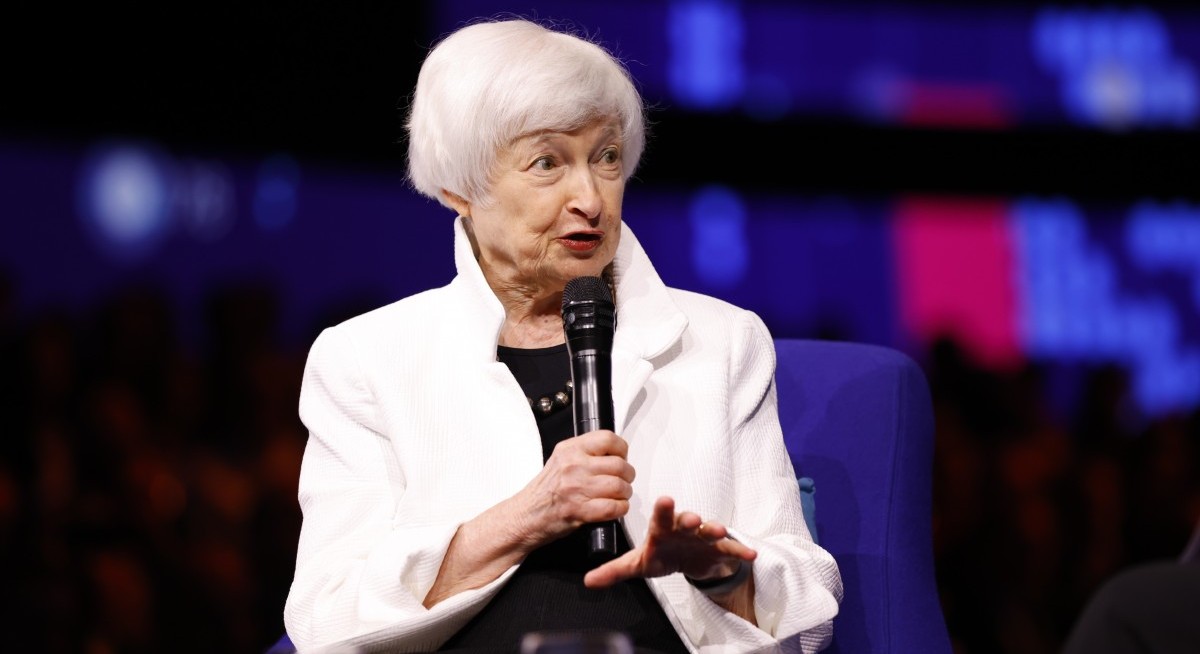


Former Federal Reserve Chair Janet Yellen does not see the US cutting its purse strings anytime soon as the country continues to issue debt. “There’s no serious discussion of deficit reduction,” she says at the Amundi World Investment Forum held in Paris from June 11-12.
Yellen believes that cutting debt levels would involve conversations that include potentially painful higher taxes or lower spending on retirement, healthcare and social programmes. However, these are not happening.
To her, there is no shortcut to lower Uncle Sam’s debt burden as there are no justifications for a lower interest rate. “Any case for cutting rates has really disappeared,” says Yellen, who was the first female Fed Chair, sitting from 2014 to 2018, as well as the first female Treasury Secretary, serving under the Biden administration.
She says that inflationary pressures have changed the outlook for rate cuts, explaining that the US is experiencing three distinct supply shocks. These include the trade tariffs on US imports, the energy shock due to the Middle East situation and the massive investment into infrastructure for artificial intelligence.
Yellen believes that the tariffs have a one-time effect, but the energy shortage could raise inflation levels above the Fed’s target for the remainder of this year and into 2027. The AI boom comes with the scaling-up of energy-guzzling data centres which has led to soaring electricity prices and more expensive consumer goods which incorporate semiconductors.
“There's a real risk that inflation expectations move up, and that could cause inflation to become ingrained,” says Yellen who adds that data suggests that the US job market has remained resilient and is in fact strengthening, extinguishing expectations for rate cuts and as well as fuel for the equities boom.
See also: May is another active month for SGX with volumes reaching new highs
Worry about financial instability
Yellen, however, warns that mounting US debt, which currently stands at around US$39 trillion, could potentially cause another financial crisis. “I'm particularly worried about financial stability risks from sovereign debt,” she says.
Yellen believes that the US on an “unsustainable” fiscal policy path and adds, “Now interest rates are higher, and the debt burden is no longer at the low level that prevailed when I thought there's nothing to worry about, and now I think there's a lot to worry about at the same time,” explains Yellen.
With the US interest debt burden exceeding defense spending, Yellen warns that an “abrupt rethinking” by market participants about the appropriate level of longer term interest rates could affect valuations and leveraged investors in many sectors of the economy, triggering financial instability.
In addition to US debt levels, Yellen is also wary of the impact of sustained geopolitical tension on central bank collaboration. “I think the other thing I would note is that in past financial crises, international cooperation, especially among central banks, has been critical to effectively addressing financial instability,” she says. The way she sees it, the fragmented political landscape could hinder cooperation on swap lines between central banks.
Fed still independent but fiscal dominance threatens monetary policy
Despite pressure from US President Donald Trump, the Fed is still making independent decisions according to Yellen. “I see no evidence that monetary policy decisions in the United States have been anything other than what a group of very thoughtful and analytic people on the Federal Open Market Committee deemed to be appropriate in light of the risks in their forecasts,” she says. “But is fiscal dominance a concern? Absolutely.”
Fiscal dominance refers to a situation in which the central bank loses the independence to make monetary policy in line with its mandate, which is price stability in the case of the US Fed. In general, fiscal dominance creates inflationary pressure with countries under fiscal dominance commonly experience higher inflation, and in extreme cases hyperinflation.
“If you look around the world, I think it's hard to find any prolonged episode of high inflation or hyperinflation that is not driven by fiscal dominance [or] lack of central bank independence,” says Yellen.
“It is a long tradition in the United States that the Secretary of the Treasury and Federal Reserve chair meet once a week for breakfast or lunch to discuss the economy. They certainly should be talking about the economy, understanding their separate responsibilities and plans. That's very important communication.”




