


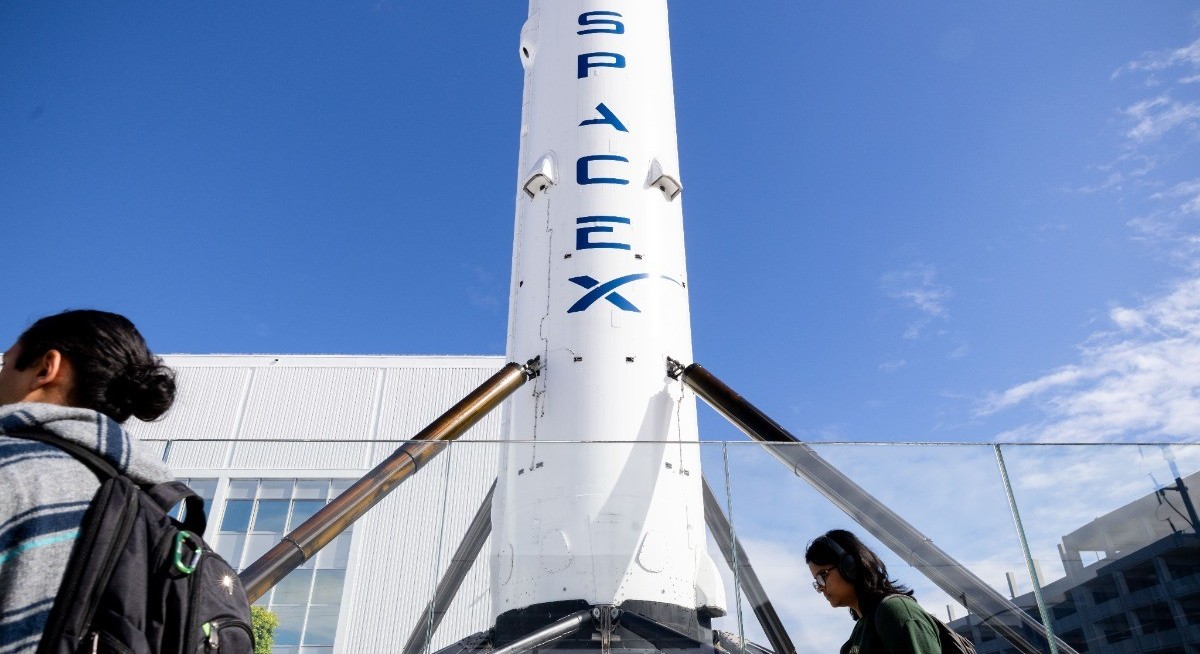


(May 21): SpaceX filed publicly for what stands to be the largest-ever initial public offering (IPO), revealing billions in losses and the super-voting share plan allowing Elon Musk to keep the company under his control.
The rocket, satellite and artificial intelligence (AI) giant is giving the billionaire the power to outvote anyone else, and promising him outsize rewards, including as many as one billion shares, if he can pull it off, according to a filing on Wednesday with the US Securities and Exchange Commission (SEC).
The goals Musk, 54, would need to hit include a human settlement on Mars with at least one million inhabitants, the filing showed. Before that can happen, SpaceX is tasked with making the dream of data centres in space a reality, part of what it says is the largest total addressable market in history at US$28.5 trillion ($36.5 trillion).
The question for investors is whether the sum of Musk’s aspirations for SpaceX are worth valuing at as much as US$2 trillion, viewed in light of financial disclosures that seem minuscule by comparison. SpaceX had a net loss of US$4.28 billion on revenue of US$4.69 billion for the first quarter, compared with a net loss of US$528 million on revenue of about US$4 billion a year earlier, the filing showed.
Musk’s plan for an IPO of unprecedented size is set to transform both the public and private markets if it succeeds. A blockbuster listing, and a rising share price after, would help dispel concern over whether private companies with limited financial disclosures and largely illiquid shares are reaching unjustified valuations in venture capital-led funding rounds.
The listing, which is targeted to raise as much as US$75 billion, showed a company that is growing quickly and burning through cash. For investors to buy into Musk’s dream, they will have to believe that SpaceX can capture a meaningful share of its perceived market opportunity — and accept that they would not be able to remove him if it goes wrong.
See also: OpenAI preparing to file for IPO in coming weeks — Bloomberg
Mature start-up
SpaceX’s filing depicts a conglomerate with a maturity practically unheard of in a pre-IPO company. Overall, SpaceX had US$18.7 billion in revenue in 2025, up from US$14 billion the previous year. During that period, the company swung from a profit of US$791 million in 2024 to a loss of US$4.94 billion last year, according to the filing.
So far, it derives the majority of its revenue from its Starlink satellite internet business, which accounted for about two-thirds of sales in the first quarter of 2026.
See also: Goldman Sachs to lead SpaceX’s mega-IPO bank line-up — Bloomberg
Subscribers to SpaceX’s Starlink internet service have roughly doubled over the past couple of years from 2.3 million in 2023 to 4.4 million in 2024 and up to 8.9 million in 2025. Income from those operations reached US$4.42 billion last year, compared with US$2 billion a year earlier.

Though SpaceX dominates the space transportation industry, and is a key rocket launch provider for both Nasa and the Pentagon, that business still loses money on an operational basis, the filing showed.
For the three months ended March 31, the space segment generated revenue of US$619 million and a loss from operations of US$662 million, the filing showed. A year ago, the company’s space segment generated revenue of US$4 billion and loss from operations of US$657 million.
The company’s ambitions for lofting data centres into orbit remain huge. It plans to launch 100 gigawatts of AI compute capacity on solar-powered satellites each year, equivalent to roughly one-fifth of total annual US power production in 2025, the filing showed.
By far, the most cash-hungry segment is AI. Out of SpaceX’s massive capital-spending requirements, which almost doubled to US$20.74 billion last year, more than half was allocated to spending tied to the AI business — a recent addition to the company after SpaceX acquired xAI this year.
Losses from SpaceX’s AI operations increased to US$6.36 billion last year, compared with US$1.56 billion in 2024, the filing showed.
To stay ahead of Singapore and the region’s corporate and economic trends, click here for Latest Section
The company is looking to bulk up in AI in part through acquisitions such as its US$60 billion deal for AI start-up Cursor. SpaceX has the right to acquire during a 30-day window, beginning shortly after the company goes public, confirming an earlier Bloomberg News report.
If either company terminates the deal, Cursor is entitled to a US$1.5 billion break-up fee in cash, and a US$8.5 billion “deferred services fee” under the company’s compute agreement, the filing showed.
Starship plans
From data centres in space to sending humans to the moon and Mars, no part of the business is more central than its massive Starship rocket. Advertised as the most powerful rocket ever developed, Starship is crucial to Musk’s ambitious plans, and the filing warned that potential delays or failures in its development could be a risk to the company’s future.
The vehicle is not yet fully operational and has faced a rocky testing cycle, with a handful of Starship flights suffering explosions in 2025. Musk has in the past stated his aspiration for its rockets to refuel while in orbit, and to put 100 to 150 tons of cargo in orbit.
SpaceX’s Starship rocket is also meant to be a fully reusable launch system, with the entirety of the rocket returning to Earth intact after each mission — something that has never been achieved. The company states that if Starship needs to undergo any unexpected design modifications or additional testing, that could lead to additional significant costs and force the company to “reallocate critical resources from other projects”.
SpaceX also said that its next generation Starlink satellites can’t launch on its Falcon 9 and Falcon Heavy family of rockets, nor can the vehicles launch the upgraded Starlink satellites that are designed to connect directly with smartphones.
Musk’s windfall
SpaceX’s IPO could deliver windfall gains to many of its early backers. The filing showed that Musk stands to benefit most of all.
Musk currently owns 12.3% of the company’s Class A shares and 93.6% of its Class B shares, which gives him 85.1% of the voting power in the company, according to the filing. Because the Class B shares carry 10 votes each, Musk will continue to control the company after the IPO, according to the filing.
After Musk, the largest shareholder is listed as Antonio Gracias, the founder of Valor Equity Partners, with 7.3% of the Class A shares. That is largely through funds at Valor and Garcia’s personal ownership isn’t immediately clear.
One striking omission in the filing is a detailed description of the stake held by Alphabet Inc’s Google, which owned 6.11% of Musk’s company at the end of 2025, according to a regulatory disclosure in April. At a US$2 trillion valuation, a holding of that size would be worth US$122 billion, according to Bloomberg calculations.
Much of the listing’s success will depend on the participation of retail investors, who could take as much as 30% of the shares in the IPO, Bloomberg News has reported. SpaceX plans to offer shares to retail investors through Charles Schwab Corp, Fidelity, Robinhood Markets Inc and SoFi Technologies Inc, as selling group members. SpaceX also plans to offer shares to retail investors through E*TRADE by Morgan Stanley, an affiliate of Morgan Stanley.
Musk sceptics
Details in the filing such as the ownership structure and the financial disclosures, not to mention the soaring rhetoric, will potentially give Musk sceptics more ammunition.
Large pension investors have criticised reports of SpaceX’s dual-class share structure giving him an effective veto over his own firing. Leaders of New York state and city pension funds and the California Public Employees’ Retirement System urged SpaceX to revise the structure, while union-affiliated pension fund adviser SOC Investment Group asked the SEC to review SpaceX’s financial disclosures.
Others may question whether the figures presented add up to what would potentially be one of the world’s largest publicly traded companies. At US$2 trillion, SpaceX’s market value would be larger than all but a handful of the companies in the S&P 500 Index, and larger than Tesla Inc which Musk also runs.
Some analysts and observers have called previously discussed valuations well over US$1.25 trillion difficult to justify, based on earlier reports of financial information that showed revenue primarily coming from Starlink, and xAI’s heavy cash burn, which prior to the acquisition was averaging US$1 billion a month.
Another key factor in its success will be whether index providers including S&P Dow Jones Indices LLC and FTSE Russell decide to follow Nasdaq Inc and change rules around how quickly very large IPO companies such as SpaceX can join key indices. Funds that track the S&P 500 index must buy newly added stocks, and roughly US$24 trillion is tied to that index alone, according to Bloomberg Intelligence.
Buying by index funds would potentially offset selling by insiders. While the filing includes a 180-day lock-up on existing shareholders, with automatic earlier releases from the restrictions for some shares, they do not all get to sell at once. The releases take place on or after the second full trading day on Nasdaq, and then are staggered over the first six months, the filing showed. Musk is not a party to the lock-up agreement.
Goldman Sachs Group Inc, Morgan Stanley, Bank of America Corp, Citigroup Inc and JPMorgan Chase & Co are leading the deal, along with 18 other banks. The company known formally as Space Exploration Technologies Corp chose Nasdaq and Nasdaq Texas to make its debut under the symbol SPCX.
Formal marketing, when SpaceX will disclose the proposed terms of the share sale, is expected to begin as early as June 4, ahead of pricing as soon as June 11, Bloomberg News has reported.
Uploaded by Tham Yek Lee




