


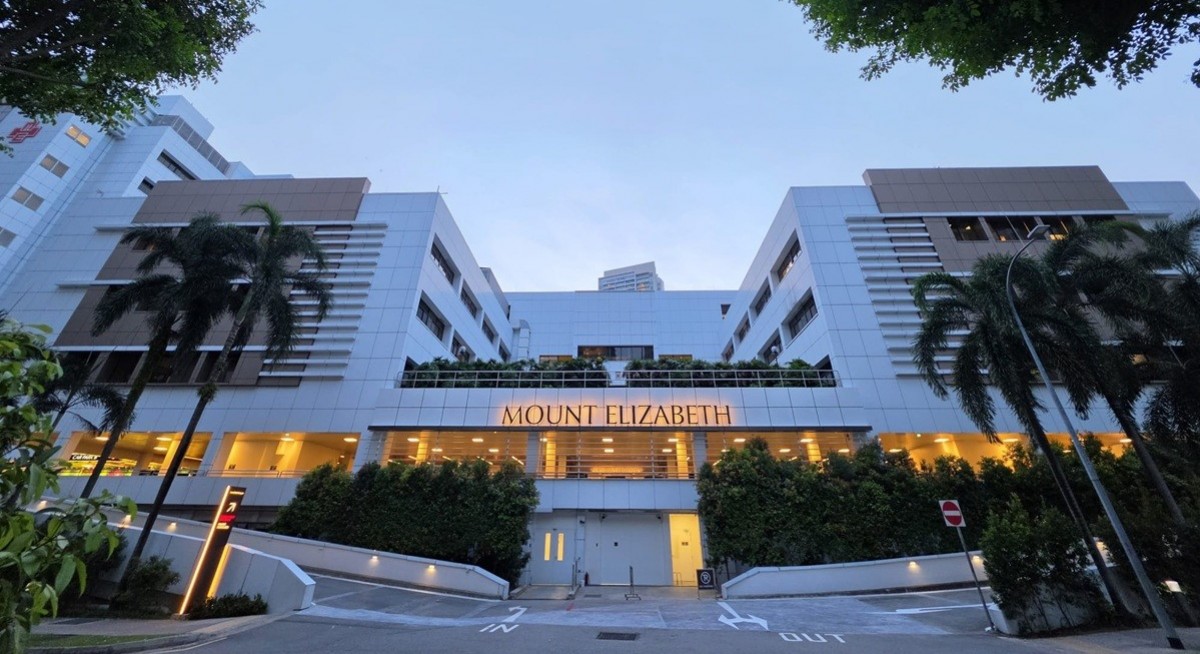


However, the completion comes amid growing competition for the regional healthcare dollar as hospitals in Malaysia and Thailand raise the bar. At the same time, changes in Singapore’s healthcare insurance market mean the free-flowing consumption of private medical services will be curbed.
From the perspective of Dr Peter Chow, CEO of IHH Healthcare Singapore, the $350 million investment — split roughly equally with associate Parkway Life REIT, which owns the physical property — is necessary for the company to meet the expected long-term demand of healthcare not only in Singapore but across the region, which is similarly facing an ageing population issue.
Chow points out that the headline number for this refurbishment is significant. Still, it has to be seen in the context that hospitals need to make regular investments to maintain their facilities over the years.
“While we have invested every year in improvements, sometimes you just need to do a big renovation. Some of the things could not have been done on an incremental basis,” says Chow in an interview with The Edge Singapore.
See also: IHH strives to lower medical costs, attract medical tourists
“We will look at what we can do while ensuring that we can continue to run the hospital, to serve patients better, to meet some of the regulatory standards and ensure that we are up to level with the latest standards of care,” says Chow, describing the investment akin to spending sinking funds collected regularly by condo management committees that are not used in equal tranches but the occasional one large spending.
When asked, Chow says that the patient load following completion of the refurbishment is “a little bit lower” than before. Still, he points out that a direct comparison cannot be made because of changes in the rooms’ configuration, as the total number of beds has been reduced to make space for more single-bed rooms rather than four-bed rooms.
Chow is unfazed by the increased competition in Singapore’s medical tourism industry. For him, a near-term reason is the appreciation of the Singdollar, as well as geopolitical uncertainties. However, he stresses that running this business is a long-term commitment. “We need to ask ourselves, in the next 10 to 20 years, will Singapore continue to be a hub for not just medicine, but a hub in Southeast Asia? If the answer is yes, then I think we need to invest in that longer term continually,” he reasons.
See also: Lilly to buy three vaccine developers for up to US$3.8 bil
In Singapore, tourism receipts have been growing and are on track to reach a new record of $29 billion to $30.5 billion last year. Chow believes that healthcare should be seen as “part of the entire proposition” for Singapore, as it is for the region as a whole. “You cannot be a financial and a commercial hub without being able to have good private health care for your business travellers or your high-net-worth people,” he says.
Flexible use, consistent message
Meanwhile, in the domestic market, there are ongoing changes to the insurance system aimed at curbing rising medical bills, which, under previous plans, were predominantly covered by insurers, leading to unnecessary treatments and procedures. Chow says that the government’s message is “very consistent” in urging more shared responsibility between patients and their insurers. As changes take place over the next couple of years, coupled with a growing, ageing population and higher expectations for healthcare standards, demand will continue to rise.
To support the growing demand, the hospital has been more flexible about space, given its location within a very densely built-up area right next to the country’s premier shopping street. Over the years, it has been shifting some of its functions to nearby buildings, rather than confining everything to the hospital proper.
For example, Paragon Medical Centre across the road houses other doctors’ clinics, as well as extensive radiology and health screening service providers. The Hereen, another nearby mall cum office space, houses the Fertility Centre and also the Haematology & Stem Cell Transplant Centre. Tong Building, meanwhile, houses some administrative offices and ambulatory care services, while Lucky Plaza is home to the Rehabilitation Robotics Centre. “We like to call ourselves a campus; not all care needs to be in the hospital,” says Yong Yih Ming, CEO of Mount Elizabeth Hospital.
As for the hospital’s own refurbishment, the motivation is to make operations more efficient and more patient-friendly. Changes were made to both the building’s structure and the furnishings of individual rooms. For example, new corridors running the entire length of the hospital, stretching 100 metres, were created on each floor. Coupled with various lifts along the way, this means much better ease of access.
Another thoughtful touch was to provide different types of lifts for patients who need to be moved between floors. Previously, because of shared lifts, some patients, as they lie in bed and are being transferred to other parts of the hospital, may find themselves looking up at members of the public in the same lifts.
Instead of providing actual safes in patients’ rooms for storing valuables, cabinets with digital locks were installed, so that anything from Birkins to laptops can be secured. “If you take this bed away, it won’t look like a hospital room,” quips Yong. Rooms are also equipped with AI-enabled CCTV cameras that can detect motion and determine whether a patient is at risk of falling. “Fall risks are a key metric of any hospital,” says Yong.
To stay ahead of Singapore and the region’s corporate and economic trends, click here for Latest Section
No details are too small to matter. For example, instead of curtain tracks wrapping around the entire bed, they are split into two to minimise the distance nurses need to walk — everything adds up.
The hospital, taking inspiration from Krisworld, Singapore Airlines’ in-flight entertainment system, has introduced “LizWorld” — Liz, of course, is “Elizabeth” for short. Around a third of the patients are from outside Singapore. The language selection of the LizWorld interface reflects this. Besides English, there are options for Bahasa Indonesia and Vietnamese. Chinese and Khmer will soon follow.
Patients’ requests for additional amenities via the app can be fulfilled directly by housekeeping, rather than summoning nurses in the wards to take the orders and relay them, which distracts them from their actual clinical work. “We’ve effectively eliminated the nurses from this whole process,” says Yong. “If nurses don’t go to you so often, we can have headcount savings.”
The refurbished hospital has several uncommon features. For example, to complement the hospital’s full suite of oncology treatment capabilities, there is a lead-lined room for patients receiving nuclear medicine. As the patients will be emitting radiation for a few days following the administration of the dosage, they need to be confined to their rooms. The toilet bowl is different, too, featuring a storage space for radioactive waste, allowing its half-life to decay to a point where it can be flushed into the general sewage to avoid contamination.
A commonly cited reason for medical inflation is the cost of buying new equipment. The flipside is that the new equipment can improve efficiency and outcomes. The hospital is equipped with a hybrid computed tomography angiography (CTA) system, also known as Angio-CT. This machine combines a high-end CT scanner and a catheterisation laboratory, enabling doctors to map real-time 3D CT images and perform interventional, minimally invasive procedures in the same setting.
In addition to better precision — knowing, for example, which specific blood vessel feeds a tumour — the use of this hybrid machine also reduces patient transport time. So instead of one visit for scanning and another for treatment, both procedures are done in one go. “Project Renaissance is an opportunity for us to upgrade our specialised clinical capabilities as well,” says Yong.
Non-profit hospital?
As part of the overall bid to increase healthcare capacity to meet structural growth in demand, the government is considering another non-profit private hospital, in addition to Mount Alvernia. One key trait of this model is to ensure some control over bill size. In return, according to Chow, the government will, for one, ensure that land costs are controlled, making it more sustainable for operators. In 2008, IHH Healthcare bid $1.25 billion for the land to build Mount Elizabeth Novena, more than half of the total cost.
Chow, as CEO of IHH Healthcare Singapore, was involved in the consultation for the non-profit hospital two years ago. However, he is not sure what the specific conditions for the proposed new hospital will be and thus prefers to provide more comments when available. “We will definitely study it very carefully and assess it,” he says.
While IHH Healthcare has a significant presence in Malaysia, Turkey and India too, Singapore remains a market, contributing ebitda of RM385 million in the most recent 4QFY2025, or 26.1% of the total. In the past year, IHH Healthcare shares have gained around 40% to trade at around $2.80.
Meanwhile, with Mount Elizabeth’s multi-year refurbishment done and dusted, is IHH Healthcare looking at undertaking similar works at its three other hospitals here? Mount Elizabeth Novena, opened in 2012, is relatively new; the building where Parkway East Hospital is sited was built in 1982; Gleneagles Hospital, founded in 1957, underwent a $150 million modernisation in the early 1990s.
Chow says IHH Healthcare will “definitely” assess such undertakings but will need to take into consideration the timing, the sequence, and the bigger picture, such as countrywide hospital bed capacity. He points out that IHH’s hospitals helped meet the surge in demand during the pandemic, allowing proper patient isolation. The extensive refurbishments on the scale of Project Renaissance will take the capacity out of service during the period.
“If we do another hospital just like what we have done here, we need to think about how healthcare will change in the next 20 years? We are not trying to rush into it, but we are definitely looking, and it’s not a matter of if,” says Chow.




