


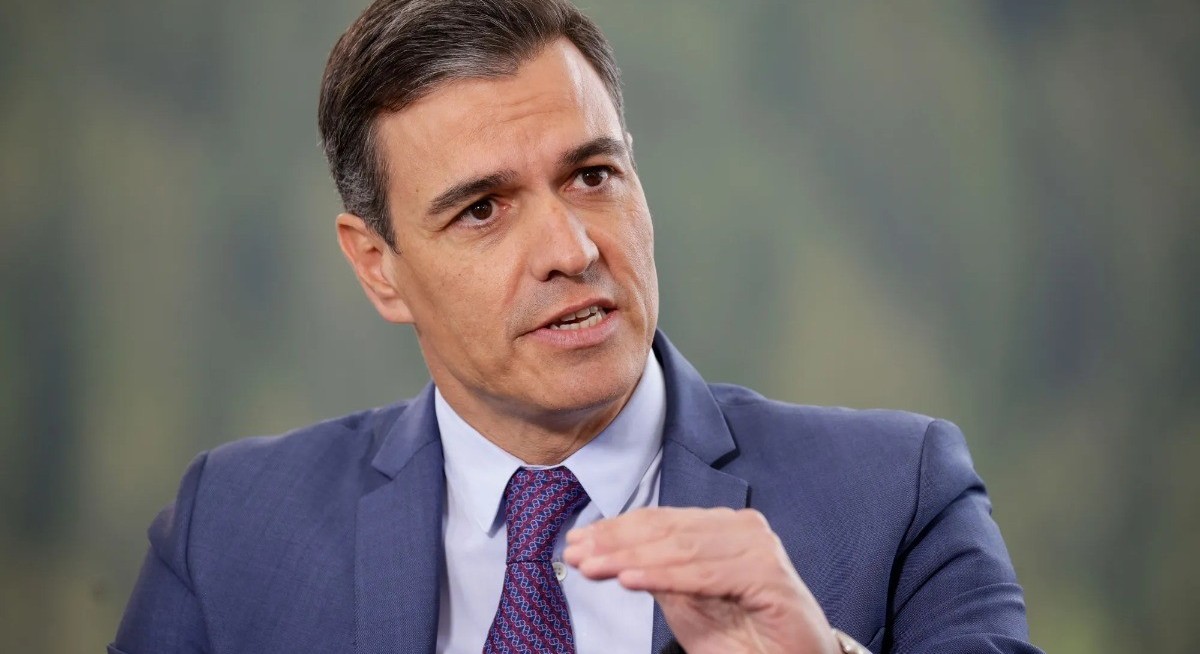


(April 13): Spain’s Prime Minister Pedro Sánchez began his trip to China on Monday by calling on Beijing to leverage its influence internationally and help bring the wars in Iran and Ukraine to an end.
“China can do more — for example, by demanding, as it is already doing, that international law be upheld and that conflicts in Lebanon, Iran, Gaza, the West Bank, and Ukraine come to an end,” Sánchez said during a speech at Tsinghua University in Beijing.
China, which is preparing to host a visit by US President Donald Trump next month, has condemned as “unacceptable” the US and Israeli strikes against Iran. President Xi Jinping, who’s scheduled to meet Sánchez during his visit, has so far stayed silent on the conflict engulfing a major Chinese friend.
On Sunday, Trump threatened to blockade the Strait of Hormuz after talks with Iran collapsed over the weekend. The war, now entering its seventh week, has lifted oil prices and raised the prospect of further economic pain around the globe.
Spain has been one of the European countries most strongly opposed to the military operations, which Sánchez openly considers “illegal”. The country has closed its airspace to flights by US warplanes participating in the conflict and is preventing Washington from using its two bases on Spanish territory for that purpose.
But Spain has also condemned Iran’s response to the US and Israeli attack and the destabilisation of the entire region. Sánchez believes that Beijing can contribute more to halting the conflicts in the Gulf and Ukraine by using the influence China still exerts over Iran and Russia — two countries with which it has extensive ties.
See also: Takaichi urges constitutional reform talks as Hormuz risk looms
“International law is the foundation of everything,” Sánchez said in the Chinese capital.
Spain has strengthened relations with Beijing in recent years, presenting itself as China’s closest ally in Europe. Sánchez, who’s making his fourth trip to China in just over three years, plans to meet political and business leaders — in addition to Xi.
Embracing China is an approach that has come with considerable risks for Spain, as Trump’s return to the White House has triggered upheaval both in Europe’s ties with Washington and in the US-China relationship.
See also: Trump vows to blockade Hormuz Strait after collapse of Iran talks
Last year, Sánchez travelled to Beijing days after US tariffs were imposed on nearly every country. It was a move seen as a provocation in Washington, with Treasury Secretary Scott Bessent calling it “cutting your own throat”.
Since then, other European countries have softened their stance towards China, which the European Union officially views as a competitor and a systemic rival.
Spain recorded a trade deficit with China of over US$36 billion in 2025, while the EU’s overall gap reached nearly US$364 billion.
Speaking at the start of his official visit to the country, Sánchez used stronger language than in the past to characterise the imbalances, calling the deficit “unsustainable” and saying “trade relations must be balanced and reciprocal”.
While a “new multipolar order” is taking shape, it “will require a more horizontal and fairer economy, in which there are no losing regions and winning ones,” he added.
Uploaded by Liza Shireen Koshy




