


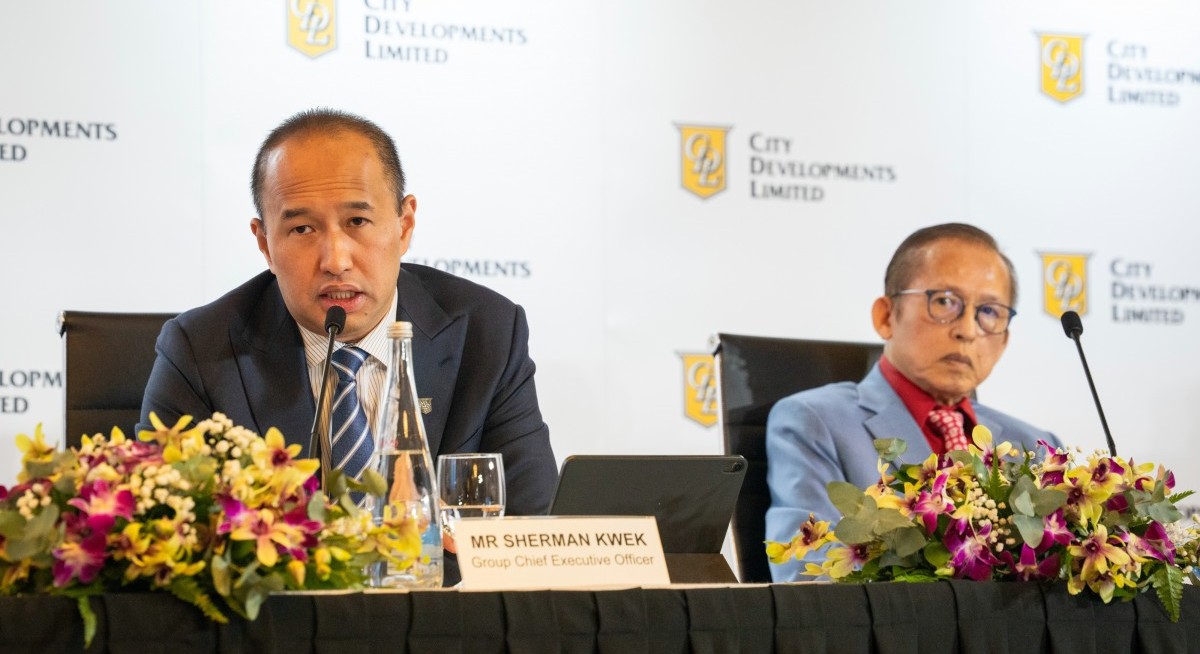


Later, during CDL’s annual general meeting (AGM) on April 29, Sherman revealed the firm’s name: Teneo, which was chosen because of its long-standing working relationship with the group. According to him, CDL did not invite any other firms to submit their bids as the company did not want to “waste time interviewing endlessly”.
“We had used them [Teneo] before ... previously they had advised us when we were privatising Millennium & Copthorne Hotels,” Sherman says. “We were very pleased with the scope that they proposed. We are also satisfied with the fees. They are not exorbitant.”
Thus far, Teneo has conducted an investor perception audit for CDL where it spoke to institutional shareholders and equity analysts to solicit their feedback about the company. Sherman says the board will meet to discuss the strategy review in May and hopes to unveil a refreshed strategy by the end of June.
What could the strategic review recommend? Following CDL’s FY2025 results in February, The Edge Singapore reported that the company is aiming to “monetise” all assets in its UK development platform by the end of the year.
See also: Relocation specialist Chasen rides chip growth; eyes more solar panel projects
After two assets were sold in 2024 and 2025, five properties remain with a carrying value of some $800 million as at end-2025.
That development platform has grown and shrunk over the years. As of May 13, the five properties in the platform are: a carpark at 28 Pavilion Road, Knightsbridge, acquired in 2013; Stag Brewery at Mortlake, acquired in 2015; office building Development House in Shoreditch, acquired in 2016; a residential development Teddington Riverside in Richmond upon Thames, acquired in 2015 and launched in 2018; and the six-unit Chesham Street in Belgravia.
As at end-2025, 148 units at the 224-unit Teddington Riverside remain unsold, while three of the six units at Chesham Street remain unsold.
See also: It’s steady-drip growth for this instant coffee maker
According to Sherman, CDL is exploring options including bulk sales for Teddington Riverside.
Some other properties in the platform have since been divested. Ransome’s Wharf was divested in 2025 for GBP69.1 million ($115.3 million). CDL had purchased the prime freehold site in 2017 for GBP58 million, or $103.4 million. At the time, CDL said it planned to redevelop the site into a luxury residential project with an estimated gross development value of GBP222 million.
Meanwhile, Sydney Street, a residential development in Chelsea, was fully sold for GBP46.1 million in 2024.
What analysts say
Bank of America (BofA) analysts Donald Chua and Kylie Wan noted in a report following CDL’s FY2025 results that capital recycling is likely to form a big part of the strategic review, with $6 billion to $7 billion of non-core assets that could potentially be sold. “The question is timeframe and how flexible CDL is on pricing, given the majority of these are offshore and/or in sectors that are seeing weak demand (e.g UK office, China commercial, global living, M&C hotels). In our view, divesting more Singapore assets is unlikely to narrow its valuation discount in the long term. Tightening geographical exposure and boosting recurring income are also possible outcomes, in our view, but would need time to execute,” the BofA duo say.
In June 2025, following the announcement of the divestment of CDL’s 50.1% stake in South Beach, JP Morgan said: “The next positive catalyst is a potential disposal of the former Stag Brewery site in Mortlake, South West London, that recently received planning approval and which CDL had acquired for GBP158 million ($335 million at the time of acquisition versus $271 million at the GBP/SGD rate on May 13) in 2013.” Mortlake’s divestment plans are likely to be included in the strategic review, market watchers say.
The UK development platform has been challenging. Notably, the various property parcels experienced delays in receiving planning permission from town councils and local authorities. Moreover, since entering the UK in 2013–2014, Brexit materialised, and the UK has had several changes of prime ministers. No surprise then that divesting this platform has been identified as a priority by analysts.
To stay ahead of Singapore and the region’s corporate and economic trends, click here for Latest Section
At OCBC Investment Research, analyst Andy Wong notes that the strategic review could enable the group to “unlock significant value” given that its investment properties are on its balance sheet at “cost less accumulated depreciation and accumulated impairment losses”. Some assets could be sold at a discount, but the capital gained can be deployed into “higher growth opportunities”.
CDL’s living sector portfolio, which has a gross development value of $3.7 billion, could be put into a funds management platform that the group has plans for, Wong adds.
In addition to the development platform and the living sector, CDL acquired two office properties in London in 2018, 125 Old Broad Street for GBP385 million ($687 million at the time), and Aldgate House for GBP185 million ($328 million at the time). Those prices translate into $662 million and $318 million as of May 13. Both these properties were identified as seed assets for a UK-based commercial REIT to be listed on the Singapore Exchange.
At CDL’s FY2023 briefing on Feb 28, 2024, chairman Kwek Leng Beng said the UK had “a lot of potential” and that the group “should be present there and be more active”.
At the time, Leng Beng believed that demand for offices in the country would start to stabilise and strengthen over time.
Some two years later, Sherman says the UK “underperformed” and the group is looking to “recycle this as soon as we can”.
During the results briefing on Feb 27, Sherman says that the group’s entry into the UK was “before [his] time”, and CDL had to engage an external manager then as it had no presence in the UK.
Beyond capital recycling, analysts are watching for updates on CDL’s Singapore operations, potential capital returns and fund ambitions, among others.
OCBC’s Wong is hoping for a “structured, medium-term strategy on its targeted geographies and asset classes over the next three to five years” alongside a “clear capital allocation framework”.
“Several regional peers have pivoted towards an asset-light strategy with the aim of improving their return on equity and to generate recurring income streams via management fees,” Wong says. “Given CDL’s large asset base, it would be well positioned to grow a fund management platform and attract high quality LPs (limited partners) as partners.”
Phillip Securities Research’s Darren Chan is hoping for a “clearer capital recycling framework” and a “more disciplined portfolio pruning” through targeted divestments, as well as more clarity on CDL’s plans to build a capital-light platform.
“We would also look for a more explicit shareholder returns policy, including potential buybacks or special dividends where appropriate,” he adds.
Plans to pare debt levels
Since FY2020, CDL’s net gearing — save for FY2022’s 84% — has consistently come in above 90%. In FY2024 and FY2025, the group’s net gearing spiked to 116% and 117% respectively, driven by a constant spate of acquisitions including St Katharine Docks in Central London, which the group acquired for GBP395 million or $636 million then.
Recognising the strain of higher net finance costs due to the higher interest rate environment, Sherman announced a $1 billion divestment target at CDL’s FY2023 results briefing on Feb 28, 2024.
During CDL’s AGM on April 23, 2025, Sherman reiterated CDL’s need to accelerate its divestments due to its “very high” gearing and said that the group would divest at least $600 million worth of assets in FY2025, matching 2024’s total divestment sum of over $600 million, although the figure fell short of the initial target of $1 billion.
In 2025 alone, however, the group had executed $2 billion worth of divestments, including the sale of its 50.1% stake in South Beach to its joint venture partner, IOI Properties. The group, in its FY2025 results presentation, said that it would focus on capital recycling initiatives. “Capital recycling is [going to] be very much a part of our business as property development and asset management… and to me, it’s core,” Sherman says.
At CDL’s most recent AGM, Sherman told investors that the new strategy will not only shape how CDL is run going forward, it will also be a way to hold the company’s management to account.
“This is how CDL is going to be morphing over time,” Sherman says. “If you don’t like what you see, then maybe this is not the company for you. But you will be able to at least see how CDL is changing.”




