


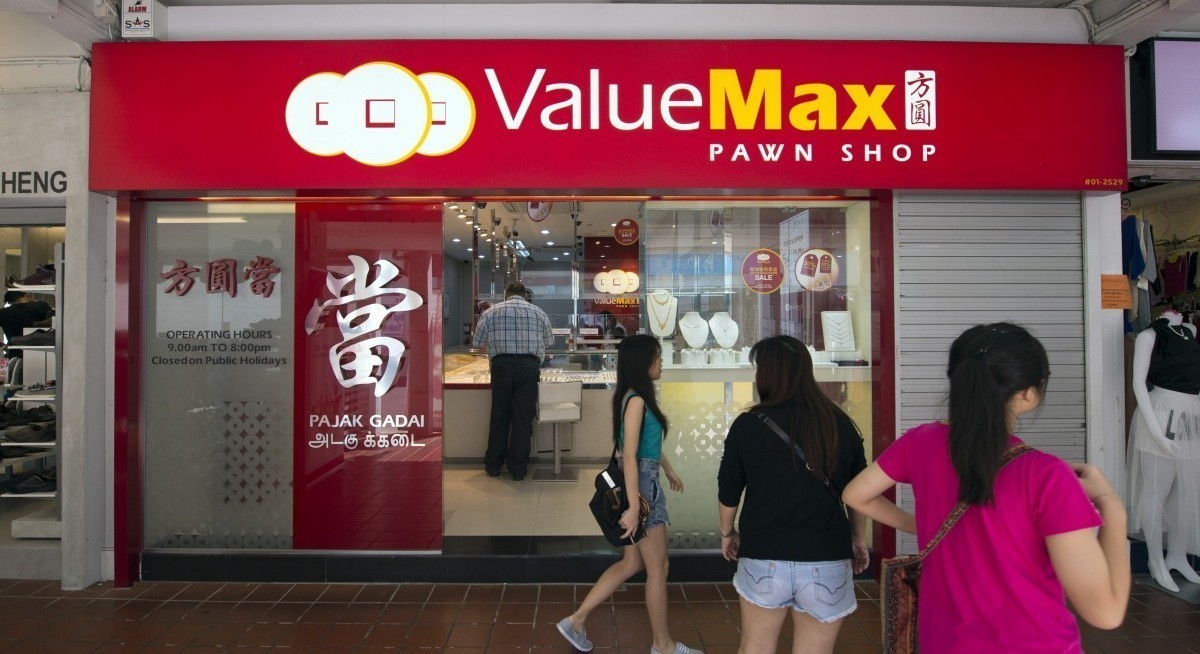


Establishing its first pawnbroking outlet in 1988, ValueMax and its associated and investee companies now operate 70 outlets in Singapore and Malaysia, according to the business’s website.
“Pawnbroking in Singapore was largely a traditional industry,” Yeah Lee Ching, managing director of retail and trading for ValueMax, tells The Edge Singapore in an email interview. “Over the years, we have modernised the model by combining pawnbroking with professional retail standards, technology and complementary financial services.”
One of the innovations introduced by ValueMax to spur growth was the transformation of pawnshops into retail spaces, with pawnbroking counters operating alongside jewellery retail displays within the same store. Yeah, the sister of CEO Yeah Chia Kai, says that this enhances the customer experience and allows the business to better monetise unredeemed collateral through jewellery retail.
She adds that ValueMax pioneered the processes for implementing the gross margin scheme to sell pre-owned gold and jewellery with little or no goods and services tax. By building this capability early, ValueMax was able to trade pre-owned jewellery at attractive prices and gain a first-mover advantage in this segment.
See also: Temasek reports record net portfolio value of $518 bil despite challenging environment
The company has also invested significantly in digital and operational systems, as well as enhancing funding flexibility by tapping credit via alternative solutions such as digital commercial papers. Together, all these measures have offered a platform for ValueMax to scale from a few pawnshops to one of the largest pawnbroking chains in Singapore.
In 2013, ValueMax’s successful growth enabled it to list on the Mainboard of the Singapore Exchange, becoming the first pawnbroker to achieve this feat. Following the listing, the Yeah family’s stake in the company exceeded 85% until recently: On Feb 26, it was announced that Yeah’s father — founder and executive chairman Yeah Hiang Nam — and his wife, Tan Hong Yee, had sold 34.8 million shares at $1.16 each to a group of investors, bringing the family’s holdings down to 81.53%.
The group of investors included abrdn Asia, Amova Asset Management Asia, Avanda Investment Management, and ICH Synergrowth Fund, which collectively forked out $40.37 million to buy these shares. Two of them, Armova and Avanda, are appointed fund managers under the Monetary Authority of Singapore’s Equity Market Development Programme.
See also: Indonesia’s Danantara wealth fund sees senior management shakeup
When asked about the reasons for the transaction and who initiated it, Yeah says the transaction aims to broaden ValueMax’s institutional shareholder base and improve share liquidity. She adds: “Such placements are typically facilitated through discussions between shareholders, financial advisers and institutional investors.”

ValueMax managing director Yeah Lee Ching says pawnbroking laid the foundation for the company to expand into related areas such as real estate and car financing, moneylending, gold, jewellery and branded watch retailing as well as precious metals trading.
Institutional investment worthy
Jaimes Chao of Tickrs Financial Singapore views the vendor share sale positively. In his Feb 26 report, Chao wrote that by increasing the counter’s estimated free float by around 32% from 110 million shares to 145 million shares, the deal addressed a “structural weakness” of thin free float that deterred institutional participation and contributed to wider bid-ask spreads.
Pointing out that the buyers are long-only institutional funds and, in particular, one of the region’s largest asset managers (abrdn Asia), Chao believes this validates ValueMax’s investment credentials. “This is the type of shareholder base transformation that typically precedes sustained re-rating,” he adds.
It was also stated that the transaction supports ValueMax in meeting the eligibility criteria for inclusion in indexes such as the iEdge Singapore Next 50 Index. Chao expects index inclusion to catalyse passive fund flows and further improve liquidity, leading to a “self-reinforcing cycle”.
To stay ahead of Singapore and the region’s corporate and economic trends, click here for Latest Section
Additional positive points about the share sale include its non-dilutive nature and the Yeah family’s 90-day moratorium on further share sales, which signals commitment and confidence in the company.
From Chao’s perspective, the block trade transformed a key risk — low free float — into share price catalysts, including institutional ownership, index eligibility and improved liquidity, without any drawbacks such as dilution and loss of key management.
Branching out from pawnbroking
While the vendor-share sale is perceived as unlocking dormant value, the fundamentals of ValueMax’s business must first be strong enough to attract investment. For FY2025, ValueMax delivered a record set of results, with profit after tax rising 23.7% y-o-y to $103.6 million and revenue up by 21.3% to $553 million.
ValueMax attributes the strong performance to higher contributions across its pawnbroking, retail and trading of jewellery and gold, and moneylending segments, supported by stronger gross margins and increased share of results from associates.
On a segmental basis, the retail and trading of jewellery and gold is the largest contributor to the top line and bottom line for FY2025, with external revenue exceeding $425 million and segment profit of $45.8 million. Meanwhile, the moneylending segment reported external revenue of nearly $67.3 million, with segment profit close to $36 million, while pawnbroking earned external revenue of $60.8 million and segment profit of around $25.8 million.
Historically, following its 2013 stock market debut, pawnbroking was the highest profit contributor until FY2021, when it was overtaken by the moneylending division, which in turn was overtaken in FY2025 by the retail business.
“Pawnbroking gave us deep experience in collateral valuation and secured lending,” says Yeah. “From there, it was natural to expand into related areas such as real estate and car financing, moneylending, gold, jewellery and branded watch retailing as well as precious metals trading.”
Yeah, adds that diversification into other businesses has enhanced earnings resilience. “Instead of relying on a single business line, ValueMax today has multiple complementary revenue streams that support long-term growth.”
Elaborating on its growth strategy, Yeah says the company aspires to become a diversified financial services group anchored on asset-backed lending and precious metals activities. Besides continuing to expand its branch network and strengthen its retail presence for pre-owned jewellery and watches, the company also seeks to increase its trading activities and footprint in the precious metals value chain, and to expand its secured loan portfolio, while maintaining strong credit discipline in the markets it operates in.
“Singapore remains our core market,” says Yeah, adding that ValueMax’s associated company in Malaysia, Well Chip, provides a strong platform for the company to participate in Malaysia’s pawnbroking, jewellery retail and secured lending market.
“The Malaysian market has a large population and growing demand for alternative financing options. Our focus is on growing the business steadily via greenfield developments and strategic acquisitions while strengthening operational capabilities and brand recognition.”
Well Chip is listed on the Main Market of Bursa Malaysia. Based on its April 6 closing price of RM1.26 ($0.32), Well Chip had a market capitalisation of approximately RM756 million. ValueMax, which owns a 65.5% indirect stake in Well Chip, recently saw its market cap cross $1 billion at its April 6 closing price of $1.07, having hit an all-time high of $1.34 on Feb 23.
A “golden counter-cyclical” play
On March 27, Singapore announced its ambitions to become a gold trading hub, and Yeah is upbeat about the development. “Greater participation from banks, funds and financial institutions helps to strengthen Singapore’s ecosystem as a precious metals trading hub,” she says. “Increased awareness and investor participation in gold markets can also support demand across the broader gold value chain, including trading and physical gold products.”
Yeah sees global interest in gold remaining strong, as investors look for safe-haven assets during periods of economic uncertainty. “Our precious metals trading business benefits from this environment through bullion trading and related activities in the precious metals supply chain,” she says.
In a report on April 1, DBS analyst Lim Rui Wen describes ValueMax as a “golden counter-cyclical” play. While Lim did not rate the stock, she sees positive upside potential, with a valuation of $1.45 per share, representing a 34% gain from its April 1 closing price of $1.08. Lim’s valuation is based on 11 times forecasted FY2026 P/E.
From Lim’s perspective, pawnbrokers such as ValueMax benefit from gold’s fundamentals. In addition, with the Middle East conflict as a backdrop, she views pawnbroking as a countercyclical hedge amid a weaker macroeconomic outlook and inflation concerns.
Analysing the company, Lim notes that the CAGR from FY2021 to FY2025 were 16%, 15%, and 15% for pawnbroking, retail, and secured lending, respectively. Lim notes that the growth was driven by both organic and inorganic factors. These include increased investor appetite for gold and higher gold prices, leading to expansion of the pawnbroking loan book and store expansion and acquisitions.
Meanwhile, Tickrs’ Chao maintains his “buy” rating with an increased target price of $1.55, reflecting the step-change in profitability, structural gold tailwinds, and a narrowing valuation discount to peers. Using a blended methodology, he values ValueMax at approximately 13 times for FY2025 P/E, cross-checked with a 12 times FY2026 estimated P/E and a discounted cash flow analysis yielding $1.40 per share.
Since the start of 2025, the counter has gained 140%. With its record-breaking FY2025 results, Chao notes that ValueMax has crossed a “landmark” profit threshold as its integrated pawn-and-gold model “fires on all cylinders”. The market and institutional investors seem to agree.




