


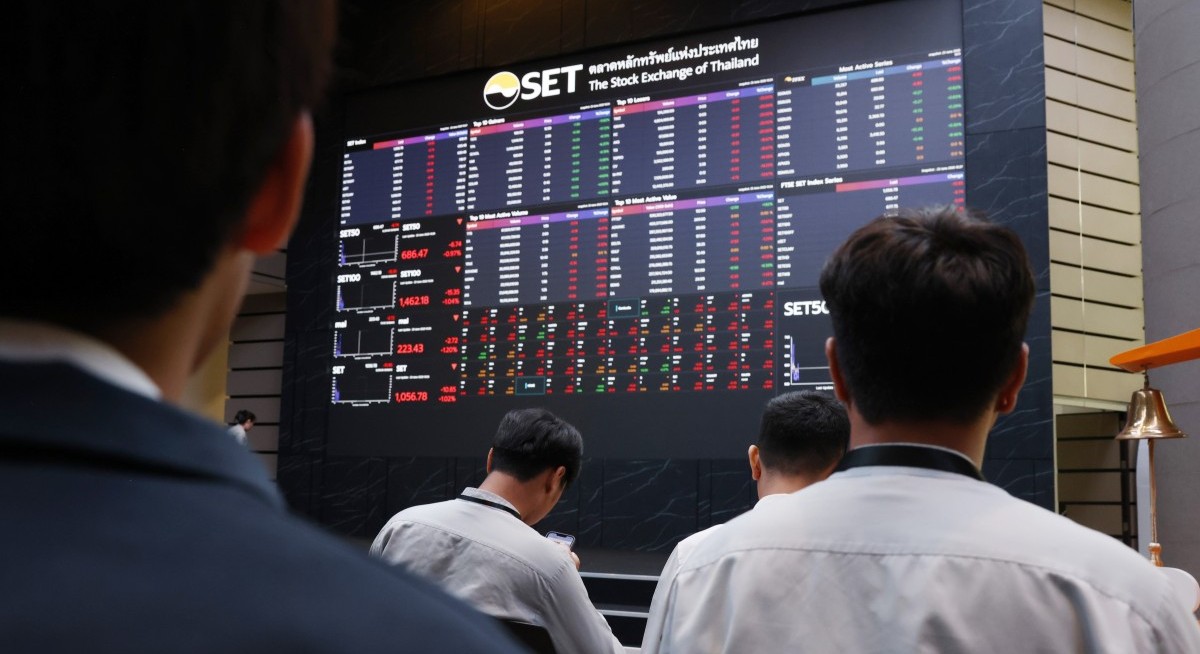


Local investors have been following foreign funds in sending vast amounts of capital abroad. Thai-domiciled funds have net sold domestic equities for seven straight quarters through September, the longest streak since 2020, according to Morningstar Direct data. Meanwhile, Bank of Thailand data show locals bought a record amount of overseas equities and debt securities in the first half of the year.
“Sluggish economic recovery as well as lowered potential growth has urged Thai people to look elsewhere for investment, especially in terms of risky assets,” said Poon Panichpibool, a strategist at Bangkok-based Krung Thai Bank Pcl. He added that falling volumes in the stock market coupled with relative low bond yields are also forcing local investors to look abroad.
Thailand's overseas portfolio investment surges
The shift threatens to deepen a selloff in stocks that reached five-year lows in recent months and spillover into bonds, where a potential sovereign rating downgrade and an uncertain outlook weigh on sentiment. While overseas buying is common elsewhere, the trend is potentially stark in Thailand, where locals account for almost 40% of the market. Their exit could risk derailing regulatory efforts to revive confidence hit by household debt and weak income growth.
See also: Thai leader Anutin strikes deal for coalition with Thaksin-backed party
The Stock Exchange of Thailand Index has tumbled 10% this year, contrasting the sharp 23% gain in the MSCI Asia Pacific Index. Foreigners have remained net sellers, offloading nearly US$3.3 billion so far. Meanwhile, Thai bonds have fared better, with foreign inflows of about US$2.1 billion through October. A gauge of returns in the local market has climbed over 7% in 2025, and the benchmark yield has fallen almost 60 basis points to 1.69%.
Take Christian Kallaehne, a 30-year veteran of Thailand’s stock market. This year, the German-born investor, who has lived in the country for nearly two decades, decided to shift the bulk of his portfolio offshore. He’s now allocating funds to foreign equities and depositary receipts of overseas firms listed on the Thai exchange. “At the moment I use that money where it can make the best returns,” he said, referring to the US and China as examples.
Supachoke Supabundit, president of Kiatnakin Phatra Securities Pcl, says demand for offshore investments has surged in recent months. “Right now, it’s a good time if you want to take money offshore because of the strong baht,” he said. In June, his firm partnered with Goldman Sachs Asset Management to help wealthy clients invest offshore, with aims to grow its assets under management to 40 billion baht (US$1.3 billion or $1.63 billion) by year end.
See also: Thai assets rally as election victory signals policy continuity
Some Thai investors are turning to exchange-traded depositary receipts (DRs) to gain exposure to hot US stocks like Nvidia Corp and Amazon.com Inc. The number of DRs more than tripled to 231 securities as of Dec 11 from 65 in 2024, according to the Stock Exchange of Thailand data.
There are some signs the selling pressure may plateau. Political uncertainty aside, stronger export growth and stimulus measures aimed at boosting consumption have prompted the government to raise its economic forecast. Still, analysts say bringing locals back will take time and requires renewed measures to keep investors at home.
“Thailand needs to develop new growth industries and improve political climate,” said John Foo, founder of Valverde Investment Partners Pte. “It needs sensible new policies to boost tourism and move up the manufacturing value chain along with addressing two key issues of high household debt, which is affecting consumption, and property market oversupply.”
Uploaded by Isabelle Francis




