


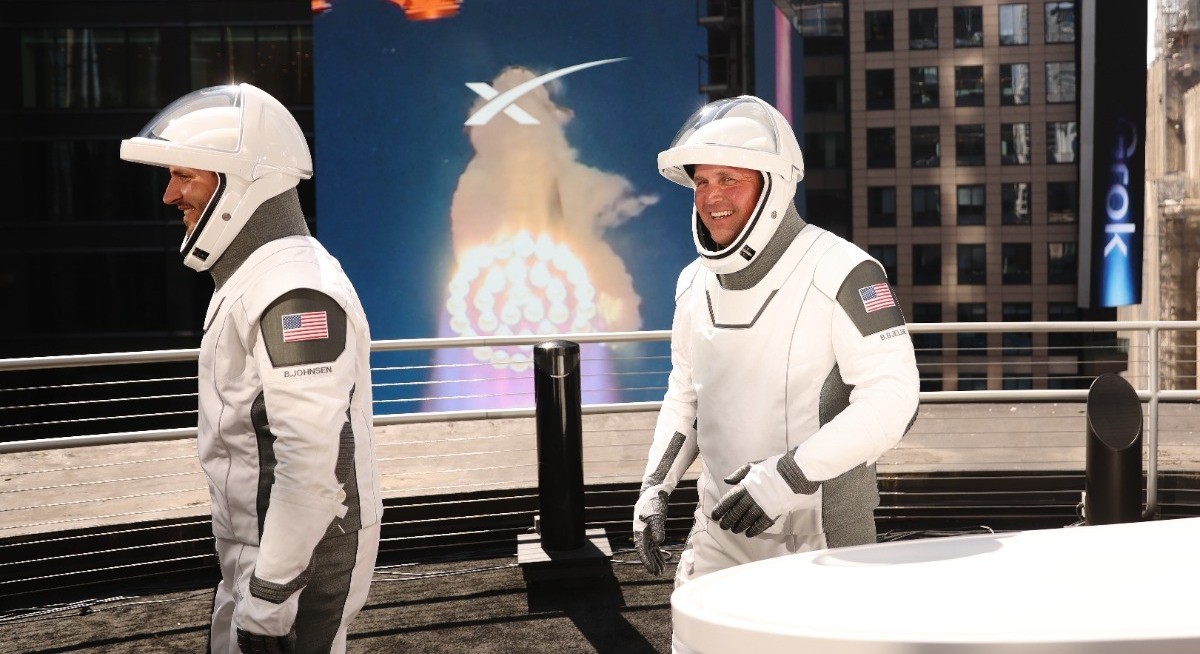


(June 19): When Elon Musk went into sales pitch mode ahead of the SpaceX initial public offering (IPO), the comparison he marshalled to justify valuing the company in the trillions of dollars, and tapping investors for tens of billions, raised a few eyebrows.
“We’re kind of like the Union Pacific,” he said in an interview in an investor presentation ahead of the IPO, citing one of his frequent touchstones — a historic infrastructure project in the 1800s intended to connect western states by rail for the first time. “People thought they were crazy” when they built it, he said, “but now California is the biggest state in the country”.
The pitch from one of the world’s most successful and divisive entrepreneurs was typical Musk. The world’s richest person and first trillionaire linked SpaceX, with its plans for orbital data centres and a colony on Mars, to a name evoking an essential part of America’s growth into a superpower, a prize easily justifying the investment that lifted the company’s market value above US$2.5 trillion ($3.2 trillion) in a handful of trading days.
The IPO was not the end of the fundraising campaign, it was the start. SpaceX is already turning to the bond market and is preparing to seek at least US$20 billion in its first deal, Bloomberg News reported. Capital expenditure could surpass US$700 billion a year by 2031 in one estimate. Is that too much to ask when the goal is, as Musk put it, making “Star Trek real”?
Ask the backers of the Union Pacific. Construction of the railroad flamed out and stopped in Utah — not California. That project was propped up by government support as it minted generational wealth for insiders before ultimately failing.
Richard White, American history professor emeritus at Stanford University, called the original Union Pacific “a mess of self-dealing and corruption”.
See also: Global capitalism bets it all on AI future, alarming voters
“To use that as your model of what your corporation is going to be, plays on the immense ignorance of the history of this country, of financial markets and most Americans,” he said in an interview.
A representative of SpaceX didn’t immediately respond to a request for comments.
Tall order
See also: Sea testing AI chatbot Migoo in quiet US foray — Bloomberg
It is a tall order to build out SpaceX’s artificial intelligence (AI) ambitions, particularly as the company is not profitable.
Research analysts at Goldman Sachs Group Inc and Evercore ISI are modeling for the company to spend more than US$1 trillion by the end of the decade, Bloomberg News has reported. The bulk of that spending will focus on SpaceX’s AI operations and centre on the vision of getting data centres into space.
In meetings with prospective investors, the company’s finance chief Bret Johnsen and president Gwynne Shotwell said they expect the IPO was the last time SpaceX would sell stock, according to people familiar with the matter. Instead of raising billions by diluting shareholders — as well as Musk himself — the plan is to tap debt markets after it touted investment-grade ratings throughout the IPO process, some of the people said, asking not to be identified as the information is not public.
Late on Thursday, the three major ratings firms gave the company investment-grade bond scores.
Oppenheimer & Co analysts led by Timothy Horan are modelling for the company to tack on more than US$400 billion in net debt by 2031, up from about US$13 billion as of a few months ago. That is vastly more than almost every US company currently has on its books and would more than triple what Oracle Corp has.
The analysts expect debt to be the primary source of funding for the company supplemented by roughly US$40 billion of additional equity, they wrote in a June 18 note.
But debt market participants have their doubts.
To stay ahead of Singapore and the region’s corporate and economic trends, click here for Latest Section
“The vast majority of the capex is going to have to be financed with equity capital rather than in our market,” said Jim Fitzpatrick, the head of US investment grade research at Allspring. “They just aren’t going to have the capacity for issuing a lot of additional debt while keeping investment grade ratings, especially since this company has no track record with the rating agencies.”
SpaceX is set to tap investors for cash potentially just as Anthropic PBC and OpenAI seek to raise tens of billions of dollars in IPOs of their own as soon as this year. Meanwhile, AI-focused members of the Magnificent Seven companies including Alphabet Inc are pooling further billions.
“It’s a simultaneous build-out of data centres and semiconductors, energy infrastructure and satellite networks,” said Justin Reed, the chief investment officer of Brown Brothers Harriman. “We are moving from this world of funding applications which was capital light and now, frankly, we are funding an entire economic ecosystem, and to us that’s why the capital requirements look so extraordinary.”
By McKinsey & Co’s count, the cost to build out data centres here on Earth will require US$7 trillion by the end of the decade. SpaceX’s orbital ambitions would likely add to that figure, potentially testing both the equity and debt markets. Some estimate that with SpaceX’s lofty multiple, equity would be easier.
“With SpaceX, if you are going to buy into the hype of the momentum regardless of valuation, at least if you are buying the equity, there’s material upside,” said Joe Hegener, the chief investment officer of Asterozoa Capital. “But in debt markets, your upside is capped at the coupon and your downside is everything.”
Bankers are optimistic that the market can continue to fund plenty of spending — particularly as it relates to building out data centres and so-called hyperscalers providing the computing power behind AI’s rapid growth.
“All of this is changing the capital markets in a pretty meaningful way,” said Lisa Clyde, a co-head of global capital markets at Bank of America Corp. “We are seeing the lines blur between products and between public and private markets, and companies are having to think more creatively about on- and off-balance sheet financing.”
The pickup in financing has led to a jump in activity across products. US IPOs and share selldowns have seen US$163 billion so far this year — even when removing SpaceX’s IPO — which is up 28% from last year, data compiled by Bloomberg showed. Debt issuance tied to AI has topped US$300 billion since November across multiple credit markets, driving near-record issuance this year, according to strategists at JPMorgan.
Monumental spending
To Jim Chanos, the veteran short-seller and president and founder of Chanos & Co, SpaceX along with the Magnificent Seven and Anthropic and OpenAI promise a monumental amount of spending that the market won’t see a return on — or even feel confident in the prospect of one — for years.
“It’s five to 10 years away or longer, so we will have this massive, massive capital spend without a lot of stuff to show for it with the exception of the people selling these picks and shovels,” he said in an interview, referring to suppliers that can profit from a gold rush without actually mining themselves.
“People are counting on really transformative changes not only in the way we live our lives but also hyper productivity growth and gross domestic product growth, I am just not so sure,” he said.
The realities of Musk’s financing plans are difficult to grasp, with historical comparisons still falling short compared to what SpaceX wants to do. But even though no one is seizing on the analogy to suggest he or SpaceX are doing anything wrong or illegal, Musk’s own comparison to Union Pacific feels on the nose to some sceptics.
Some associate Union Pacific with the so-called Credit Mobilier scandal. According to Stanford’s White, although Union Pacific had a huge amount of capital, much of it was siphoned off to the Credit Mobilier, the construction company working on the project, which was owned by insiders at the time.
“The fact that Union Pacific had the biggest fraud of the 19th century attached to it — the Credit Mobilier — which was a complete general contracting scam underneath the umbrella of Union Pacific building out the railroad, it’s a little ironic isn’t it?” Chanos said.
Uploaded by Tham Yek Lee




