




For retailers, banks and airlines, launching a new site can mean months of waiting to get it online. ViewQwest wants to turn that inconvenience into a managed-services business.
In Singapore, companies can usually assume that fibre connectivity will be available when they open a new office, shop or branch.
Elsewhere in Asia, that assumption can be costly. A business may have secured a lease, hired staff and stocked shelves, yet still be waiting for the connection needed to process payments, run central systems or offer customers Wi-Fi.
In some markets, the delay comes from patchy fibre coverage. In others, a company must negotiate with several carriers to connect all of its locations. The result is that expansion plans can be slowed by the practicalities of getting a site online.
ViewQwest, a Singapore-based network and cybersecurity provider, has built its business around helping multinationals manage those gaps from market to market. It does so by buying services from local carriers, choosing whichever one can serve a particular site and presenting the result to customers as one managed service.
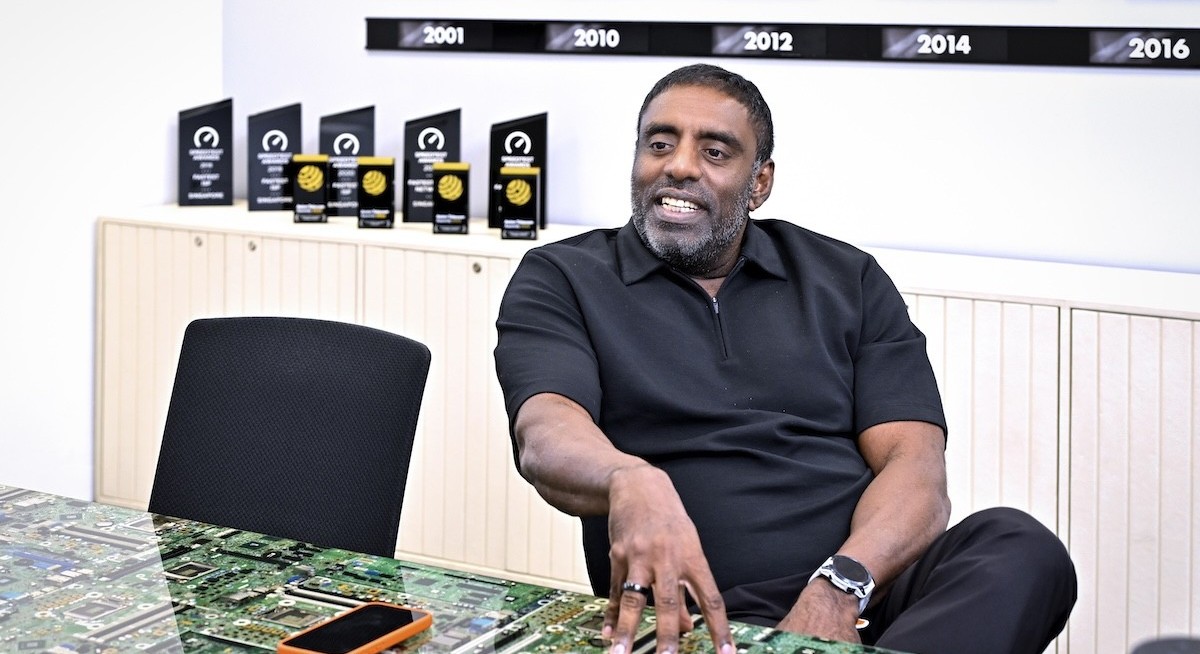
“We are agnostic and neutral. We don’t own any of the connectivity infrastructure outside Singapore and Malaysia. So, we will pick the best options that are available in markets [outside of those],” Vignesa Moorthy, ViewQwest’s founder and CEO, tells The Edge Singapore.
See also: Singtel weighs REIT as long-term funding option for AI infrastructure
For companies with large branch networks, the issue is not a lack of carriers. It is that no single network provider can connect every site. Hong Kong, where fixed-line competition is hardly scarce, makes the point. “You have three or four different operators in the country from a fixed network standpoint, but you still cannot get ubiquitous access across the country [because a carrier may serve one building but not another],” says Moorthy.
In Indonesia, the constraint is often more basic, with fibre unavailable in some locations. In the Philippines, installation can take months even where service is available. These gaps can delay store or branch openings and disrupt payment terminals, stock systems, booking tools and customer service.
ViewQwest helps to address those gaps by combining fibre with mobile connections and, where necessary, Starlink’s satellite internet. For an airline customer in the Philippines, it installed Starlink backup at ticketing sites exposed to typhoons, mounting the equipment on steel poles designed to withstand winds of up to 350 kilometres an hour.
See also: Singtel's partial sale of Gulf Development stake reaps $140 million gain
According to Moorthy, that flexibility stems from ViewQwest’s position as a buyer rather than an owner of network infrastructure. “[Local carriers in Asia] like working with us because we don’t own any of the infrastructure. So, they don’t see us as a threat,” says Moorthy.
ViewQwest’s neutrality also allows it to bridge gaps between carriers. In Hong Kong, where rival operators can be reluctant to work with one another, Moorthy says the company sometimes acts as an intermediary for customers seeking coverage that no single provider can supply.
One network problem, two revenue streams
Different carriers and equipment across markets can leave companies with inconsistent coverage as well as uneven security controls. “Inconsistency leads to security issues, because you may approach securing your [IT/network] infrastructure in this country in a certain manner, and you end up doing it in a different manner in a different country, just because the network provider you work with [operates] differently,” says Moorthy.
This turns a connectivity problem into a cybersecurity challenge. A patchwork of branch systems, employee devices and local providers gives intruders more possible entry points and more routes to explore after they get in.
The risk grows as companies add AI tools and autonomous AI agents to internal systems. “As customers deploy more AI solutions, what they need from a network standpoint is better ring fencing,” says Moorthy. In practical terms, that means limiting what a compromised device or software agent can access.
To help enterprise customers tighten their cybersecurity controls, ViewQwest partnered with Zero Networks in October 2025 to offer automated microsegmentation in Asian markets. The approach is designed to place tighter controls on which devices and systems can communicate with one another, so that a compromised laptop, shop terminal or server does not become a route into the rest of a company’s network. This is appealing to companies with many sites, as a breach at one branch should not become a problem for the entire business.
To stay ahead of the latest tech trends, click here for DigitalEdge Section
Putting such controls in place, however, is only part of the task. They also need to be monitored and updated as employees, devices and applications change. “What’s the point of having a firewall that nobody knows how to use?” asks Moorthy.
He adds that companies are therefore increasingly asking ViewQwest to manage security tools after they are installed, particularly when they lack the staff to do so themselves. This demand sits within a broader market for outsourced cyber protection. MarketsandMarkets estimates the global managed security services market will grow from US$39.5 billion ($51.21 billion) in 2025 to US$66.8 billion by 2030, an annual growth rate of 11.1%.
Making sprawling networks manageable
ViewQwest operates across 11 territories, including Singapore, Malaysia, Indonesia, the Philippines and Hong Kong, according to Moorthy. Supporting sites across those markets means dealing with customer interactions and network alerts from multiple carriers. ViewQwest is using AI to do those tasks more effectively.
It is rolling out a system that automatically reviews customer calls, emails and other interactions, assesses whether an issue has been resolved, and flags unresolved cases for escalation. Instead of waiting for managers to sample calls after the fact, the aim is to identify poor outcomes soon after they occur.
It applies the same approach to network operations. When an alert suggests that a site is offline, AI tools can check whether the connection has genuinely failed, open an IT ticket with the relevant carrier and track the response. “Using our AI agent, we are able to evaluate, ‘is the network at the site really down?’ And if it is down, [it can automatically] open a ticket with that network provider for us,” says Moorthy.
He adds that the aim of using AI in the company’s operations is not to replace staff, but to help them handle a larger volume of routine alerts and customer issues. This allows employees to focus on cases that need judgment or intervention. “We need to deliver more, and we need to deliver better, and the only way we’re going to get there is through the use of such tools.”
Delivering that service at scale is one part of ViewQwest’s model. The other is a consultative engagement with customers, which can begin with a connectivity problem but extend to broader network and security transformation.
That approach has helped lift ViewQwest’s revenue to around $100 million, with annual growth of roughly 15% to 20% in recent years, shares Moorthy. Much of that growth has come from enterprise network transformation and managed services.
Looking ahead, ViewQwest is considering expansion into Japan and Australasia. Its challenge will be finding people who can build the same depth of local market relationships that have underpinned ViewQwest’s growth elsewhere in the region. “I think we’ve made an effort to have very deep knowledge of the markets that we operate in, [which has differentiated us from larger rivals],” Moorthy adds.
That knowledge underpins the role Moorthy wants ViewQwest to play with enterprise customers: helping them find the best fit for their organisation and business objectives, while taking the complexity and inconsistency of managing multiple providers and systems off their hands.




