




The race to agentic AI will depend less on model power and more on whether companies can make their data reliable enough for machines to act on.
Chris Chelliah, senior vice president for technology at Oracle Japan and Asia Pacific, says the shift lies in what happens after a system produces an output. While generative AI tools stop at recommendations, agentic AI systems can autonomously carry out tasks, whether that means flagging a fault for immediate repair or executing an end-to-end business process. This changes the risk profile. “If [the data used by agentic AI systems is] not grounded or accurate, the impact of the output can be really bad,” he tells The Edge Singapore on the sidelines of the Singapore leg of the Oracle AI World Tour 2026.
The question becomes whether the data behind those decisions can be trusted and traced. Without that visibility, organisations are unlikely to hand control of consequential decisions to autonomous systems. “In an agentic world, the single most important thing is data. No data, no AI,” Chelliah asserts.
Why data matters more than the model
Most large cloud providers ask customers to gather all their data into one place before applying AI. This process can take years, cost significant sums and, in regulated industries, often run into legal restrictions on where data can be stored or processed. Oracle’s pitch is the opposite: leave the data exactly where it is and bring AI to it instead.
In practice, that means the company indexes and processes data across multiple locations at once — be it on a company’s own servers, a third-party cloud, or Oracle’s own cloud infrastructure — and builds a single layer on top that AI can draw from without anything being moved. Existing rules about who can see what are preserved throughout, so a chief executive might have full visibility across the organisation’s data while an engineer on the ground sees only what is relevant to the job at hand.
See also: SoftBank's Son dismisses Musk’s idea for orbital data centres
Since the data stays put, rules that prohibit information from crossing national borders are met by default rather than by workaround. This carries real weight for regulated industries across Southeast Asia, where data sovereignty regulations are tightening. “If your data is already there, I’m not moving it. Out of the box, I already meet the [data/AI] sovereignty requirements,” says Chelliah.
He also draws a distinction between what he calls “adopt and adapt” paths to AI deployment. Customers can either use AI agents already embedded in Oracle’s software applications or configure the platform to draw on their existing data wherever it sits. Both paths can run at the same time, something he contends competitors cannot match. Companies that wait until all their data is consolidated before deploying AI will find the technology has moved on before they finish, he says.
SMRT puts it to the test
See also: Getty Images surges 145% after announcing OpenAI deal
SMRT handles more than two million passenger journeys a day across Singapore’s mass transit network, and the consequences of a system failure are felt immediately and publicly. It is the kind of operating environment that is ideal for testing Oracle’s claims about data trust.
The rail operator has spent the past year building Jarvis with Oracle. Developed by Strides Technologies, SMRT’s engineering and technology innovation arm, Jarvis is an intelligent analytics platform that pulls together maintenance and operations data into a single source of truth. It uses machine learning for predictive fault detection and proactive maintenance intervention, and gives engineers a natural-language interface to query the system and speed up troubleshooting. Multiple AI agents run within the platform, including vision and text agents as well as agents covering engineering domains such as signals and communications and network and system maintenance, with more planned.
However, those AI agents work alongside human engineers, who “primarily take the outputs of the AI to make the final decision”, shares Albert Soh, head of business operations and head of analytics at Strides Technologies.
That approach is rooted in both safety and organisational philosophy. Soh describes SMRT’s AI programme as an extension of its kaizen culture, which refers to the Japanese practice of continuous improvement that the company’s chairman has embedded across the organisation. The aim is for AI to take on repetitive, data-heavy tasks so that engineers can be more productive and concentrate on judgment and problem-solving, instead of reducing human headcount.
Deploying AI in an environment where safety is paramount demands a different standard than most enterprise AI projects. The system has to be accurate, consistent, and what Soh calls “explainable”, meaning it must show its reasoning rather than just deliver an output. “A black box [AI]… is not going to work for a safety-critical system.” For the most critical components, the platform is calibrated to err on the side of caution, flagging potential problems even when the evidence is not conclusive. Getting that calibration right depends on engineering expertise that no amount of data alone can substitute for.
SMRT’s choice of Oracle also reflects the flexibility Chelliah describes. The operator wanted an AI architecture that could work across multiple cloud providers and swap between AI models without being rebuilt from scratch, much as it has always expected hardware systems to outlast any single technology cycle. “Today, we could be using Google’s Gemini, but tomorrow it could be Anthropic’s Claude. We are ready to build a system that we are able to move in and out [from],” says Soh.
Oracle’s AI Customer Excellence Center in Singapore supported the development, testing, and validation of Jarvis. Oracle Autonomous AI Database serves as its core data layer, consolidating train performance figures, sensor readings, and asset lifecycle records, while OCI Enterprise AI and vector search capabilities enable the large language models that power the platform’s analytical and conversational functions.
To stay ahead of the latest tech trends, click here for DigitalEdge Section
The work before the work
What the SMRT project illustrates is how much groundwork enterprise AI requires before it can do anything useful. The predictive capabilities now inside Jarvis took three to five years to build before the platform itself existed.
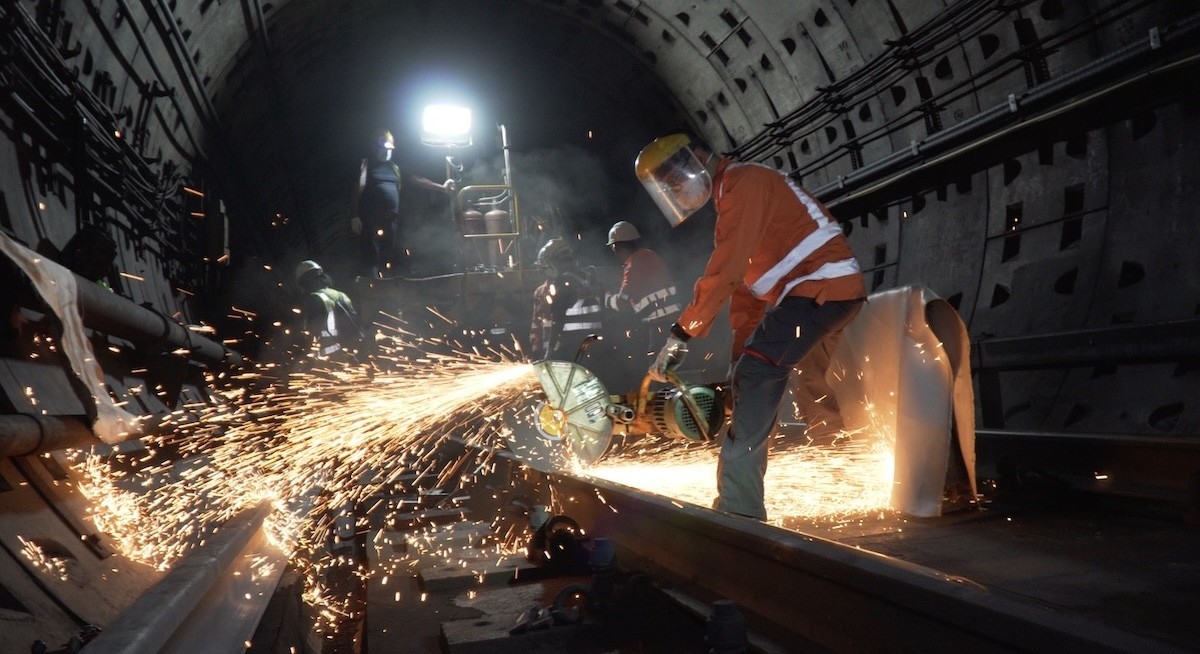
Getting that data ready meant standardising records from systems that have been running for up to 38 years, many of which were never designed to communicate with each other. The effort currently focuses on the North-South and East-West Lines, where most of the legacy infrastructure and maintenance challenges are concentrated.
Data quality and standardisation remain works in progress, with systems still being brought into the common architecture over time. Pulling what was ready into Oracle’s infrastructure has taken close to a year on top of that, and expanding beyond the current 50-user pilot will take several more years, shaped as much by the human challenge of changing how engineers work as by anything technical.
The use cases Jarvis supports today show what becomes possible once that foundation is in place. One involves predicting mechanical failures in the trackside equipment that switches trains between lines. If that equipment fails, a train cannot change direction and passengers are delayed. Since those failures tend to follow detectable patterns, the system can flag warning signs days ahead, giving crews time to carry out planned maintenance rather than emergency repairs.
A second use case covers the roughly 2,000 doors on the train station platforms of the two lines. Instead of cycling through all doors on a fixed schedule regardless of their condition, the system monitors how long each door takes to open and close, identifies those that are degrading, and helps teams focus their work where it is most needed. A door that might otherwise fail unexpectedly on a busy platform can be caught and fixed before it becomes a problem for commuters.
Soh is clear that not every failure can be caught in advance. Electrical faults can occur without warning and leave nothing useful in historical data. Jarvis does not try to predict the unpredictable. Its value is in handling the failures that do follow patterns, so that engineering attention can go where it is genuinely needed.
Jarvis remains in an early deployment phase, with Strides planning more rigorous measurement once it concludes. “We are going to scale that up in our subsequent deployments, and from there, we will go into quantification more accurately,” says Soh. The pilot is expected to wrap up in 2026, after which SMRT/Strides will consider expanding it to its other train lines.




