




Castlery joins over 10,000 B Corps across 103 countries and 160 industries. There are currently 104 B Corps included under the furniture industry on B Lab’s website. With 487 full-time employees, Castlery is the largest retail B Corp headquartered in Singapore by employee count, and ranks in the top 10% by size among B Corps headquartered in Asia.
To receive the certification, Castlery had to complete two B Impact Assessments (BIA) — one each for the developed and emerging markets, answering more than 500 questions in total. According to Castlery, more than 150 questions were reviewed during the process, for which it provided “detailed documentation”.

Declan Ee, Castlery’s co-founder and president, says customers “shouldn’t have to choose between furniture they love and furniture they feel good about”. “Having our business be B Corp certified recognises the work our team has done across product design, material sourcing and craftsmanship, and holds us to a higher standard as we continue improving how our furniture is designed and made.”
See also: The city that knows itself
Castlery released its first sustainability report in conjunction with the April 15 announcement, covering the company’s activities in FY2025 ended March 31, 2025. The 88-page report sets out how sustainability considerations are integrated across environmental, social, governance and economic aspects of its operations.
On emissions, Castlery says it has achieved carbon neutrality across Scopes 1 and 2 since 2023. The company does not generate Scope 1, or “direct” greenhouse gas emissions from its operations. To fully offset the emissions that arose from Castlery’s use of electricity in its operations — or Scope 2 — the company retired 610 Renewable Energy Certificates (RECs) in FY2025, up from 518 in FY2024.
In absolute, “location-based” figures, Castlery recorded 293 tonnes of carbon dioxide emissions equivalent (tCO2e) in Scope 2 emissions in FY2025, up from 237 tCO2e in FY2024.
See also: OCBC launches free ESG tool for more sustainable SMEs and supply chains
A Castlery spokesperson tells City & Country that the RECs are purchased from “credible, certified sources in the region, spanning solar, wind, hydro and biomass”. “The focus going forward is on reducing our actual emissions footprint, particularly on Scope 3, rather than relying on offsets alone.”
Across the 15 categories of Scope 3 emissions, the largest share of Castlery’s indirect emissions comes from Category 1 (purchased goods and services), at 84,034 tCO2e in FY2025, up some 11%.
Responding to City & Country, Castlery says it works with manufacturing partners across Asia, “the bulk of which is in Vietnam and China”.
Castlery says it is addressing its Scope 3 emissions by working with partners like Danish shipping and logistics giant Maersk to reduce ocean freight emissions by approximately 5,000 metric tonnes annually.
Maersk handles Castlery’s ocean freight, intermodal transport, distribution and warehousing needs. In FY2025, Castlery signed a 10-year ocean and integrated logistics agreement with Maersk, which reportedly reduced ocean freight emissions by 3,873 tCO2e in FY2025.
Responding to City & Country, Castlery says it will use a “mass-balance model” and purchase sustainable biofuels that are used in Maersk’s operations. Through the ECO Delivery 2.0 programme, Castlery purchases fuels and Maersk substitutes the equivalent volume of fossil fuel with biofuel elsewhere in their network. The process is externally audited by PwC, and delivers an 85% carbon dioxide emissions reduction on a well-to-wheel basis.
While Maersk is investing in green methanol-enabled vessels as part of their longer-term decarbonisation pathway, Castlery’s current partnership is on this certified biofuel programme.
While Castlery’s sustainability report contains climate-related disclosures aligned to the recommendations of the Task Force on Climate-related Financial Disclosures (TCFD) — the industry standard — the report is not externally assured. This “remains a future objective”, says Ee in his foreword.
Aside from emissions, Castlery says approximately half of all returned products are either donated or recycled, diverting them away from landfills.
Castlery has also cut expanded polystyrene (EPS) packaging by 80% for products weighing under 45kg. Across a third of its product range, Castlery has replaced EPS packaging with 100% recyclable corrugated board.

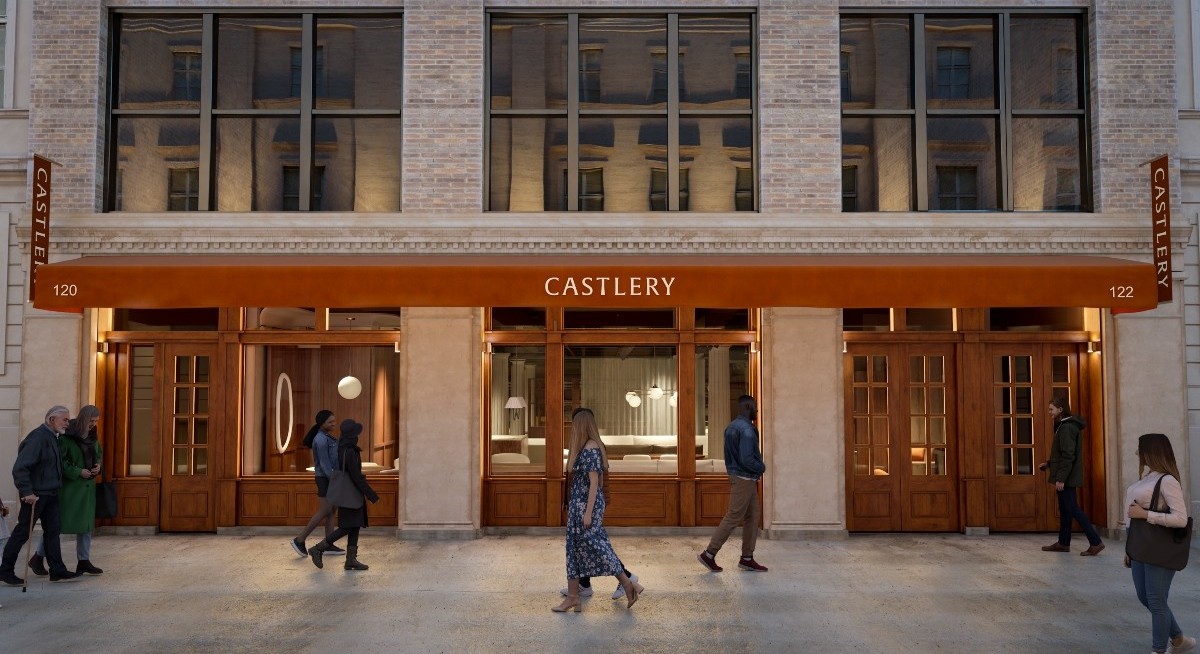
Since its start here in 2013, Castlery has grown to serve customers in Australia, the US, the UK and Canada. The US reportedly contributes about 70% of Castlery’s global revenue. Since entering the US market through its online store in 2019, Castlery will open its first physical store in New York this May, a 3,000 sq ft flagship in Manhattan’s Chelsea neighbourhood with a seven-figure investment and a 10-year lease.
This will mark Castlery’s fourth showroom worldwide, after it opened stores in Brisbane in August 2025, Sydney in June 2024 and Liat Towers in Singapore in 2022.
“We have always believed that great design should not come at the expense of the world we live in. As a father of three kids, the goal at Castlery was always to design furniture that is responsibly made, safe for the home and built to last,” adds Ee. “Becoming a certified B Corporation is a reflection of these values that have guided us since day one and a promise to customers, partners, and communities.”




