




Singapore’s office market is among the most tightly held in the region, with the Central Business District’s (CBD) strong grip on quality stock. Around half of our office supply is found within the Downtown Core, encompassing Raffles Place, Marina Bay and Shenton Way. Of this, approximately 70% comprises modern Grade-A developments, based on Knight Frank estimates.
This cluster of high-quality office space within a relatively small geographic area has naturally attracted institutional ownership, with prime buildings predominantly held by major developers, listed REITs and investment funds. While this has supported market stability, it has limited direct ownership opportunities for small- and medium-sized enterprises (SMEs), entrepreneurs and family offices looking to own rather than lease.
Participation in Singapore’s office market has traditionally been skewed towards leasing rather than ownership; against this backdrop of concentration and institutional control, strata office developments are a rare alternative, enabling occupiers and private investors to directly own a stake in Singapore’s tightly held office landscape.
The birth of strata-titled developments
The concept of strata office ownership in Singapore was formally introduced by the Land Titles (Strata) Act of 1967, which allowed buildings to be subdivided into individually owned units. Aimed at lowering the capital barrier for entrepreneurs, professional firms and SMEs to acquire office premises without needing to purchase entire buildings, this “bite-sized” ownership model opened the door for smaller businesses to enter a market dominated by institutional landlords.
Early strata offices like People’s Park Centre, Goldhill Plaza and International Plaza set the template for occupier convenience and visibility via central locations, excellent transport connectivity and integration with a mix of retail and residential options.
See also: Workspace typologies are shifting in Singapore: Knight Frank
In the late 1990s to early 2000s, newer-generation strata offices like Sunshine Plaza, Tong Eng Building and Samsung Hub introduced modern specifications: smaller yet highly functional units and enhanced management standards. This broadened the buyer profile beyond owner-occupiers to investors and family offices seeking long-term wealth preservation.
Among them, Suntec City’s office towers, which underwent enhancement work between 2012 and 2019, emerged as a benchmark for the segment. Today, these offices continue to record active and high-value resale transactions exceeding $3,000 psf.
Since then, new strata office supply has become scarce, largely due to stricter planning regulations limiting strata subdivision in key CBD areas and developers’ preference for whole-building ownership. Existing options continue to age, defining a niche shaped by limited supply, a captive pool of buyers and a scarcity premium.
See also: 14-unit strata office portfolio at High Street Centre for sale at $17.8 mil
Scarcity by design and market performance
Knight Frank data estimates that strata-titled offices account for only about 16% of the country’s total office leasable stock, with most concentrated in older developments constructed during earlier phases of Singapore’s commercial growth. Many of these now face ageing specifications, smaller and less efficient floor plates and progressively shortening lease tenures.
Supply will tighten even further. The Urban Redevelopment Authority’s (URA) March 2022 policy restricting the strata subdivision of commercial units within key CBD areas states that office space in these locations can no longer be subdivided into smaller strata units for sale, closing the door to new strata-titled office stock in Singapore’s core commercial precincts.
What exists today is largely what the market will have to work with, going forward.
However, the strata office segment still demonstrates resilient transaction activity and firm price performance. In 2025, 354 strata office units were transacted for $1.1 billion, exceeding the 330 units sold in 2024.
Activity remained concentrated in the CBD and city-fringe markets, with the Central Area accounting for 224 transactions (63% of total deal volume), representing approximately $892 million in sales value.

Leasehold strata offices — holding shorter tenure profiles — continue to dominate market activity, comprising about 70% of all strata office transactions in 2025. This reflects buyers’ continued willingness to acquire well-located leasehold assets with sufficient remaining lease life to support a viable investment and exit horizon.
A clear market preference for location and building quality is evident and for well-positioned assets with sufficient remaining lease life, demand has proven durable.
The scarcity premium is evident in newly launched projects, too. A notable example is Solitaire on Cecil, which came to market in March 2023 and sold out in 16 months.
The final three units transacted between $4,130 psf and $4,200 psf, highlighting robust demand and buyers’ willingness to pay a premium for new, well-positioned strata office product within the CBD.
Strata office pricing dynamics
A closer look at strata office transactions in the Central Area reveals that tenure and building age are the key factors influencing pricing. 999-year and freehold assets command a premium, with brand-new under-construction units averaging $4,166 psf, compared with $3,297 psf for leasehold offices of similar vintage.

Buyers seeking brand-new units with modern building specifications at lower entry price points will find more value in older or freehold stock. This suggests that well-located leasehold offices will continue to demonstrate pricing resilience and offer a more accessible entry point relative to older options.
Among resale transactions of leasehold strata offices located in the Central Area, larger units have outperformed smaller units since 2021. Comparing weighted average resale prices in 2021 versus 2025, units in the 2,001 sq ft to 3,000 sq ft and 3,001 sq ft to 4,000 sq ft bands rose 32% and 8%, respectively, while the 4,001 sq ft to 5,000 sq ft segment saw the strongest growth, increasing 25% to $2,758 psf from $2,209 psf.
In contrast, sub-1,000 sq ft units were the only segment to decline, falling 10% over the same period.

The trend reflects a straightforward supply-demand mismatch: larger floor plates are scarcer and owner-occupiers value them for layout efficiency, branding presence and room to grow.
The enduring value of strata offices
The case for owning centrally located strata offices is compelling, even as prices continue to trend upward.
The simple reality here is that these assets offer one of the few routes to direct ownership in prime Singapore locations and replacement supply is severely limited.
For many buyers, this appeal goes beyond smart economics; a CBD or city-centre corporate address conveys permanence, credibility and brand stature — qualities that remain especially valued among professional firms, family offices and established SMEs.
Importantly, the absence of additional buyer’s stamp duty or seller’s stamp duty widens the buyer pool. The transactional friction that constrains residential investment is also removed, while strengthening existing owners’ holding power.
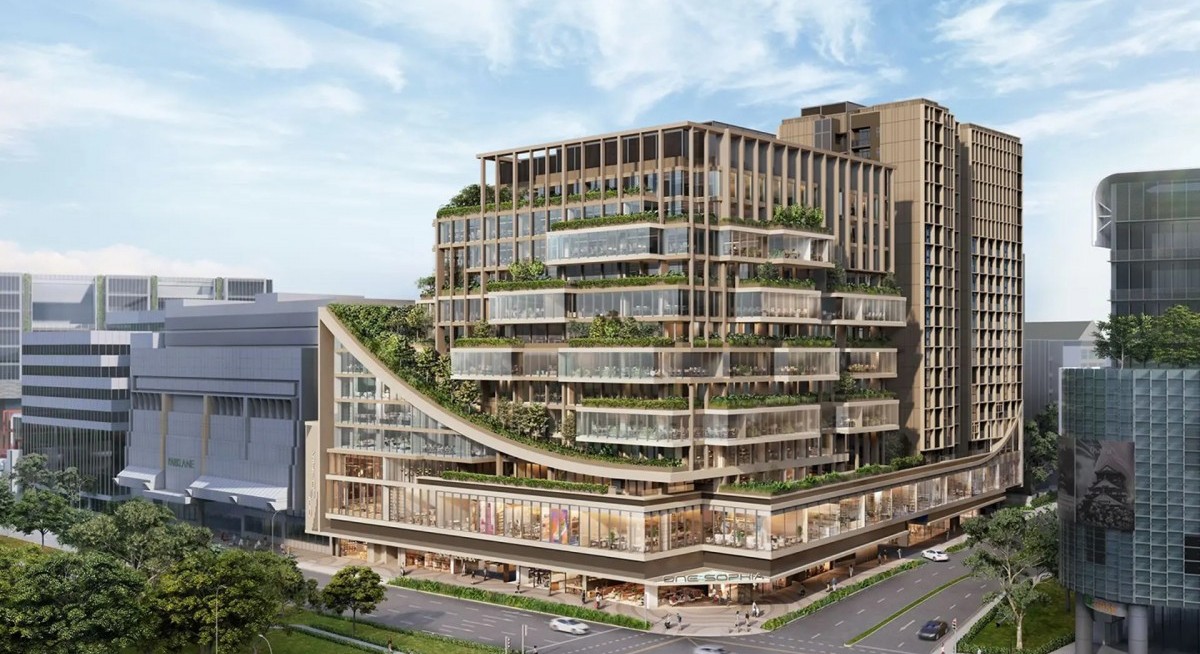
Upcoming offerings, The Golden Mile (TGM) and One Sophia, could further highlight how the strata office format will evolve to meet changing occupier preferences.

TGM’s concept of “heritage offices” proves such assets need not be confined to low-rise boutique shophouses. Its larger, more efficient floor plates and higher ceilings, complemented by a vibrant retail podium and medical suites, enhance long-term rejuvenation and rising activity as a live-work-play destination.
Similarly, One Sophia brings a contemporary mixed-use proposition to Dhoby Ghaut, one of Singapore’s most connected city-centre nodes. Businesses there will enjoy the connectivity and convenience increasingly expected of modern workplaces.
Together, these newer formats will speak to start-ups graduating from co-working spaces, firms rationalising their footprint and mature businesses seeking a permanent Singapore base with greater privacy and control.
The long-term thesis is straightforward: in the strata office market, supply does not respond quickly to demand because scarcity results from stringent government regulation. Buyers who secure the right asset early should enjoy capital preservation across market cycles.




