


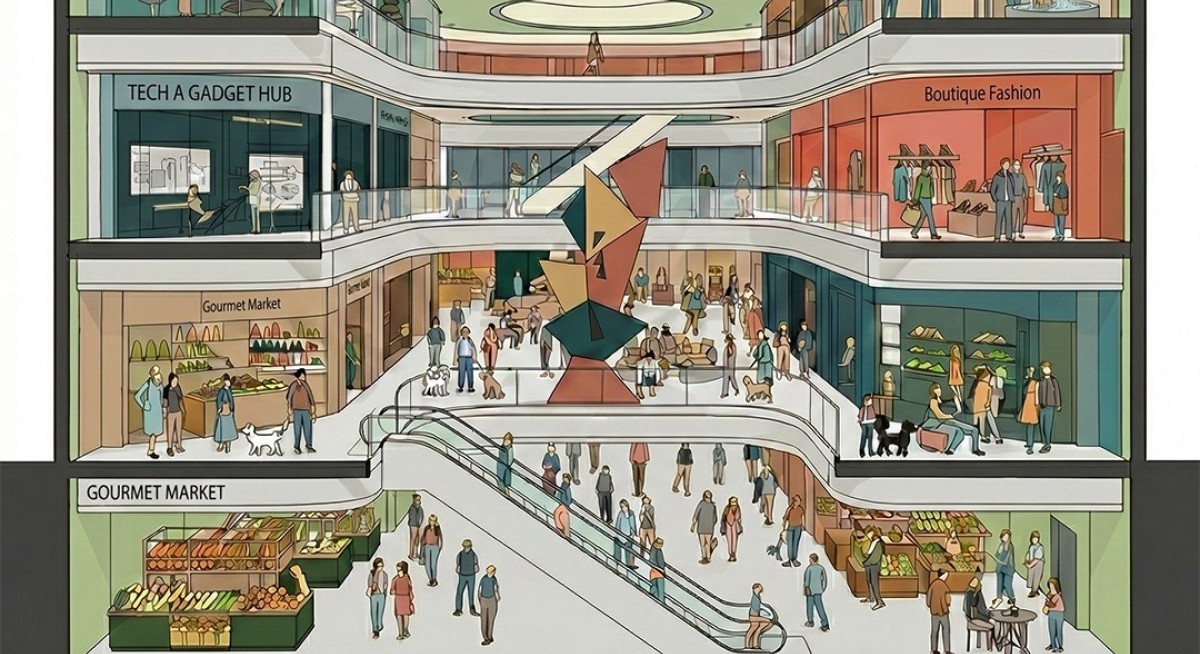


Over my 30 years as an architect designing mixed-use projects in urban settings — residential, hotels, offices and retail — success always hinges on how spaces are weaved into the urban fabric and everyday life.
Retail and hospitality form the public-facing heart. They require careful planning plus built-in flexibility to evolve with trends. That’s what makes positioning (or repositioning) retail assets so compelling: from upfront strategy to curating tenant mix and building a realistic long-term leasing pipeline.
In mixed-use, retail is the engine driving foot traffic, vibrancy and spillover value that elevates offices, residences and hotels. Without it performing strongly, the whole development can feel disconnected.
At the core of retail planning are anchor tenants — their placement and selection. These magnets establish identity and guide circulation. Thoughtful positioning (around location, size and visibility) sets the tone; without the right anchors, smaller tenants and the ecosystem often struggle.
The same logic applies to investors hunting undervalued assets: a project is truly investable only if a retail revival potential is realistic through permeable strategic planning, smart anchor placement and thoughtful adjacencies.
Tenant mix isn’t logo-chasing; it’s spatial synergy. How do long-dwell uses connect physically with quick-turnover ones? How does one feed the next to build momentum, not silos?
The goal is an ecosystem where tenants complement rather than compete fiercely, creating synergy that drives cross-traffic, longer visits and sustained vibrancy across the mixed-use stack. Owners make this seamless by crafting destinations where retail activates the neighborhood and keeps customers coming back.
Quality GFA, not just any GFA
Positioning retail is critical. It starts with high-quality gross floor area (GFA) and permeability, but tenant mix truly unlocks the potential.
Refurbishing an asset is often mistaken for a “refresh”. Among investors, there is a natural, almost instinctive tendency to focus on the packaging — the surface-level aesthetics like interior fit-outs, new signage or facade treatments. While these matter, they’re interchangeable over time. The true foundation of an asset’s success lies in its core planning and the quality of its GFA.
I’ve been reflecting on why some projects struggle despite significant refurbishment. Usually, it’s a fundamental conflict: maximising “sellable area” on drawings and spreadsheets versus ensuring actual commercial activation of the asset. Many owners instinctively push to maximise every centimetre of leasable space. Yet over‑optimising for square footage can deactivate the people flow a commercial property needs to thrive.
I see shopping malls with extensive street frontage — great visibility, perfect for integration with the neighborhood — yet layouts fixate on shop counts at the expense of permeability. When mall entrances are placed too far apart, a simple trip to an anchor supermarket can stretch into 400m roundtrip, even when the destination sits just 10m away.
Instead of pulling people in, the planning pushes them away. A high-end interior refit cannot solve a layout that fails sensible retail planning.
The same logic applies when common areas are minimised to enlarge individual shop sizes. On paper, those units look like profit‑makers; in reality, they’re hidden deep in the floor plan, with no connectivity or visibility to the street. By prioritising size over presence, visibility and frontage are sacrificed. These units become the hardest to lease because they lack the physical presence to engage the market.
Core planning decisions such as connectivity, permeability and people flow are permanent. Interiors can be refreshed next year, but a planning failure that blocks customers is far harder to fix.
Strategic planning isn’t a cost; it’s capital protection. It’s the foundation that secures return long after the packaging fades.

Joey Wong is founder and principal architect of Place Architects, and founder and principal adviser of Place Developments, a strategic real estate advisory. This piece is adapted from two LinkedIn posts by Wong on tenant mix and strategic design




