


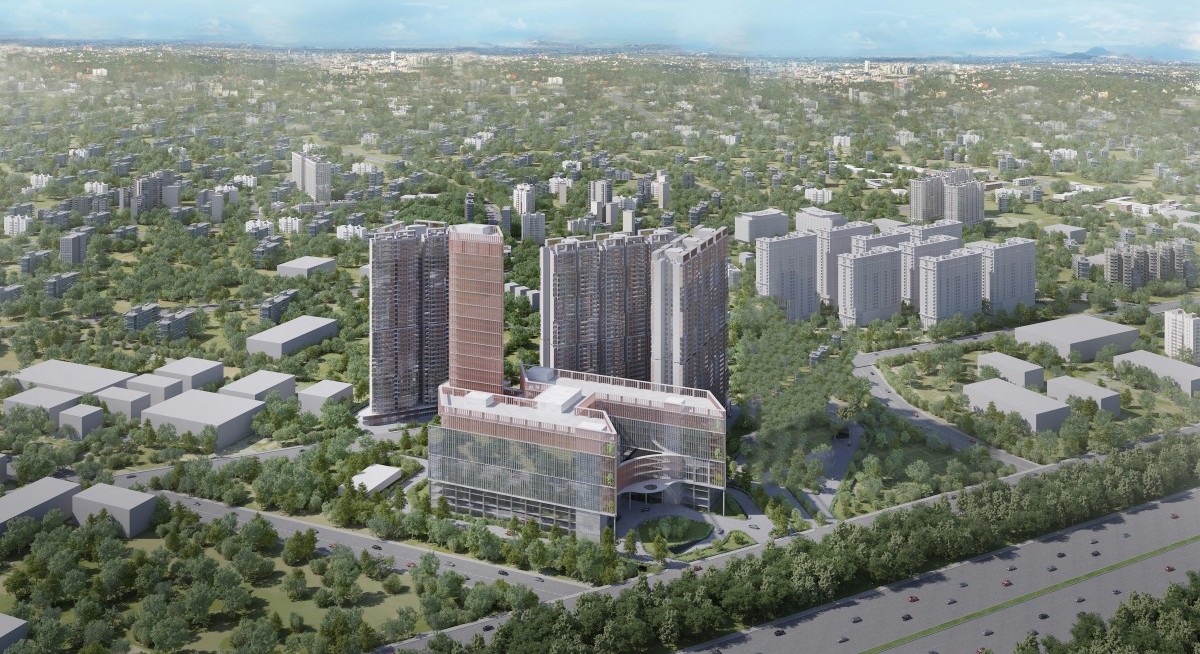


Listed on the Singapore Exchange Mainboard since December 1995, Thakral announced in January that it had entered into agreements to raise its stake in TIL Investments, the entity that owns the Gurugram land, from 13.64% to 95.28%, for $93.9 million. This is subject to shareholder approval at an upcoming extraordinary general meeting to be called.
The move reflects Thakral’s conviction that the parcel can support a large mixed-use development with healthcare at its core.
The land has development potential of more than 2.5 million sq ft and the group has said the project is expected to include a hospital, a health and wellness centre, as well as residential and commercial components.

See also: Fewer GCB deals in 1H2026, but larger quantums lift average psf near record: PropNex
For Thakral, the hospital is not simply one building on a large land bank; it is the starting point for a longer value-unlocking strategy in the fast-growing corridor of New Gurugram, where the group believes infrastructure, housing demand and commercial expansion are converging.
CEO and executive director Inderbethal Singh Thakral says the company is bullish on the scale of value creation possible over time. “We are excited this year, because of our initiative to move forward [in Gurugram] and unlock value for this project. It’s going to be so enormous over there,” he says in an interview with City & Country.

See also: ‘Breathe life’ into precincts by investing in commercial property: Steward Asia
The project is still in its early stages, but the group is clear about the steps it is taking to unlock value on this plot of land. Rather than competing head-on with the surrounding wave of residential launches, Thakral wants to position the site as essential infrastructure for an area that is being rapidly built out.
Inderbethal’s view is that a hospital, followed by a complementary wellness ecosystem, can create a destination that generates recurring income and raises the value of the remaining land.
Gurugram’s potential
Location is key for this land parcel. The way Inderbethal sees it, the site is strategically located in the centre of “New Gurugram” and within the National Capital Region (NCR), where urban sprawl has steadily pushed activity away from tighter parts of Delhi and into Gurugram’s newer growth corridors.
Gurugram accounts for 61% of total office leasing in Delhi NCR, according to JLL Research data in slides shown for Thakral’s results for FY2025 ended Dec 31, 2025.
According to CBRE Research, Gurugram is also India’s fastest-growing high-end luxury residential market, notching $3.36 billion in residential transactions in 2025.

Inderbethal says the company first spent years studying the best use of the land, with location ultimately shaping the decision. “We’ve been working on this for the last three years, maybe even slightly more. First, initially, trying to understand what will be the best use of this land, given its location,” he says.
To recap, Inderbethal shares that his father, along with some family members, purchased this piece of land some 30 years ago. “My father’s selection of properties has always been excellent… location must be excellent,” says Inderbethal.
The group has identified multiple demand drivers around the site. Large residential projects are already being launched nearby, and developers are marketing high-end apartments with pre-sales that have reportedly been snapped up quickly.
The broader area is also expected to benefit from infrastructure upgrades, including metro connectivity and proximity to major roads linking Gurugram to Delhi and other key nodes. Thakral says the site sits in an “intense zone” under government policy, which could offer additional flexibility for mixed-use development over time, subject to approvals.
The group views Gurugram as one of the most influential urban nodes in the Delhi NCR, supported by rapid urbanisation, planned infrastructure and demand for integrated developments. The group says the proposed increase in ownership reflects how the project has moved beyond a pure land-holding phase and into a more defined development trajectory involving regulatory discussions and talks with potential partners and operators.
While a passive land bank can sit on a balance sheet for years, a land parcel with a clear use case, advanced planning, operator discussions and surrounding demand can be worth much more.
Thakral first acquired its 13.64% stake in the site in 2024. In 2025, the group recognised a fair valuation uplift of $9.2 million from this investment.
Management has indicated that the project will be a long-term growth engine alongside its lifestyle business and investment portfolio. In its FY2025 results, the group says it sees “meaningful long-term value creation potential” as development progresses.
Still, the company is not approaching the site as a blank slate. One constraint is that much of the land is institutional, which makes healthcare and related uses more logical than a purely residential play. Institutional land refers to land designated by the government for facilities that serve the public, including hospitals, educational institutions and government offices.

Another challenge is competition. Inderbethal says there is already significant residential activity in the area, and going directly into the same segment may not be the best way to maximise value.
According to Indian business daily The Economic Times, there is a pipeline of 11,958 homes under construction in the vicinity of the site as of 3Q2025.
This includes DLF Privana, a premium 116-acre township with over 4,000 residential units selling at $320 psf.
“For us to go head-on and compete in the residential space makes no sense. Instead, let’s look at how we can facilitate that whole area and see how we can complement everybody,” he says.
Healthcare destination
The first property planned for the site is a hospital. Inderbethal says that the group has narrowed a shortlist of “tier-1 hospital operators” and is in the process of selecting one.
The selected operator will support the group’s hospital construction, thereby de-risking execution and operations. Under this unique business partnership model, Thakral will neither be the hospital operator nor fund the hospital’s construction. The selected operator will be responsible for building and operating the facility, while Thakral participates by providing the land and an economic arrangement that can provide recurring revenue.
“Once you create a hospital, that becomes a destination,” says Inderbethal, who sees a gap in the local catchment and believes this project intends to fill it. Currently, there is no hospital within a 5km radius of the site, based on the company’s studies, while the surrounding area is seeing a build-out of housing and commercial activity.
Hence, the project is expected to meet a local healthcare need while serving as an anchor for the broader development of the plot of land.
Aside from the hospital serving nearby residents, the group is optimistic that Gurugram’s connectivity could support medical tourism from other Indian states and neighbouring countries. The site is also located about a 23-minute drive from the Indira Gandhi International Airport.
The hospital’s proximity to the airport, along with cost-conscious overseas Indians and regional patients, could spur demand for this upcoming hospital, says Inderbethal. He also observes a common trend among expats worldwide: they prefer to return to their home country to seek treatment.
“A lot of Indians, if they have health problems, will come back to India to seek treatment,” says Inderbethal, who believes cost and service efficiency there is better than that found in the West.
Meanwhile, the hospital’s eventual size has not been finalised, but expectations point to a range of 600 to 900 beds. Inderbethal also suggests the facility could take years to fully ramp up, which is one reason the group sees this as a long-duration project rather than a near-term earnings event.
In his view, that is acceptable because the hospital is intended to establish the ecosystem around it, not merely provide an immediate return.
The hospital is also meant to be the anchor property for the larger plot of land. Securing the operator and launching the hospital pave the way for the group to start making firmer decisions about the rest of the land. The group says approvals and planning could take around 10 to 12 months once an operator is locked in.
Wellness supports healthcare
With the hospital as the anchor, the wellness centre is meant to be the project’s most important follow-up piece. Thakral sees it not as a generic medical office block, but as a complementary ecosystem that feeds into the hospital and makes the overall site more valuable.
Inderbethal describes the concept as a non-competing extension of the hospital. “For the wellness centre, we are looking to include tenants that are non-competing clinics that can feed into the hospital business, such as dental clinics and ophthalmology clinics.”
That could suggest a campus model that links to the hospital rather than a standalone tower. While initial plans include the clinics, the group is also considering leasing space to other health-related services, as well as a service apartment component and a small retail segment.
Management has made clear that it does not currently envision a large retail asset beside the hospital. Instead, the idea is to build enough supporting activity to serve patients, families and healthcare tenants, but not to dilute the site’s healthcare-led identity.
The wellness component is also where Thakral plans to retain more direct exposure. The hospital is expected to be built and operated by a hospital operator, but Thakral intends to keep it within the group — it will develop, own and then lease out the space. “We plan to hold this [wellness centre] for [recurring] rental income,” says Inderbethal.
With this plot of land, the group aims to combine recurring revenue from the hospital and wellness centre. At the same time, a potential residential component could generate development profit or a revenue share over time. That said, Inderbethal is aware that a stabilised wellness asset could create annuity income and asset value over a much longer horizon.

As the wellness centre will be owned and operated by the group, Inderbethal is exploring the potential to grow this “brand” beyond the Gurugram space and replicate it elsewhere.
Although several of Thakral’s ambitions for this land remain aspirational, the group’s focus on the order of development, starting with the hospital, explains its strategy — to establish it as a healthcare and wellness hub and build around that.
On a potential residential portion, the group is keeping its options open. Inderbethal says Thakral has spoken to several developers and understands the likely economics of a joint development agreement, in which the developer would take on approvals, construction, sales and marketing in return for a revenue or area share.
Such a structure would de-risk that part of the project for Thakral and could generate substantial cash flow over time, he adds. But Inderbethal also indicates that management does not want to rush into a deal at the wrong point in the cycle.
While Inderbethal admits there is a lot of value to unlock on this piece of land, the group will take a cautious approach to how each space will be properly monetised, rather than rushing to develop the whole 21 acres at once. It wants to sequence the land so that each piece raises the value of the next.
Thakral will share more details about the Gurugram project at its upcoming annual general meeting (AGM). While the date of the AGM has yet to be announced, the group typically holds its AGM at the end of April.
“For the next 15 years, we will unfold our larger plan [for the land]. We will keep looking at how we can enhance the value, while managing the risks for ourselves,” says Inderbethal.
Photos and infographics: Thakral Corporation
For more property trends and breaking news, visit City & Country’s microsite at theedgesingapore.com/cityandcountry




