




As at March 31, FPI’s non-REIT Australia portfolio comprised 55 assets valued at $3.4 billion, while its non-REIT Europe portfolio comprised 20 assets valued at $0.9 billion. Frasers Logistics and Commercial Trust’s (FLCT) Australia portfolio valuation stood at $3.2 billion, comprising 61 industrial and logistics (I&L) assets and three commercial assets; its portfolio in the EU comprises Germany (33 I&L assets) and the Netherlands (seven I&L assets) at $1.8 billion and $0.4 billion, respectively.
“Based on our first half-year results, we’re at $12.7 billion of assets under management, with 188 completed properties across those five countries,” says Reini Otter, CEO, FPI. In addition to Germany and the Netherlands, where FPI develops, leases and manages assets, FLCT has a presence in Singapore and the UK.

“A key strategic element of the business is our land bank. We’ve got about 2.7 million sq m of land bank. Our pipeline generally consists of 10 to 15 projects underway at any one time, roughly around 300,000–400,000 sqm overall,” Otter says.
See also: $1 bil ‘well-being destination’ Therme Singapore breaks ground at Marina South
FPI’s strategy is to build the best assets in the best locations. “What really matters for us is prime assets in core locations. We’re not after scale for its own sake. We focus very heavily on quality; that’s proven by the awards we win and, importantly, by the GRESB rankings we’ve achieved over the years. We’re not aiming to be the biggest, but we do like to think of ourselves as one of the best operators in this sector,” Otter explains. GRESB is the provider of sustainability data and environmental, social and governance (ESG) benchmarks for property assets.
Having a strong GRESB sustainability score or ranking offers improved access to capital and enhanced market credibility. A high GRESB ranking indicates the company is an industry leader, making it easier to attract global investors and secure sustainability-linked loans on better terms.
GRESB also allows companies to compare their portfolios’ ESG performance to that of peers. High GRESB rankings correlate to green-certified, high-performing buildings. Modern corporate tenants increasingly demand spaces with low carbon footprints and excellent occupant well-being, giving certified portfolios a clear occupancy advantage.
See also: Sunway MCL, CSC Land JV tops four bids for River Valley Green (Parcel C) GLS site at $1,730 psf ppr
At its core, FPI develops mainly I&L properties. Sometimes, the properties are offered to FLCT; some are kept on FPI’s balance sheet, and FPI has partnered with third parties to own and manage assets. “We think of FPI as industrial and logistics specialists across the full value chain. That’s everything from development all the way through to portfolio management; the flywheel of acquire, develop or add value, recycle and reinvest is very important as it kind of shapes where we build and how long we hold it for,” Otter adds.
On partnerships
How capital is managed is central to FPI’s portfolio management. FLCT is FPI’s preferred capital partner. The REIT has a right of first refusal (ROFR) to FPI’s properties.
“The REIT perspective gives FLCT access to a pipeline of prime assets that we develop that they would otherwise have to source on an open market competitive basis, and that is fundamentally the value proposition of a sponsored REIT. It also allows the balance sheet to have a partner to take the assets out on known terms in a very transparent, independent and arm’s-length process. That alignment really matters,” Otter explains.
In Australia, the strategy is to use FPI’s balance sheet to develop and own properties. FPI does everything from aggregating multiple sites over many years, securing rezoning, getting all the planning permits and infrastructure ready, bringing the services online and securing a tenant. FPI bears the construction and leasing risk, which is often outside of the risk appetite for FPI’s partners.
In Europe, FPI sometimes acquires obsolete, disused manufacturing facilities. “We’ll demolish it, clean it up, get the approvals, build, lease and then sell. It’s about matching the product or the risk appetite to the partner,” Otter says.
Beyond FLCT, FPI has partnered with Morgan Stanley Real Estate Investment and Aware Real Estate, which is the property platform of Aware Superannuation Fund. In April 2025, FPI announced its first capital partnership in Australia with an investment vehicle sponsored by Morgan Stanley Real Estate Investing (MSREI).

Wurth Vantage Yadala, Queensland, is a joint venture between FPI and Morgan Stanley Real Estate Investing (MSREI)
Named the Frasers Prime Logistics Venture, the 50-50 joint venture covers a portfolio of eight major industrial assets located in Sydney and Brisbane. Spanning a total gross floor area (GFA) of 188,000 sqm, the portfolio is valued at approximately A$600 million ($542.82 million). It is fully leased, with 11 tenants.
In October last year, FPI’s partnership with MSREI expanded to include a portfolio of nine industrial assets from FPI. Located across New South Wales, Queensland and Victoria, the assets span approximately 163,000 sqm in gross floor area and are valued at around A$500 million.
The expansion introduced a newly established joint venture, Frasers Logistics Partnership, which will hold four assets, while five assets, including one under development, will be added to the Frasers Prime Logistics Venture announced in April 2025.
“The Morgan Stanley relationship is a good example of what institutional appetite is for assets of our quality when the conditions are right, so we aren’t running a single channel model; we’re running a platform with multiple exit options, and I think that is the right discipline for a portfolio of this scale,” Otter says.
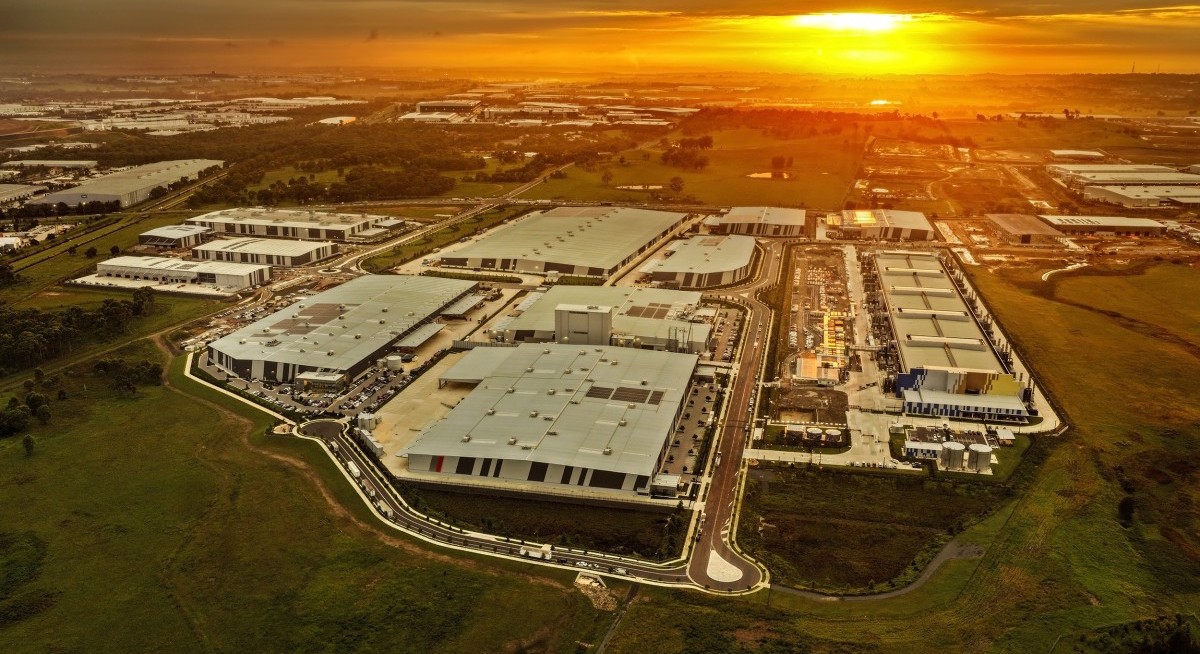
In 2020, FPI started developing 118ha of industrial land in Kemps Creek, Western Sydney, New South Wales (NSW). In 2022, FPI entered into a A$1 billion joint venture with Aware Real Estate for The Yards in Kemps Creek.
The Yards received industry recognition for the ARDEX Oceania headquarters, which won Best Industrial Development at the 2025 Urban Development Institute of Australia (UDIA) NSW Awards for Excellence. In addition, FPI’s Probiotec Multipack at The Yards was granted the first National Australian Built Environment Rating System (NABERS) embodied carbon rating.
More recently, in April, PIP ANZ, formerly Bisley Workwear Australia, officially opened its new purpose-built facility at The Yards.
“Beyond FLCT, we do look at the full range of capital channels that depend on the market, the environment, the structure and the partner at the time,” Otter says.
How long FPI holds on to the assets depends on the conditions. Some have been recycled immediately on completion, while FPI has held on to assets for more than 10 years. “We look at the asset itself, we look at the market, we look at what the business needs at the time, and then we make a strategic call on that,” Otter says.

The Yards received industry recognition for the ARDEX Oceania headquarters, which won Best Industrial Development at the 2025 Urban Development Institute of Australia (UDIA) NSW Awards for Excellence
Logistics as part of the ecosystem
FPI has been in operation for 100 years and Otter points to the company being ranked among the top three developers in Australia in terms of bringing in new stock and the highest quality developments.
“We’re extremely data-driven, so where you buy land, because fundamentally, we come from a development background, is extremely important,” Otter indicates.
Secondly, industrial property is relationship-driven, so longevity in the market and relationships carry weight. “I will get calls from customers I’ve dealt with over a decade ago looking for the next transaction, so we will always, if we do a transaction with one person in one state, we’ll look to repeat that somewhere else,” Otter adds.
Thirdly, customers look for efficiency. Third-party logistics providers (3PLs) measure their returns on the efficiency of the properties they occupy. “Nobody relocates to a new industrial facility unless they can improve business efficiencies. Logistics assets are not a discretionary purchase; it’s a utility purchase. We want to help our customers improve their business efficiency,” Otter explains.
FPI has gone beyond just building warehouses by positioning its assets as part of the supply chain ecosystem, which resonates with institutional investors. “Probably the biggest change is that when I started in the late 1990s, not many people wanted to be involved in industrial [assets]. Now, it’s a global institutional asset class, and everyone wants to be involved, so that’s probably one of the biggest changes,” Otter says.
As an institutional asset class, its customers’ digitalisation, robotics, AI, autonomous vehicles and other increasing needs including energy imply that industrial property is no longer simply a collection of buildings.
“It’s not just buildings needing more power and higher floor loadings, although they do. The more interesting design challenge that I see play out is that every city has a different supply chain. The logistics network that serves Sydney looks nothing like the one that serves Amsterdam. I’ve been coming at this from an architectural design perspective, both in terms of the logistics infrastructure and the building itself. Understanding those differences is important for building design, because the building is part of a system that’s city-specific,” explains Otter, who trained as an architect.
The tension is between optimising for automation, but retaining the flexibility to change the infrastructure within the building when technology and customer demand change over time. Warehouses are long-lived assets; but often the smart technology inside them has a shelf-life.
“Every generation of technology is designed to solve a problem. What we’ve learned is that flexibility and adaptability are the enduring design requirements,” Otter concludes.
Photos: Frasers Property Industrial




