




According to CLI’s six-page research report titled Tracking AI’s impact on offices and business parks in Apac, AI is “unlikely to reduce the relevance of physical workspace across Apac any more than Covid-19 did, but it will reshape its purpose and value”.
“Demand will become more selective, concentrating in locations and assets that can support innovation, coordination and still-nascent but increasingly complex human-AI workflows,” say authors Tran Hanh Linh and Wayne Teo from CLI.
At the same time, space that is unable to adapt to these requirements will face growing structural headwinds, reads CLI’s report, released April 9. This is accelerating a “K-shaped divergence” where “high-specification, well-located and infrastructure-ready assets will remain integral to business operations, while commoditised space will face structural pressure”.
Across the Asia-Pacific region (Apac), office employment is projected to grow steadily by 3.5% in 2026, according to CBRE’s 2026 Apac real estate outlook. However, office occupiers’ expansion plans vary significantly by country and sector.
The technology sector (which includes AI) recorded the highest proportion of occupiers planning to expand, led by China, Singapore and India. In contrast, fewer than half of tenants in other sectors indicated intentions to expand, notes CLI.

S’pore as an Apac HQ
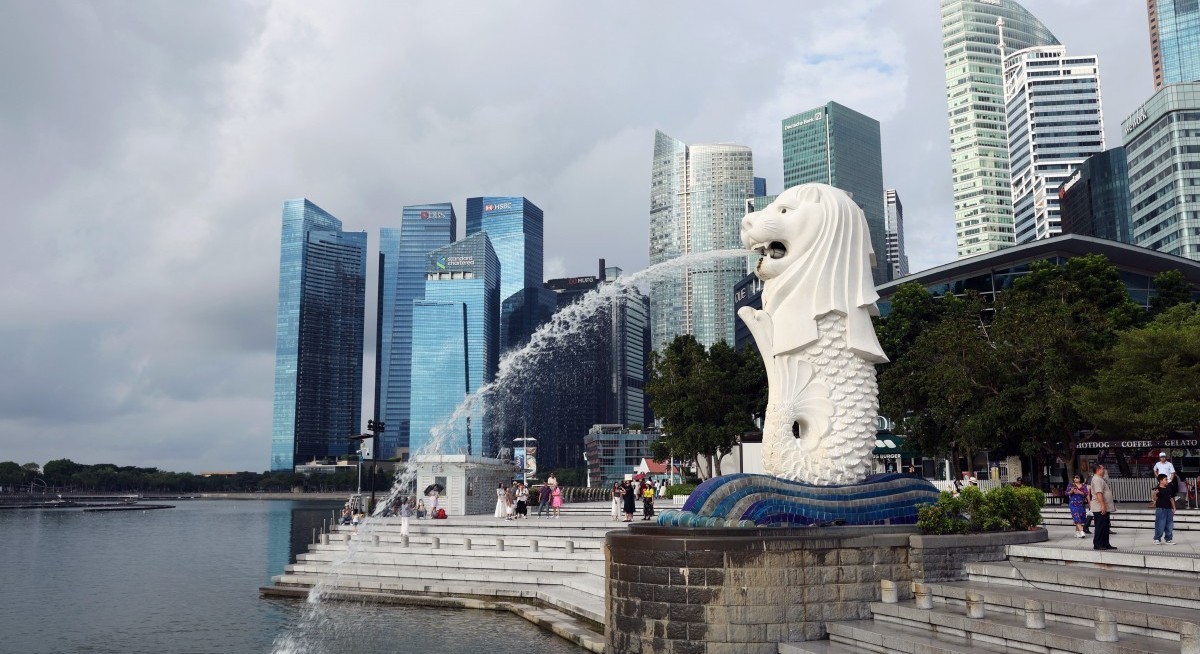
Growing AI adoption is shaping office demand in Singapore, with both traditional sectors and AI-native occupiers seeking “premium, strategically located Apac headquarters (HQ)”, says CLI.
Greater use of AI workflows, analytics and digital tools is driving tenants to prioritise “high-quality, well-located and amenity-rich offices”, reinforcing the ongoing flight-to-quality trend, adds CLI. “Demand is coming not only from AI-native firms but also from traditional sectors like financial institutions, legal and professional services, which are increasingly integrating AI into their operations.”
According to CLI, some of the largest AI players in the quantitative finance sector operate at CapitaSpring and Raffles City Tower, with one firm demonstrating “cross-market synergies” in Singapore and Shanghai.
But stronger demand for prime Central Business District (CBD) office space in Singapore is meeting a supply crunch that is set to last for the next two years. Only 0.35 million sq ft of new space is expected by 2028, underpinning projected rental growth of around 4.4% per annum between 2026 and 2028.
CLI says past declines in Singapore business park occupancies due to hybrid work and back-office offshoring have “stabilised”. Instead, tenants are now exploring expansion after experiencing the effects of “over-consolidation”, claims CLI.
“Despite caution on long-term commitments, AI has not led to reduced space requirements or downsizing,” adds CLI. “Business parks with technology, biomedical and research tenants remain resilient, supported by nearby research institutions, hospitals and the growing AI ecosystem.”
Kampong AI, the integrated start-up community at one-north announced during Budget 2026, is expected to anchor approximately 70 additional AI firms in the area. In addition, CLAR’s upcoming 11-storey 27 International Business Park near the Jurong Lake District, “will further strengthen demand for high-quality space”, says CLI.
India’s large AI workforce
India’s large and young AI-ready workforce is translating directly into rising occupier demand, as global corporations increasingly channel AI-related investments into the country, says CLI.
India’s AI workforce is projected to comprise some 1.25 million professionals by 2027, with the AI market there projected to grow at 25% to 35% through 2027, according to Deloitte.
India also leads in AI hiring growth and accounts for 20% of all AI projects globally on GitHub, ranking second, according to the Stanford Institute for Human-Centered Artificial Intelligence.
Global Capability Centres (GCCs) are the largest driver of Grade-A office demand in India. These offshore entities established by multinational corporations (MNCs) are expected to account for 35% to 40% of total office leasing demand in 2026, consistent with the historical average of 38% between 2020 and 2025, according to CBRE.
New growth is anticipated from mid-market companies, global unicorns and emerging sectors. Bengaluru, Hyderabad and Delhi are the top three metros for GCC expansion; together they accounted for 69% of total GCC absorption in 2025, according to CBRE.
CLI says tenants there are focusing on integrated technology parks and campus-style environments to accommodate larger, more complex and innovation-led teams. “For example, a global software development services provider serving leading technology firms such as Google, AWS and SAP leased over 125,000 sq ft in the last few years at International Tech Park Hyderabad, with further expansion planned in 2026.”
In 2026 and 2027, around 45% of new office supply in India is expected to be Grade-A, with around 65%-68% located within integrated technology parks, up from 54%-58% in 2024 and 2025, says CBRE.
China impacted by supply glut, headwinds
China’s AI development is perhaps most recognised through DeepSeek, which launched a generative AI chatbot in January 2025 that rivalled models from the West, reportedly at a cost of just US$5.6 million.
AI is emerging as a meaningful source of new leasing demand for both China’s offices and business parks, says CLI, but there also has been some space consolidation due to AI-driven optimisation.
Still, broader macroeconomic headwinds remain the main drag, adds CLI. In 2025, nationwide average office rents declined 10.4% y-o-y, the second-largest annual decline since 2008, while vacancy rose 1.3% y-o-y to 24.7%, reflecting supply additions (4.43 million sqm) that continue to outpace demand (2.15 million sqm).

CLI believes there are early signs that demand is stabilising. Full-year net absorption surpassed 2 million sqm for the first time in three years, while expansionary momentum from the technology, media and telecommunications sector drove Beijing's vacancy to its lowest level in three years.
Leasing demand is becoming more concentrated in specific submarkets and asset types aligned with AI development, even as broader market conditions remain challenging, says CLI. “This suggests AI is becoming a more measurable demand at the submarket level, but remains insufficient to absorb the broader supply overhang.”




