




Economic impact
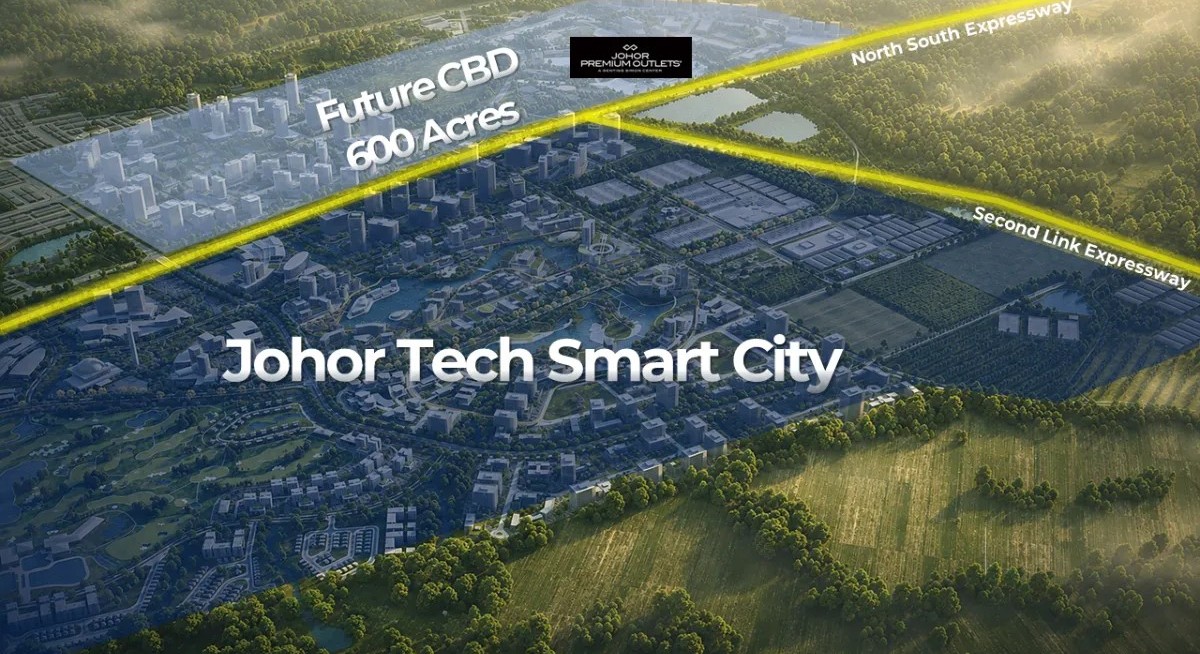
The project operates across several economic multiplier channels. At a GDV of RM80 billion, JTSC anchors a substantial portion of the JS-SEZ’s credibility as an investable zone and is expected to catalyse land value appreciation across the Kulai-Senai corridor.
Employment creation spans AI, smart agriculture and research roles, with the Johor Talent Development Council coordinating federal and state agencies, universities and TVET (Technical and Vocational Education and Training) institutions to build the required talent pipeline.
Crucially, the project arrives at a pivotal moment. The JS-SEZ blueprint is still being finalised and is expected to be formally signed by the Malaysian and Singapore governments before end-2026.
See also: Resorts World Sentosa suit: Malaysian court rules gambling debt not enforceable
This development signals strong private-sector confidence ahead of that milestone, potentially accelerating broader foreign direct investment into the zone.
Beyond commercial value, the AgTech Campus directly addresses food import dependency, a structural cost for both Malaysia and Singapore, carrying sovereign economic significance that extends well beyond its commercial GDV. An embedded 100-acre solar farm further reduces grid dependency, improving the project’s long-run cost competitiveness.
Sectors that will benefit
See also: Malaysia eyes regional leadership in low-altitude economy as drone rules take shape
Technology and AI
The 688ha Knowledge AI Campus, anchored by a 430-acre innovation hub built on Huawei’s infrastructure blueprint, will directly benefit data centre operators, AI solution providers and digital infrastructure players.
AgTech and food production
The AgTech Campus is built around three components: SEEDS (crop and seed R&D), SUPERFARMS (smart cultivation and scalable crop production) and SPROUT (a commercial and lifestyle hub incorporating farm-to-table experiences, educational tourism and international conferencing).
Beneficiaries include precision-farming companies, agri-input suppliers and cold chain logistics operators.
- Real estate and construction: The 2,300-acre master plan will generate sustained construction activity across industrial, commercial and residential segments, with positive re-rating expected for surrounding land in Kulai-Indahpura.
- Education and TVET: The talent pipeline mandate creates direct demand for universities and vocational institutions to co-locate or partner with the development.
- Hospitality and agri-tourism: The SPROUT component introduces a nascent but high-growth agri-tourism concept, particularly attractive, given Singapore’s cross-border visitor flow into Johor.
- Renewable energy and logistics: The embedded solar farm creates demand for EPC (engineering, procurement and construction) contractors and energy management firms, while Kulai’s position on the North-South corridor and proximity to Senai Airport position it well for supply chain integration serving both campuses.
Recommendations
Five priorities stand out. First, the JS-SEZ regulatory framework should be fast-tracked, with Kulai explicitly mapped within the incentive structure for tech and agri-tech sub-sectors ahead of the year-end signing.
Second, Singapore market linkages should be formalised through offtake agreements and supply partnerships with food distributors or sovereign entities, hardening demand and unlocking co-investment.
Third, structured SME participation, through a vendor development programme and dedicated SME zones within SPROUT or the innovation hub, would ensure meaningful trickle-down economic participation, consistent with the Johor Menteri Besar’s stated intent.
Fourth, talent-readiness must be actioned during the pre-construction phase, not deferred: Curriculum alignment, apprenticeship pipelines and graduate placement agreements with anchor tenants should be locked in early.
Fifth, integrating E-ART (Elevated Autonomous Rapid Transit) or bus rapid transit feeder connectivity to the Johor Bahru–Singapore Rapid Transit System (RTS) Link would expand the effective talent catchment area and strengthen the cross-border Singapore-Johor worker dynamic.
Key challenges and mitigations
Execution and phasing risk is the most immediate concern. An RM80 billion project across 2,300 acres represents a decade-plus build, and early phases risk appearing underpopulated without disciplined sequencing and anchor tenant commitments.
Quick-win zones, particularly the innovation hub core and a SUPERFARMS commercial pilot, should be prioritised to generate visible early economic activity.
Geopolitical technology exposure arises from Huawei’s role as the infrastructure blueprint partner for the Knowledge AI Campus, which may deter Western-aligned foreign direct investment.
Technology-neutral zoning with clearly demarcated, sovereign-compliant infrastructure options for non-Huawei operators is the recommended mitigation.
Talent supply-demand mismatch is structurally significant. Johor currently lacks the depth of AI, robotics and precision agriculture talent required for a 10,000-strong specialised workforce.
Early memorandums of understanding with universities, international student attraction programmes and a work-pass framework enabling Singapore-based professionals to work on the Johor side are essential lead-time investments.
Agricultural commercialisation risk is real: AgTech developments are capital-intensive, with long payback cycles.
The involvement of China Shouguang Vegetable Industry Group, DAYU Irrigation Group Co, XAG and AIRSAT Technology Group provides operational credibility, but these partnerships must be structured as active joint ventures, not advisory arrangements.
Infrastructure-readiness — power, water and broadband at the scale of a combined AI campus and large-scale smart farming operation — requires early engagement with Tenaga Nasional on grid reinforcement and the National Water Services Commission on water supply, ahead of development approvals.
Outlook
The project is likely to unfold in three phases.
In the near term (2026 to 2028), critical milestones include the JS-SEZ agreement signing, early Knowledge AI Campus infrastructure works and the first SUPERFARMS commercial pilot, with positive land market re-rating in Kulai anticipated through this period.
In the medium term (2029 to 2032), operational activation of the innovation hub and AgTech components should attract secondary tenants and trigger supporting residential, retail and hospitality development, with SME spillover effects becoming measurable.
In the long term (post-2032), if well-executed, Johor Tech Smart City could emerge as Southeast Asia’s most credible integrated AgTech-AI urban node, directly advancing the Maju Johor 2030 agenda.
The risk remains that ambitious Malaysian master plans have historically underdelivered on anchor tenant conversion and infrastructure timelines.
The differentiating factors here are Genting Group’s balance sheet depth, the JS-SEZ structural tailwind and clear political commitment. The first 36 months of execution will be definitive.
Samuel Tan is CEO of Olive Tree Property Consultants. This story first appeared in the July 6 issue of The Edge Malaysia




