


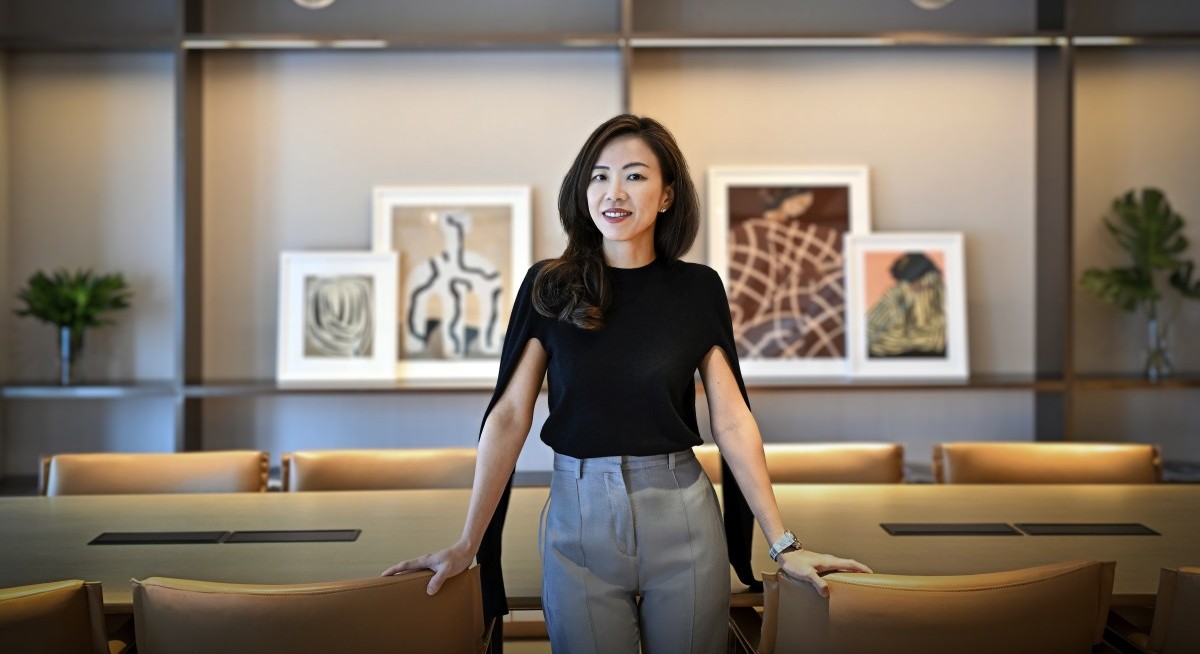


“Amara Hotel opened in 1986, and I was there for the opening. There are two stone lions outside the front door, and I remember my grandfather carried me to sit on top of one of the lions,” recalls Teo, COO of the Singapore-headquartered hotel and property group.

The entrance of Amara Singapore in the 1980s
She was barely eight years old then. Forty years on, she is part of senior leadership at the family business and has big plans.

Her great-grandfather, Teo Teck Huat, founded the company in the 1930s as the Teo Teck Huat Group. The company was later renamed Teo Teck Huat Investments before changing its name again to the current Amara Holdings.
Teo says Amara evolved from the family’s business as builders — “Amara” means “everlasting eternity” in Sanskrit. The opportunity to enter the hospitality business came in the 1980s with the acquisition of a site in Tanjong Pagar, where Amara Singapore and 100AM now stand.
See also: Muslim tourists set to drive US$310 mil in annual spend by 2030
The hotel was initially intended to be operated by Scandinavian Airlines (SAS) under the SAS Amara brand. However, a financial crisis in the 1980s led the operator to withdraw just before the hotel’s opening. “We had gone through the planning with [SAS]… The hotel was designed with a Scandinavian theme,” Teo tells City & Country. “The family, very true to spirit, decided to roll up our sleeves and just do it ourselves.”
She is a third-generation leader of Amara Holdings, with her father, Albert Teo, still serving as CEO. Teo recalls spending her childhood tagging along with him to construction sites and selling gingerbread cookies at the hotel during Christmas. But joining the family business was not part of her initial plans.
Teo graduated from the Wharton School at the University of Pennsylvania. Before joining the family business, she worked in the finance industry at UBS and Credit Suisse. “I just felt that I was seeking a sense of purpose that was related to my family. What better way to contribute and find purpose than to help the family business and to build on what the previous generations have done?”
She sees it as a “natural evolution” to join the family business, bringing her banking experience in capital management to Amara. “Running hotels may seem like a sexy business, but the nuts and bolts of it, the basics, are still the same. You’re running a business and have to consider growth strategies and financial discipline in capital allocation; a lot of those basic skills I practised during my banking days.”


The exterior, entrance and lobby of Amara Singapore in the 1980s
No plans to relist
Amara, previously listed on the Singapore Exchange, was delisted in July 2025 after almost 30 years on the bourse. Teo says that while the group was proud of its listing status, it had never raised capital on the market and had a very limited free float for minority investors.
“At a later part, the company was deeply undervalued. Those are the main reasons why we decided to privatise the company,” says Teo. After delisting, the group enjoyed more flexibility in terms of making longer-term strategic decisions without the short-term pressures of the public markets.
An entity called DRC Investments that is backed by multiple parties, including Hwa Hong Corp, Wing Tai Holdings and the Teo family controlling Amara, offered 89.5 cents per share to take the hospitality firm private. The price offered was a 27% premium over Amara’s last traded price prior to the announcement and a 33% premium over Amara’s net asset value per share of 67.3 cents.
The offer was declared “fair and reasonable” and the privatisation offer became unconditional as the free float fell below 10% on May 15, 2025. The deal was completed on July 18, 2025.
With the delisting, Amara had the opportunity to take a step back and re-examine growth plans — establishing new businesses and dedicating resources. At this point in time, there are no plans for Amara to relist, even though the market is running hot with a government-led market rejuvenation programme.
Before delisting, the group’s last reported FY2024 ended Dec 31, 2024, results saw earnings decline by 74% y-o-y to $1.8 million from $7.2 million, though revenue was 7% higher y-o-y at $123 million. The lower earnings were mainly due to a loss in the fair value of investment properties and higher costs.
As at end-FY2024, the group’s cash and cash equivalents stood at $29.5 million. It also paid out a final dividend of 0.5 cents per share.

Building upon foundations
Coming into the family business, Teo says it is challenging to balance legacy with new ideas for transformation. “It is a delicate balance,” she says, adding that change cannot happen too quickly or too slowly.
She still works “very closely” with her father, and together, they have brought the Amara brand towards a transformation. “The company has gone through some changes, but I would not think of it as a ‘reset’; it is really building upon the foundation that we have laid over the last decades and trying to grow the company from there,” says Teo.

The father-daughter duo’s first venture into a resort property was the Amara Sanctuary Sentosa. Officially opened in 2007, the 140-room property spans 3.8ha, offering a range of room types and even one- and two-bedroom pool villas — the latter configuration measures a sprawling 230 sqm.
Amara recently revamped its two local properties, with renovations at Amara Singapore in Tanjong Pagar and Amara Sanctuary Sentosa aimed at refreshing guest rooms, public spaces and brand experiences as the group updates its offering.
The overhaul was first announced in April 2024 as a comprehensive redesign of the group’s flagship domestic assets. The exercise is meant to deliver “meaningful connections, memorable experiences and tailored spaces”, says the company, while tying both properties together through contemporary interiors and sustainable travel features.
At Amara Singapore, renovation works were completed in September 2024. The 389-room hotel was redesigned by Studio HBA, a division of Hirsch Bedner Associates. Beyond the rooms, the revamp includes a new lobby bar, a reimagined cafe and upgrades to event spaces.

Design cues draw from the surrounding Tanjong Pagar neighbourhood, including preserved shophouses, hawker culture, Chinatown’s history and heritage trees seen in the nearby Duxton Plain Park.
All rooms and suites at Amara Singapore have been redesigned to better suit a mix of business and leisure stays, with the addition of workstations, chaise lounges, energy-efficient air-conditioning, motion-sensor lighting and in-room filtered water taps. Materials such as timber laminate, tan leather and black metal are used to reflect the area’s built heritage.

Teo says: “This refurbishment is not merely a routine exercise of upgrading but a reinvigoration of our commitment to luxury and innovation, while not losing sight of our roots as one of the first hotels in Tanjong Pagar to cater to business travellers.”
Meanwhile at Amara Sanctuary Sentosa, the redesign focuses on suites, villas and shared spaces, with cross-disciplinary design studio FARM appointed as design partner.
The project was completed in mid-2024 after a five-month redesign. The resort’s new look leans heavily on biophilic design, using indigenous stone, timber, reclaimed wood, greenery and sand-inspired tones to tie the property more closely to Sentosa’s landscape and history.
The redesign extends to the lobby, which now features a 4m everfresh tree under a skylight, as well as to the new 146-seat Sanctuary Tearoom. Some studios and suites have also been converted into dual-key apartments with kitchenettes to cater to larger groups of travellers.

The refurbished lobby of Amara Sanctuary Sentosa features a 4m everfresh tree under a skylight

At 58 sqm each, the 12 Couple Suites at Amara Sanctuary Sentosa come complete with direct pool access
Amara is also tying the redesign to sustainability. Since August 2024, both Amara Singapore and Amara Sanctuary Sentosa have obtained Global Sustainable Tourism Council (GSTC) certification. The Washington-headquartered non-profit assesses hospitality operators on effective sustainability planning, maximising social and economic benefits for the local community, enhancing cultural heritage and reducing negative impacts to the environment.
At Amara’s properties, new sustainability features include refillable bathroom amenities, filtered water systems and fewer single-use plastics. The Sentosa property will also offer bicycle rentals, while Amara Singapore has introduced recycling bins and initiatives to cut food waste.
Teo says: “This certification stands as a testament to our dedication to prioritising sustainability in every aspect of our operations and design. We believe that regardless of the scale, each green practice contributes to alleviating the current climate crisis.”

Amara tomorrow
Refreshing existing properties is just part of Amara’s plan to evolve with the times. Today’s travellers are increasingly seeking to minimise their environmental impact even as air travel remains carbon-intensive.
This trend is not confined to younger travellers; those aged 61 and above are also more likely to adopt sustainable behaviours when overseas. According to Booking.com’s Travel & Sustainability Report 2026, travellers in the APAC region aged 61 and above are the most willing to reduce general waste and energy consumption while travelling and are also the most likely to support local independent stores, outpacing other age groups.
Amara’s evolution is more than just renovation and modern furniture — Teo sees it as a business expansion story for the group as it increases its global footprint.
“Our ambition is to scale up our current hotel portfolio — both in terms of the portfolio and the brand,” says Teo, adding that the group is intending to expand its presence into more locations by investing in key gateway cities in Asia Pacific, Australia and the UK.
For now, the group remains rather asset-heavy, owning most of the hotel properties it operates. To outsiders, it appears Amara may have the potential to recycle some assets.
Teo is aware that the asset-light trend is the way to go for faster expansion. “We will start to move towards being asset-light,” she says, adding that the group will be balancing its portfolio between both extremes.
“We do see opportunities to scale up by way of partnerships or management agreements. We will also continue to invest in real estate,” she says.
Aside from building its hotel empire, Amara is looking to enter “other adjacent living sectors”, such as student accommodation, senior living and co-living. While there are no definitive plans yet, Teo says the group is currently exploring these segments.
Already, the group has entered the residential segment, entering into joint ventures or consortia with other developers. Some of its residential developments include Sanctuary @ Newton, 10 Evelyn, Killiney 118, The Linear and more.

Completed in 2022, 10 Evelyn is a freehold, 56-unit development in District 11 (Novena) comprising four five-storey blocks

Completed in 2025, Sanctuary @ Newton is a freehold District 11 development comprising 38 two- to four-bedroom homes within a single 15-storey block
Teo says that Amara brings the “resort experience into the design of city life”, as Amara brings to the table its design lens and experience in the hospitality industry to the consortium. The way Teo sees it, it allows the consortium to then offer “better products”.
Moving forward, Teo admits that the hospitality landscape is competitive both here and abroad. While ensuring that a property’s design is modern enough to attract new guests, retaining the character of the building — along with the spirit of its staff — can bring about “authentic neighbourhood experiences”.
“We are proud to be a Singaporean brand, and we share a lot of values with our country — quality, efficiency and reliability,” says Teo. “Those are values we hold closely and try to bring out in our service culture.”
Photos: Amara Holdings, Albert Chua/The Edge Singapore
Revisit our interviews with hospitality leaders in City & Country:
Far East Hospitality finds its niche while going ‘asset-light’
‘IPO is a possibility at a point when it makes sense’: Ascott CEO




