


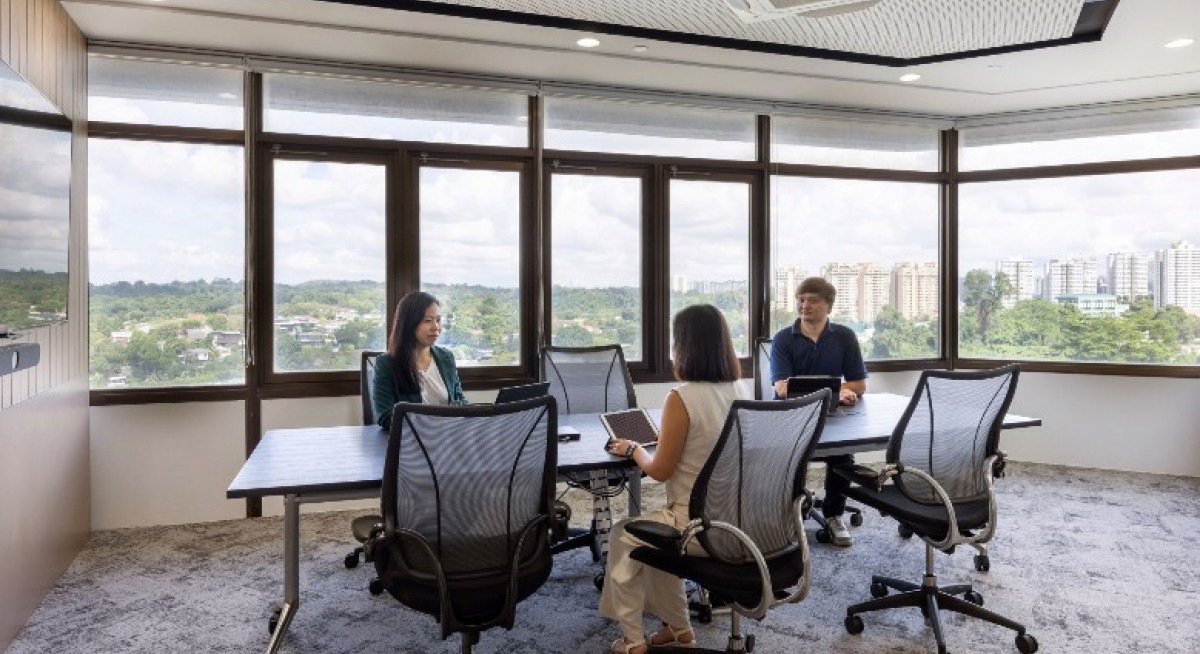


Design and productivity at the workplace have always worked hand in hand, and in 2026, this connection has become more prominent. Despite economic stagnation driven by global geopolitical developments, companies are willing to invest in creating workplaces that foster ideas and innovation while ensuring employee well-being and sustainability.
This trend is clearly reflected in the Singapore market, where modern enterprises are adopting flexible, tech-driven and energy-efficient layouts to encourage collaboration and integrate hybrid work models.
Firms are also doubling down on the physical office as a strategic asset. In JLL’s Future of Work Survey 2024, 65% of respondents signalled that they expect the overall budget for corporate real estate to increase by 2030.
In 2025, office space demand in the country continued to recover, with sectors like finance, legal, and technology leading the way. Building on this recovery, the 2026 market signal is clear: as long as physical workplaces add value and do not become cost centres, firms will invest.
The Central Business District witnessed this shift closely in the recent past. In a move to prioritise flight-to-quality and recentralisation, companies have been investing in well-connected, Grade-A offices to enhance their professional output.
Additionally, the way organisations work has fundamentally changed since the majority of the global workforce returned to the office in a hybrid format. In today’s setup, collaborative and alternative workspaces are increasingly a requirement rather than an option.
See also: Remixed: Zouk enters a new chapter
Open floor plans and breakout rooms are in demand and are being incorporated alongside individual cabins. Offices like Quahe Woo & Palmer LLC in Singapore have prioritised spaces that focus on both shared areas and private offices.
They built a cloister-style model, which reduced the need for long corridors while improving access across the floor. This design also helped natural light reach shared spaces and provided privacy for individual work.
Beyond physical layout, environmental factors such as lighting and acoustics have emerged as critical performance drivers. Optimised lighting promotes productivity, employee well-being, and the overall workplace atmosphere; while it may seem secondary, it enhances the environment, creating a more positive workspace.
See also: How Singapore’s micro-climates affect the longevity of our homes
Acoustics are just as vital. With the rise of open floor plans, addressing noise concerns has become essential. Soundproof meeting rooms and noise-cancelling technologies have emerged to help create environments that reduce distraction and encourage a variety of work styles.
Long-term adaptability is also being prioritised this year as businesses redesign their spaces. With fixed layouts becoming increasingly redundant in today’s volatile business climate, most teams are seeking flexible layouts. This allows spaces to grow and change with the organisation.
Workstations can be converted to meeting rooms, project areas to collaboration zones, and shared spaces to suit team sizes. These “day 2 scenarios” allow businesses to redefine their workplaces without major design changes or relocation, helping maintain efficiency and manage long-term costs.
This level of adaptability has become a cornerstone of corporate real estate planning in Singapore’s competitive market. According to the Deloitte 2023 Global Human Capital Trends survey, approximately 87% of business leaders believe developing the right workplace model is a priority for their company’s success.
While initial post-pandemic office designs emphasised collaboration and social interaction, many organisations now recognise the need for spaces that facilitate deep focus. This has led to a noticeable shift toward quieter, focus-driven workspaces and a resurgence of library-style quiet zones, giving employees areas to concentrate without distraction.
Alongside employee-focused considerations, companies are emphasising how they present their offices to clients, in industries such as law, finance and consulting, the office functions as an extension of the organisation’s brand.
There is a growing emphasis on well-designed, client-facing spaces. Reception areas, meeting suites and hospitality zones are increasingly designed to reflect professionalism and brand identity. These spaces help shape first impressions and provide an environment where important discussions can develop.
Interestingly, although social spaces still exist in most offices, their importance varies globally. In Singapore, employees spend 26% of their time in social hubs — an average higher than their global peers, according to Unispace’s Global Workplace Insights Report, released in late 2025.
The report also found that workers in Singapore spend 64% of their working hours in the office per week, 13% more than their global counterparts. This points to a picture of 2026 where the office is increasingly seen as a destination for connection, growth and shared experiences, rather than simply a place for individual desk work.
The bottom line is clear: workplaces must evolve to keep pace with changing times. Current economic and geopolitical pressures might dictate the pace of investment, but by focusing on flexible infrastructure and design fundamentals, businesses will remain resilient.
Strategic, well-designed spaces ensure that an organisation stays adaptable and effective, supporting consistent productivity regardless of what the future holds.

Paul Saville-King is group CEO of the integrated workplace strategy, design and construction services firm Unispace




