




Catharine’s interest in architecture began at a young age, as she grew up loving crafts and design. “My father was very gifted in craft. So, I was that kid who built little doll houses for my paper dolls. He used to tell me that the buildings are living elements; so, you must nurture them, and [in return] they will protect us.”
That advice shaped her dream of becoming an architect, though her journey was unconventional. Choosing arts over science in high school, she had little early guidance on architectural requirements. After completing the Malaysian Higher School Certificate (STPM), she completed a certificate at Ungku Omar Polytechnic in Ipoh, followed by a bachelor’s degree in architecture at Universiti Malaya. She then worked as a Part 1 architect in Subang Jaya and sometime in Ipoh.
In 2005, a holiday to Aberdeen, Scotland, became a turning point in her career. Catharine applied for hundreds of positions in the UK and secured an interview in Glasgow, which convinced her to relocate to the UK. Realising further qualifications were needed for progression, she completed a postgraduate diploma in architecture at The Glasgow School of Art. After that, Catharine was seconded to Dubai for six months to resolve site issues for a hospital. Upon her return to the UK, she completed her master’s degree in architecture.

See also: Arcc Spaces appoints The Afternaut Group to design Bank of Singapore Centre co-working space
Later, she moved to London and secured a role at the Ministry of Justice in 2013, where she began her journey in digital technology for construction. At the ministry, her team was responsible for using technology to design and create a digital representation of building components using laser scanning technology to design buildings for the ministry in England and Wales. While working at the ministry, she completed her professional practice and became a qualified architect in 2017.
In 2019, she was headhunted to join the UK Parliament and is recognised today for pioneering the integration of digital heritage requirements into conservation projects for historic buildings.
Cloister Court façade restoration
See also: Maximising project value through design
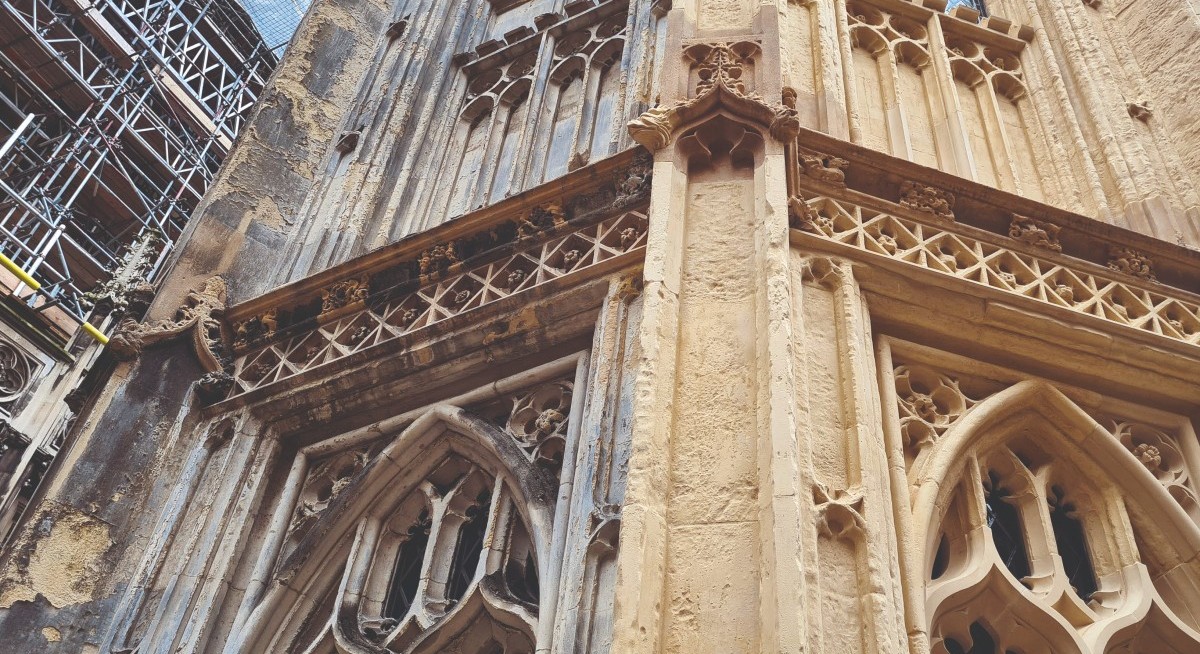
One of her most prominent works at the UK Parliament was the conservation of Cloister Court near Westminster Hall, which was built in the early 16th century.
Through this project, Catharine identified a gap in existing Building Information Modelling (BIM) classification systems.

“In Parliament, we had a BIM asset pick list that we shared with the consultants, but I soon realised that it included only UniClass coding for mechanical, electrical and plumbing elements.
“It had too generic information for the architectural fabric. So, a door was just a door; a window was just a window. There was no information about how to differentiate a heritage door and a non-heritage door, for example. So, this was my eureka moment.”
She then compiled a detailed asset pick list of building elements, from roof pinnacles to doorknobs, and collaborated with the National Building Standards to develop machine-readable, standardised codes for heritage assets.
For that project, she tested BIM for a heritage façade, embedding conservation data into a 3D model and aligning with Historic England’s guidance. The process required software improvisation and parallel development of UniClass codes.
“Traditional 2D conservation information was [then] integrated into 3D models, providing a structured output for future asset management. The goal was to create a framework that could digitally manage and conserve heritage buildings,” she says.
According to Catharine, the restoration took three years from 2019 to 2021. Without digitalisation, she says the project would have come to a halt as activities on site was limited due to working within constraint space.

Elizabeth Tower restoration
Catharine was also involved in the conservation of Elizabeth Tower, also known as Big Ben, in London. The building was completed in 1859 and stands at 96.2m.
The project began with scaffolding being erected in 2017, while she was still with the Ministry of Justice. “I would often arrive early to work, not knowing that I would later be involved on the other side of the project,” she says.

It was also one of the first projects to introduce BIM, which brought many new inventions, she says.
“It was a complex project, especially since the building tilts slightly. The lift didn’t exist initially. Installing a lift in a ventilation shaft was challenging. A 3D scan and model were crucial, because it would allow structural engineers to adapt the design, taper the structures and ensure the lift could work vertically.”
She adds that the model also provided valuable visual information for stakeholder engagement, helping consultants and the public understand how the building would look and how security measures would be implemented.
“When I joined, I wasn’t involved in the initial stages. So, I focused on reviewing the heritage information and data from the model. I examined how it was put together, identified gaps and worked on incorporating architectural fabric information to present a more complete picture.”
In the conservation of Big Ben’s stonework, Catharine says, surveys revealed damage caused by centuries of pollution and water exposure. “A tracing system was applied to the model to assess each stone, quantify repairs and plan maintenance for the next 30 years. By digitally recording stone sources, we found that future repairs could be planned without starting from scratch.”
She says restoration works took five years from 2017 to 2022. Without digitalisation, she says much of this coordination, would have required repeated site access, manual reconciliation, a longer than intended timeline and a cost risk increase.
More digitalisation needed
Catharine is currently pursuing her PhD, specialising in smart heritage building conservation at Middlesex University in London.
“The architectural elements of built heritage often lack standardised coding, meaning FM (Facilities Management) systems and building fabric don’t always speak the same language. My approach is to address these gaps systematically, ensuring all assets are maintainable — the only variable being the frequency of care.”
Catharine’s research focuses on integrating digital twins with conservation for sustainable asset management. For context, a digital twin is a virtual representation of a physical object or system. She explains: “For instance, historic buildings were often designed with internal rainwater pipes. Extreme rainfall or climate change can cause leaks that go unnoticed until significant damage occurs. Using real-time monitoring, AI and machine learning, we can detect abnormal flows or leaks early. So, it enables proactive intervention before serious damage happens.”
The goal of a digital twin is to create a selective, digital replica of a historic building, she says.
A digital twin allows multiple stakeholders to view and interpret different aspects of a building according to their needs. Some applications monitor temperature, airflow and lighting, whereas her approach focuses on understanding how the building itself functions daily, identifying issues and protecting it.
While most of Catharine’s case studies focus on heritage buildings in London and the UK, she also examines examples across Europe to understand how environmental factors can influence the care of historic structures.
Working on these projects has been more than she ever dreamed possible.
“Heritage [conservation] isn’t about anti-technology; it’s about applying the right technology for the right reasons,” she says. “I look at it as an honour and privilege for an ‘Ipoh mali’ lady to be given this opportunity, which is why I do my best, alongside our team, to preserve this special Unesco World Heritage for future generations.”
This story first appeared in the March 30 issue of The Edge Malaysia




