


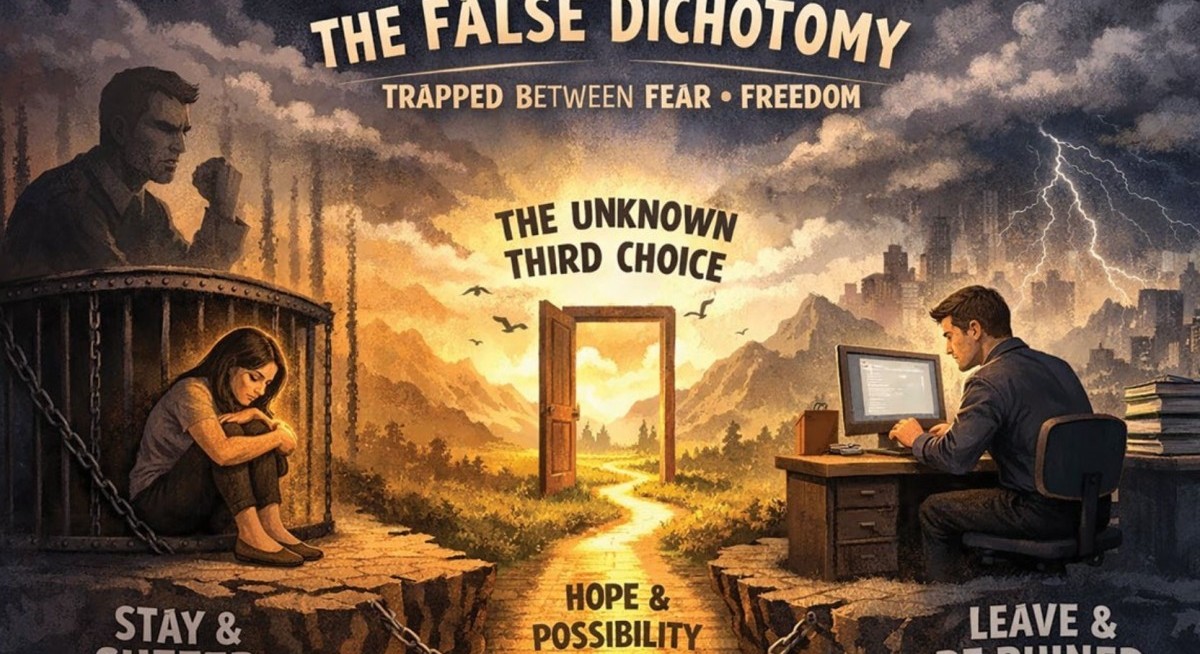


She might have told herself she would leave. She might have even packed once. But fear is a clever thing. It does not scream; it whispers.
What if you cannot make it alone? What if he is right? What if no one believes you? What if?
So, she stayed, trapped not by the walls but by the uncertainty — the belief that freedom meant chaos, that loneliness was worse than pain.
Yes, Ellis lived inside a false dichotomy — the lie that she had only two choices: stay and barely survive, or leave and be destroyed. Fear paints the world in black and white. The truth is there is always more than two choices. The space between fear and freedom is where the healing begins; the unknown unknown reveals more choices.
See also: The future of media in the AI age (Part 7/9): The interpretation economy
Or imagine John, who sat in the same cubicle for years, typing words that meant nothing to him. Convinced that he was lucky to have a stable job — a pay cheque, a title, a desk with his name on it. He told himself this was adulthood — stability, responsibility, survival.
But each keystroke felt like a small betrayal of the dreams he once had. The purpose of telling the truth in a way that matters, giving voice to the unheard, and holding power accountable. Now, he authors stories that no one reads.
He stayed, convincing himself that quitting would mean failure; chasing dreams was a childish luxury. Years slipped by, and dreams folded into the bottom drawer. Work did not kill him, but it was a quiet erosion of purpose. He did not hate his job; he just did not realise he had built his own cage — yes, steady and padded, but utterly without meaning.
See also: A recurring pattern in the history of information
The above are compelling stories because they feel true — we see shades of this in our own lives and societies. It is the logic of choosing “the devil you know”. In philosophy, we call this “the dilemma of complacency”, when humans prefer the known misery over terrifying freedom and uncertainty.
Why am I writing this? I was reminded of this human trait when I attended the Khazanah Megatrends Forum (held in October 2025, so yes, I wrote this piece a few months ago). Professor David Spiegelhalter gave an excellent presentation on “The art of uncertainty: How to navigate chance, ignorance and risk”. The key takeaways for me were that there will always be unknown unknowns, we will never know all the options and therefore we cannot always optimise. Instead, we need humility because our probabilities are based on assumptions and simplifications. More crucially, we must not just focus on the worst-case scenario and never take any risk. The way to mitigate is not to take no risk, but to focus on resilience, on redundancy.
His views resonate with me. Risk should be embraced, with humility in the extent one believes in oneself. While his presentation was not in the context of false dichotomy, it is relevant and appropriate in application. Many people are confronted with one form of false dichotomy or another — and are oblivious to them.
What is false dichotomy?
It is when people are presented with a rigged choice, instead of choosing good and better. But it is a choice between a known, stable negative and a catastrophic, unthinkable negative.
We described the dilemma of complacency above, where people stayed in bad relationships, dead-end jobs or toxic patterns rather than leap into the unknown.
In political history, it is the typical “tyrant’s bargain”. The people are aware of the oppression, corruption and incompetence, but are terrified that change will shatter the fragile peace and unleash horror. It creates apathy and despair. By making the alternative so terrifying, it leaves only the “safe” option — where “choice” is only an illusion. To avoid fear, the people choose their own subjugation. It is a brilliant use of fatalism and engineered hopelessness.
For more stories about where money flows, click here for Capital Section
There are only three inevitable outcomes:
1. The Slow Decay: Without any change, the outcome will only get worse.
2. The Revelation: Someone proves the alternative is not that terrible, a real choice becomes available. The false dichotomy is broken.
3. The Desperate Leap: When the situation gets so intolerable that even the unthinkable option becomes an acceptable gamble.
What is clear is that being trapped in a false dichotomy, believing that there is no option, is the worse outcome — continued deterioration and without hope!
The power of rejecting a false dichotomy
One can reject a false dichotomy by consciously choosing the perceived “worse” option to break a cycle of control — even if it is for an intervening or interim brief period. Sometimes called the “nuclear option” or “strategic defiance”, it can be a catalyst for change but comes with significant risks.
In game theory, we call it a “credible threat”. It must be real and committed. It forces parties to make concessions.
And in so doing, one demonstrates agency (non-passive), resilience (signal a willingness to endure short-term pain for long-term gain) and leverage (create uncertainty).
Conclusion
Choosing the perceived worse option when presented with a false dichotomy is not obvious to most people, and certainly not immediately. But it can be a powerful solution. It forces a re-evaluation of the options and can lead to meaningful change, restoring genuine choice eventually.
But it requires courage — a willingness to face uncertainty.
Do not allow yourselves to be trapped by others into believing you do not have a choice.
Is this not so true for so many? Whether in relationships, in careers … or as you are so often told when you vote. Be brave.
To quote Act II, Scene II of William Shakespeare’s Julius Caesar, “Cowards die many times before their deaths; The valiant never taste of death but once.”
Portfolio commentary
The Malaysian Portfolio gained 1% for the week ended March 17. The best-performing stock was United Plantations, up 7.5%, buoyed in part by the rise in crude palm oil prices. Other gaining stocks include LPI Capital (+2%) and Kim Loong Resources (+1.2%) while the only loser was Hong Leong
Industries (-1.7%). Total portfolio returns now stand at 215.4% since inception. This portfolio is outperforming the benchmark FBM KLCI, which is down 6.5% over the same period, by a long, long way.
The Absolute Returns Portfolio, on the other hand, fell 0.8%. The loss pared total portfolio returns to 38.4% since inception. Alibaba (+0.9%) was the only gainer while the top losers were Kanzhun (-4.4%), SPDR Gold MiniShares
Trust (-3.5%) and Ping An – A (-1.3%).
The AI Portfolio too ended in negative territory, down 0.1%. Total portfolio returns now stand at -0.8% since inception. The top gainers were Unusual Machines (+5.4%), Amazon (+1.2%) and Datadog (+1.1%). Sieyuan Electric (-4.5%), Minth (-3.7%) and Naura Technology (-2.8%) were the notable losers last week.

Borrowed minds and branded thinking: Prestige is not proof
The views expressed in this column are rarely fashionable. They often go against the grain of conventional thinking or popular views, and occasionally irritate those who hold power. That is not the intention. It is merely the outcome of independent thought.
In public discourse, it is far easier to repeat what others believe — especially when those views come from authority, titles or with political backing. But serious analysis demands courage to examine the facts and say what one believes to be true, especially when it is unpopular.
Ideas must stand the strength of their reasoning.
These include the series we wrote on the MAGA Pathway — why Trump’s tariffs can be positive for the US, contrary to common narrative that it will be disastrous and stupid — and more recently, on US economist Joseph Stiglitz and left-leaning economists’ calls for democracy to control capitalism. Generally, on the economics of incentivisation and meritocracy versus the economics of redistribution.
Some people have said to me, surely the views expressed by such well-known and highly respected people are more correct than ours. My response is this short sidebar: I call it “BRANDED THINKING”.
Many people buy shoes because of the brand. The shoes may not fit well or may not be comfortable. But they are fashionable and the logo carries prestige. The wearer endures the discomfort because the brand signals status. Intellectual discourse often works the same way. Sorry, dear readers, here I go upsetting you again.
Ideas attached to famous names — be they Nobel laureates or bestselling authors — are adopted without scrutiny. Their reputation is the logo — worn proudly even when it does not fit.
Disclaimer: This is a personal portfolio for information purposes only and does not constitute a recommendation or solicitation or expression of views to influence readers to buy/sell stocks, including the particular stocks mentioned herein. It does not take into account an individual investor’s particular financial situation, investment objectives, investment horizon, risk profile and/or risk preference. Our shareholders, directors and employees may have positions in or may be materially interested in any of the stocks. We may also have or have had dealings with or may provide or have provided content services to the companies mentioned in the reports.




