


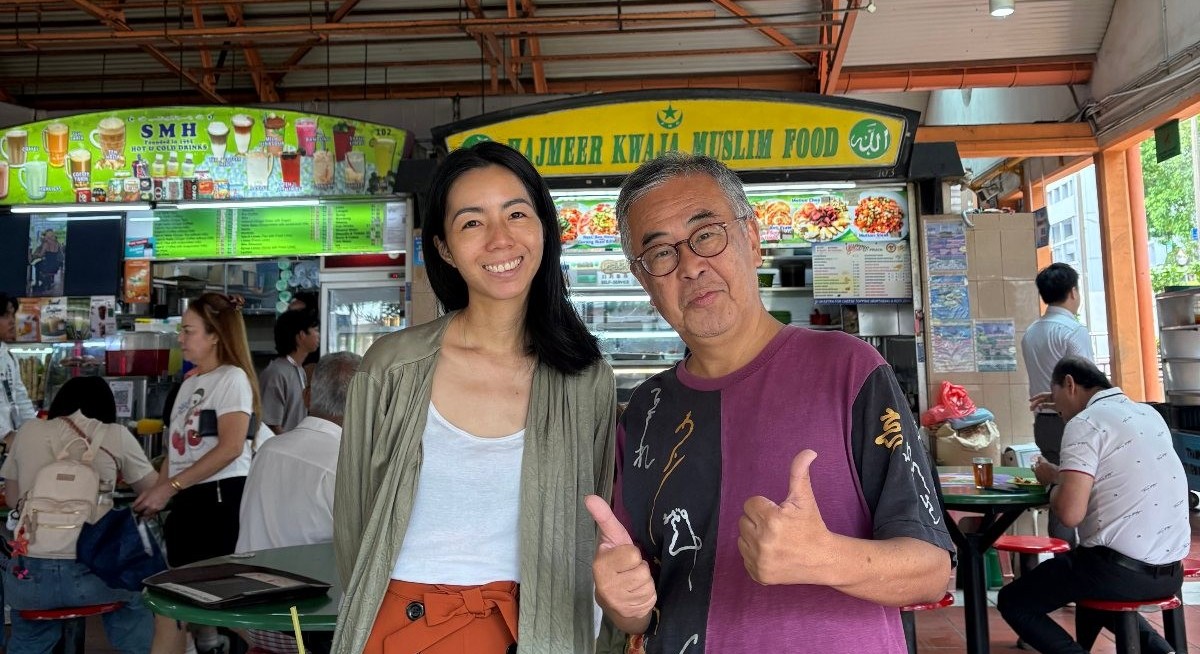


Song began his career in 1984 as a “boring macro analyst” in Kuala Lumpur and has never looked back. After moving to Singapore in the 1990s, he has witnessed the city’s evolution firsthand. Even after retiring last August from his final post as an economic advisor at CGS International Securities Singapore, Song remains a keen watcher of the local economy, combining official data and his ground observations to parse the challenges or opportunities ahead. These days, Song has a part-time role as economic advisor at Singapore-based fintech firm SDAX.
To him, an indicator of a thriving economy is simply whether people are spending money. “What are consumers doing? Are they staying at home and not coming out to spend? What are they spending on? It boils down to ‘bellynomics’,” he says, referring to the term, which he defines as the “study of food, money and work”.
“Eating and drinking are something we all have to do daily… GDP growth really comes from that very simple thing: What are people doing that leads businesses to decide whether to hire, invest, expand, and that will clearly lead to jobs,” he notes. “It boils down to whether you are spending on essentials or whether you have sufficient disposable income to spend more?”
At Maxwell, Song takes the pulse of the economy by eyeing the queue at Tian Tian Hainanese Chicken Rice. Locals might have their own favourite stalls, but tourists always flock to Tian Tian. The line is fairly consistent on most days, but on certain periods — such as the F1 weekend or the Chinese national holidays — it stretches longer, hinting at a surge in tourist numbers. Tourism generates around 4% to 5% of Singapore’s GDP.
See also: Connecting genuine growth with employment
Food as part of a country’s story
For Song, food is more than just an economic statistic. It is a reflection of those who’ve come to live and work here. The first wave of immigrants brought dishes like Hainanese chicken rice, Teochew bak chor mee and Eurasian devil’s curry — the foods Singaporeans cherish.
Song likens Singapore’s journey to Chinatown, which he views as a microcosm of how the city-state’s economy developed through immigrants across all races. “Which is why we have, in one street, a Chinese temple, a Hindu temple, a Muslim mosque, all basically close to each other.”
See also: Singapore households face record power bills as war impact hits
In recent years, a new wave of immigrants has left a significant mark on Singapore’s food scene, introducing dishes such as Vietnamese pho, Korean barbecue, Middle Eastern kebabs and halal Chinese food, alongside a growing presence of people from Xinjiang.
Modern Singapore, much like its history as a British colony, has become an international business hub, a transformation reflected in the diverse range of global cuisines now found in hawker stalls, small eateries and fine dining establishments, says Song.
Rising competition, shifting tastes
Since Covid-19, the catering segment has been a clear winner. People grew accustomed to having food delivered or served at their premises, and the habit stuck; F&B outlets are compelled to adapt.
Meanwhile, the full-service restaurant segment has become increasingly fraught. Despite high-profile closures — Prive, Lady M and Eggslut all shuttered in 2025 alone — new restaurants continue to open, including at the high end. Given merciless rental and labour costs, Song questions the sustainability of many of these ventures. The pool of consumers remains fixed even as the number of offerings grows, and diners are getting pickier.
To him, the restaurants that have succeeded so far are owned by owners with “very deep pockets” and have other businesses that generate enough cash flow to absorb any potential losses from their restaurants.
Consumer tastes are also shifting. The first wave of Japanese omakase restaurants going for up to $500 per head may have been exciting, but it is yesterday’s news. With the yen at historic lows, it is no wonder Singaporeans made a record 726,600 visits to Japan last year — many of whom, presumably, to experience the real thing in Japan, Song adds.
For more stories about where money flows, click here for Capital Section
Meanwhile, a newly-opened Wenzhou-style Chinese restaurant, Wenzhou Mansion, the first in Chinatown to charge prices typically seen in European or Japanese fine dining: $199++ for a set lunch. Wenzhou, located just over five hours’ drive from Shanghai, is known for its prosperity and as a pioneer in private economic development.
Changing lifestyle habits are reshaping the landscape further. Where previous generations opted for cai png or economic rice, which can go for just $4 or so, Generation Z prefers “rice bowls”, which can cost a minimum of $10 and are, as Song says, essentially the same thing. Younger hawkers are also now selling dishes such as ramen and paella, reflecting a generation that travels more and eats more broadly. These shifts — “how you eat and live your day” — will shape how businesses deliver their goods and services. “[It’s] very interesting,” he adds. “I wish I had another 100 years to live to see what unfolds over time,” says the 66-year-old.
What’s next for Singapore?
In the near term, Song sees further developments for the northern area due to the upcoming Johor Bahru-Singapore rapid transit system (RTS), which will, by the end of this year, link Johor Bahru’s Bukit Chagar Station with Woodlands Station. He adds: “That means, in Singapore, one less set of prata will be sold in the morning. And people will be crossing over there. Then it comes down to, ‘do we need that growth in F&B?’”
With the RTS open, the economist believes there may be a more “stable equilibrium” of F&B offerings here. Singaporeans are evidently still willing to pay in Singapore dollars for Malaysian brands such as Oriental Kopi, but whether that holds once crossing over becomes effortless remains to be seen.
“Now, we have reached a point in which where you live, you already have so many F&B offerings: your traditional hawker centre, your neighbourhood kopitiam (coffee shop), your private kopitiam, you just have a lot more where you live [and] work, unless you’re right in the middle of an industrial zone,” says Song. “It really boils down to how easy, especially for those on the northern side, to cross over.”
When that happens, small businesses in Singapore may be affected, although prices may be adjusted upwards in Johor. At the same time, it will be interesting to monitor trends and note how often Singaporeans will want to commute to Johor just to obtain basic necessities.
On the longer horizon, Song notes that things will remain resilient as long as more people continue to move here and more jobs are created. Investments will also have to remain flowing in.
“It’s a very good and serious question, because we come back to the US’s trade policies,” he says, noting that before US President Donald Trump assumed office for the second time, Singapore and the US had a free trade agreement in place since January 2004. “Clearly that’s gone out the window now, because the US is no longer that reliable partner, as they were before.”
The domestic key manufacturing sector leans heavily on two industries: electronics and pharmaceuticals, which account for over 20% of the country’s non-oil domestic exports (NODX) at any given month. Companies are forced to make decisions amid uncertainties in US trade policies. What they could do is to figure out how flexible they can be in a world of global economy minus one, he notes.
For the nation to stay competitive, the country must ask if it can continue to be Asia’s gateway. Song says the city-state is where businesses come to set up shop. While our ports and airports remain among the busiest globally, China has surpassed them, becoming “better” and “more connected”.
The Republic remains relevant for the region as its gateway, and whether it can remain so amid the competition depends on a whole lot of factors, from politics to the rule of law. “All these things matter,” he adds.
Walking tours, retirement plans
Sometimes, Song plans his walks by using the Central Area scale model inside the URA Centre, adjacent to the Maxwell Hawker Centre. His routes have taken him to regular haunts within a two-hour radius like Gardens by the Bay, and his recent jaunts have taken him to places like Lavender Street, City Hall, Little India, Ghim Moh, Pasir Panjang, Joo Chiat — practically anywhere where there are kaki, kawan and makan (friends and food), cold beer, complaints about the heat and stories to share.
Post-retirement, Song has been conducting informal walking tours of Chinatown, using ‘bellynomics’ as his guide, tracing Singapore’s economic history through its food stalls. The tours are unofficial, and the timing is whenever he feels like it.
For Song, he is not merely functioning like a hospitable host. He remains a sharp economist — someone who is able to connect the dots and communicate what these observations mean to an average family or to a business. “That, to me, is important.”




