


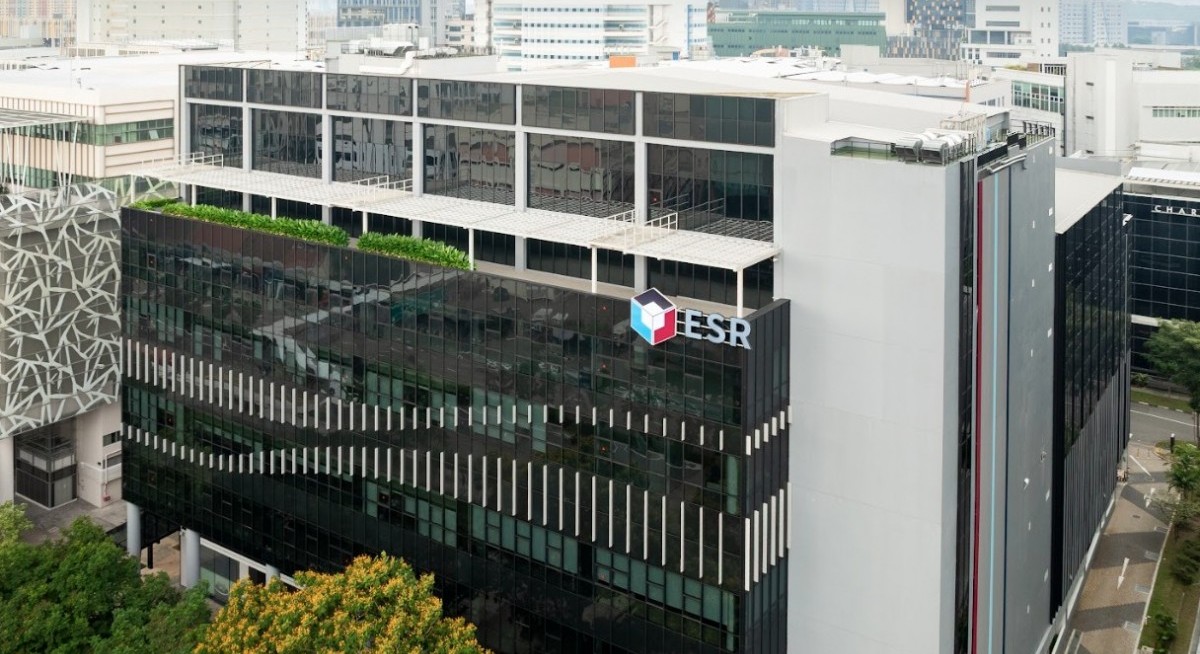


In a recent interview, Adrian Chui, CEO of ESR-REIT’s manager, says his strategy over the past four years has been clear: to reinforce the quality of earnings as well as the quality of assets. On Feb 26, building on a stronger foundation, ESR-REIT introduced a new strategic framework to succeed the 4R strategy, marking a transition to its next phase of growth that focuses on a total return basis.
The additions comprise of five related strategies to the mainly fulfilled 4R plans. In its five-point adjacent strategy, ESR-REIT is looking to drive total unitholder return of 8%–10% a year for the next five years by growing both net asset value (NAV)and distributions per unit (DPU).
In the first of the five-point plan, the manager will continue to rejuvenate the portfolio through asset enhancement initiatives (AEIs) and/or redevelopment. The manager will also address the short land lease. Secondly, the REIT is seeking to grow its size over the next five years to capture the benefits of scale and improved liquidity. This would be done through a combination of accretive acquisitions, AEIs and redevelopment. As at Dec 31, 2025, ESR-REIT’s assets under management (AUM) stands at $5.2 billion.
“We believe that, based on our strategies, as well as a visible, executable pipeline, we should be able to achieve the objectives we have set for the REIT,” Chui says. The tailwind for ESR-REIT is the government’s focus on enhancing Singapore’s capital market through the Equity Development Programme (EQDP). During Budget 2026, a further $1.5 billion was added to the $5 billion earmarked for the EQDP.
“We believe that there is a chance that our overall improved liquidity will get us into better indexes, especially with the implementation of EQDP with a focus on local mid-cap stocks. There is a real opportunity to attract some of this capital that will push us into the realm of the larger caps with more stable earnings, underpinned by our quality portfolio,” Chui said during a results briefing in February.
Point three reiterates the Singapore core for the REIT where Singapore will continue to account for more than 50% of portfolio value, along with growth in selected international markets. In FY2025, Singapore contributed 83.6% to rental income, followed by Australia at 11% and Japan at 5.2%.
ESR-REIT reported gross revenue of $446 million in FY2025, up 20.4% y-o-y. Net property income (NPI) rose by 25.6% y-o-y to $328.7 million. Last year’s growth in gross revenue and NPI were driven primarily by income contribution from ESR Yatomi Kisosaki Distribution Centre and 20 Tuas South Avenue 14 (acquired in November 2024) as well as positive 11.7% rental reversions from lease renewals — the fourth straight year of positive rent reversions. This was further supported by income contributions from 7002 Ang Mo Kio Avenue 5, 21B Senoko Loop and 16 Tai Seng Street, which completed their AEIs in 3Q2023, 1Q2024 and 3Q2025, respectively.
In terms of asset class, as at end-2025, logistics accounted for 47.6% of AUM, followed by high-specs industrial with 24%, general industrial with 14.7% and business parks with 13.7%.
Sponsor ESR had supported the REIT with a pipeline of modern Japanese logistics assets and backstopping of equity fundraisings. In point four of ESR-REIT’s five-point plan, it will continue to lean on ESR’s pipeline and presence across developed Asia-Pacific. Point five refers to capital management, where the aggregate leverage target will remain within the high 30% to low 40% range.
“Since 2023, we’ve done the necessary work in terms of making sure our underlying portfolio and earnings quality have improved tremendously. We’ve got a good investment-grade BBB rating from Fitch Ratings. We have very visible earnings from both rentals and lower financing cost, and will be sharpening our focus on key areas,” Chui says.
Looking ahead, ESR-REIT will be redeveloping 2 Fishery Port Road into a cold storage and food processing facility at an estimated redevelopment cost of $200 million–$250 million an expected yield on cost of about 7.0% and equity internal rate of return (IRR) of 12%–15%, with work expected to start in 1H2027.
Addressing land lease: Freehold land is cyclical; Leasehold is terminal
During an hour-long interview in March, Chui did not mince his words about short land leases for Singapore industrial land and their impact on industrial REITs. ESR-REIT’s average land lease is 31 years, and it has diversified to Japan and Australia to offset declines in Singapore.
In fact, the short land lease makes an appearance in point number one in ESR-REIT’s five-point expansion of its 4R strategy introduced in 2022. The expanded strategy focuses on both NAV and DPU growth, which are counterpoints for industrial S-REITs.

Artist's impression of 2 Fishery Port Photo credit ESR-REIT
Investment properties in REIT portfolios are valued based on their rental income, outlook for rents, occupancy, and land tenure. For assets with land leases of more than 30 years, this is not a problem. However, as land tenure falls below 20 years, discount rates (which are used to compute net present value) and capitalisation rates start to rise. Rents will have to rise to compensate for the declining land tenure; otherwise the valuation or capital value of that land starts to decline. This is termed as “land lease decay”.
Part of the reason industrial REITs trade at higher yields to commercial REITs is that capital return forms of part of the yield as land leases decay.
If the land has 20 years of lease left, that means it hypothetically loses a simple average of 5% of its property value per year until the value becomes zero in its final year. “That’s the depreciation of the land lease but that 5% has time value of money,” Chui points out. If you take the present value (PV) based on an average discount rate of 7% to 8% for properties with land lease of 20 years or less, the land lease decay works out to be about 3% a year. Hence, if the net property income yield sits at 7%, the 3% is basically a return of capital, Chui figures. This leaves the investor with a resultant yield of about 4%, similar to some Grade-A commercial properties.
“What is the underlying yield? Is it reflective of that asset class?” Chui asks. Compare the underlying yield of a leasehold industrial property in Singapore to a freehold industrial property in Japan which yields 4%, he continues. Looking at net-net, the yield is about the same. “Investors see the 7.0% figure as the yield because they are receiving cash in their pocket. They may not fully understand that you’re actually paying yourself part of the 7.0%,” he says.
“The strategy in the last three years was very clear. We made sure we reinforced the quality of the earnings as well as quality of assets. That, primarily, was driven by the fact that we have some very short land lease assets which were taking a toll on the NAV. We could run DPU up by 2% to 3% but NAV starts coming down, so in the end, it’s a flattish return,” Chui points out.
In 2022–2023, Chui and his team went through the portfolio and identified assets which had limited growth potential either because the asset size was small or the land lease was short. “We decided to divest those and recycle the capital to assets where there is a potential for redevelopment or major AEIs,” Chui says. “Our rationale is this: We can continue to generate a 7.0% yield on the asset by holding onto them, but it’ll come a time when the value becomes zero. Hence the real underlying yield is about 4.0% over the period the asset is held. Alternatively, we can look to divest these assets today and take a short-term gap in terms of lower DPU and NAV as there will be no income due to the sale. Recycle the proceeds to newer and longer leasehold or even freehold assets so that they can generate sustainable income over longer periods despite property cycles and provide AEI opportunities. Experienced real estate investors will tell you this: ‘Freehold land is cyclical; Leasehold is terminal.’”
Last year in December, ESR-REIT announced the completion of the divestments of two non-core assets at 2.3% above valuation, and the proposed divestment of eight non-core assets for $338.1 million, at 2.0% above their end-November 2025 valuation. Four of the assets have less than 13 years of remaining land lease.
Looking at the FY2025 results, Chui points to the growth in the REIT’s core DPU which rose 7.6% y-o-y to 21.44 cents. “Every line item is up from revenue to NPI margins together with expenses and interest costs improving. Basically, DPU is up. The quality of the earnings has improved, with 98% from underlying operations which is more visible, sustainable and predictable,” he says.
During the high interest rate environment, some S-REITs paid 80% of DPU from underlying operations with the remainder from capital gains.
Chui is also aware that investors ascribe a premium to Singapore assets, an aspect that institutional investors point to, because Singapore is viewed as safe, the Singapore dollar is seen as a haven currency, and the legal and regulatory frameworks around land and finance are very clear and predictable.
“Investors understand that Singapore is a stable country. Asset valuations and rentals do not fluctuate widely, which is why we think having a Singapore core is important,” Chui notes. However, in Japan and Australia, NAV is not a big issue because of freehold status. NAV may fluctuate due to market cycles but not because of a decaying land lease.

7000 AMK Ave 5 Photo credit ESR-REIT
Capital management, hedging
As at end-2025, gearing remained within ESR-REIT’s target, at 43.4%. If the announced divestments had been completed by end-2025 and net proceeds were used to repay debt, ESR-REIT’s pro-forma gearing would fall to 38.5%.
During the year, debt cost further reduced to 3.35%, and the investment-grade BBB rating with a stable outlook by Fitch Ratings led to a compression of loan margins by 30 bps for the upcoming refinancing.
On the foreign exchange (FX) front, as at Dec 31, 2025, 9.7% of the REIT’s AUM was subjected to FX fluctuations. Although 16% of AUM is denominated in Australian dollars (AUD), and 9% in Japanese yen (JPY), 42% of AUD investments are funded by AUD debt, and 97% of JPY investments are funded by JPY debt.
“There’s a natural hedge. We are able to borrow locally at quite a high quantum,” Chui says. For instance, ESR-REIT is almost fully hedged in Japan. That means if the yen weakens, both asset value and debt decline in tandem, with the impact on NAV neutralised. The impact of foreign currency fluctuations translates into just a 3% impact on valuation.
In a recent research note, DBS Group Research says it thinks ESR-REIT will continue to divest non-core assets and recycle the proceeds into higher yielding opportunities. “The rejuvenation of its portfolio entails redevelopment projects and AEI to drive organic growth in earnings and NAV, as well as redeployment of proceeds into better quality assets in Singapore and abroad,” the report says.
“While its peers find it increasingly challenging to make accretive acquisitions in most major markets, ESR-REIT can look to its sponsor’s pipeline that is valued at US$2 billion. It recently completed the acquisition of a modern logistics facility in Japan from its sponsor at a relatively attractive yield that will generate accretion to DPU,” DBS adds, referring to the ESR Yatomi Kisosaki Distribution Centre which was acquired in November 2024. DBS has a “buy” rating and target price of $3.20 per share based on a weighted average cost of capital of 6.5%, and implied yield of 6.9% to 7% over the next two years.
Chui says the key is to ensure the REIT’s properties are relevant, especially for high-spec industrial and logistics assets, where technology growth can impact demand for space.
“The lifespan of an industrial asset is probably shorter as compared to other asset classes. Manufacturing facilities are affected by technological changes. At a global property conference, I was asked how AI has impacted us. It’s an indirect impact,” Chui points out.
For instance, tenants that use AI may need more power to support their activities. “If all the logistics are fully automated and run on AI, then you need more power. The way we construct or carry out AEIs need to take this into consideration,” Chui adds.
He recalls that there was resistance to capex spend on environmental, social, and governance (ESG) some 10 years ago. “Today, when we do budgeting, we tell the Board how much the maintenance capex is, how much the improvement capex is and how much green capex is, because we need to achieve our ESG targets,” Chui says. Green capex also results in cost savings and potentially better rentals, albeit it takes a longer time to flow through, because tenants prefer a Green Mark certified Gold Plus or Platinum building. They too have ESG commitments to meet.
“The strength of ESR is in logistics and I would like to leverage on the track record of the expertise of the sponsor’s logistics network to drive the plans for ESR-REIT,” Chui says. And of course, he hopes that all investors, not just his institutional investors, will look at total returns. “We find that long-term institutional investors look at total returns because they understand this concept of return of capital.”
Now, armed with a clean DPU, anchored by a stable portfolio, the REIT’s NAV and DPU growth is well-positioned to shield its investors from an increasingly volatile geopolitical backdrop.



