


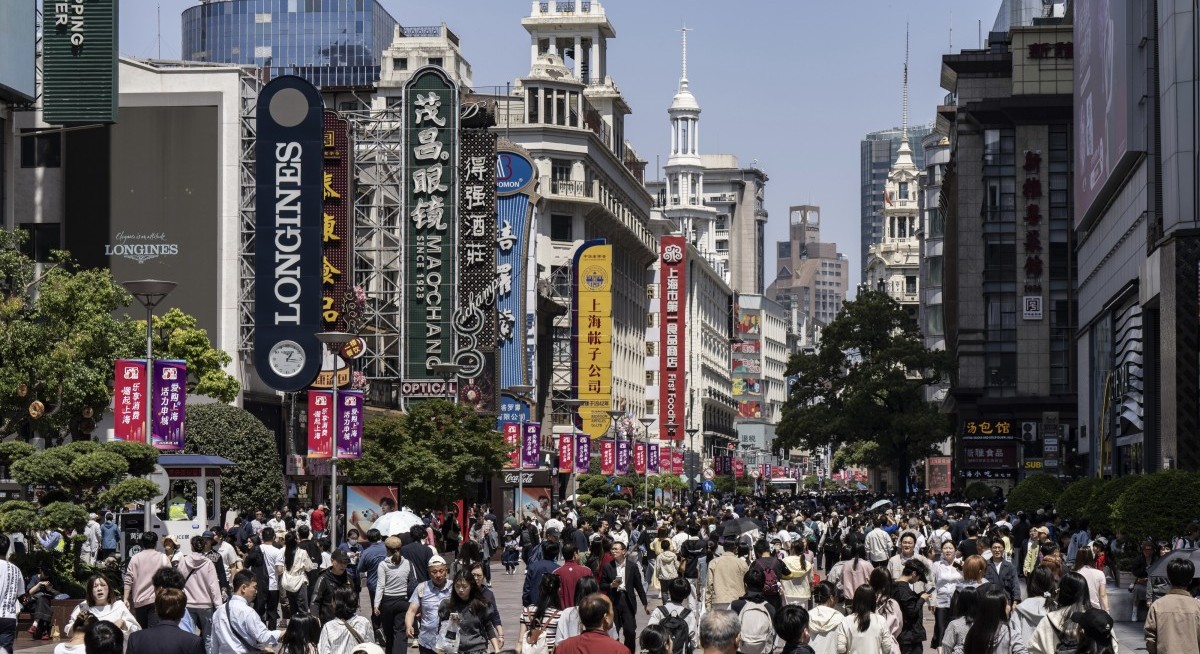


On the other hand, market watchers are pointing to China as one of the few bright spots in the market amid the ongoing energy crisis. Analysts from the Bank of Singapore and HSBC continue to remain bullish on China’s stock market. The country’s diversified energy mix means it remains relatively insulated from the uptick in oil and gas prices.
According to Wenli Zheng, a portfolio manager at T Rowe Price, China’s lower GDP target is a reflection of its commitment to pursue technology- and consumption-driven growth over short-term growth that is propelled through fixed-asset investments.
“It’s more about the emphasis on quality versus quantity,” says Zheng. “In the old days when China’s growth was 7% to 8% or 10%, this was a period when urbanisation was happening very fast. This was a period where you needed to create 10 to 20 million jobs every year. But now, we are beyond that stage. The urbanisation has started to slow down because of demographic issues.”
In other words, China is behaving no differently from any other country that has made the leap from a developing to developed economy. Zheng says China’s earlier growth was largely driven by its investments in fixed assets such as property and infrastructure. While that has certainly helped raise the standard of living for the population, it did come at the expense of rising leverage, which then precipitated in the property bust we saw in the 2020s.
See also: Valuing companies using discounted assets
“So, China has tried to restructure the economy from fixed-asset investment to technology- and consumption-driven. That will be a more gradual process as compared to fixed-asset investment, where you have a huge stimulus and drive short-term growth.”
China is more than its mega caps
Zheng has long been keeping a finger on the pulse of the Chinese economy through managing T Rowe Price’s China Evolution Equity Strategy. The fund is invested in Chinese stocks listed in Hong Kong, Shanghai, Shenzhen as well as Chinese American Depositary Receipts. Notably, Zheng’s fund excludes the largest 100 China companies, instead preferring companies from the mid-cap space so as to better capitalise on any mispricing opportunities.
See also: Cash is king, until it is not: Lombard Odier
“Out of all the 7,000 public companies in China, only 1% of those companies are mega caps with a market cap of over US$30 billion ($38.5 billion), but that 1% accounts for 66% of the MSCI China benchmark,” Zheng says. “If you look at the average China fund out there, they put about 60% of their assets into the 1% of companies. The result is a lack of differentiation between passive and active.”
What’s more surprising, Zheng says, is how companies that have been able to enjoy compound growth at 20% or more over the past three to 10 years have come from the non-mega cap space.
“Everyone owns Tencent. Everyone owns Alibaba. So, you want to give them something different,” Zheng adds. “Our design allows us to capture the future winners much better and capitalise on the fact that China is a very inefficient market.”
Zheng’s fund is benchmarked against the MSCI China All Shares index. The fund has generated an annualised one-year excess return of 27.6% as of end-March. Assets under management reached US$500 million, nearly double of what it was three years ago.
Everything goes back to property
The current state of the Chinese economy can be traced back to the bursting of the property bubble in 2020. What was initially a growth engine for China has since morphed into an albatross around its neck. That said, the impact it has on the economy is uneven depending on the demographic in question. This, Zheng says, will create growth opportunities for certain sectors.
According to Zheng, Chinese youths and retirees are consuming more than those in the middle class. This is even more pronounced in China’s lower-tier cities, which are faring better than their top-tier counterparts.
For more stories about where money flows, click here for Capital Section
“This divergence — a lot of that has to do with property because in top-tier cities, the property price was very high. For most people, they will need to borrow from the bank and leverage up to buy the property. When the property price goes down, it has a huge negative wealth effect on people living in Tier One and Tier Two cities,” Zheng says.
In contrast, property owners living in lower-tier cities were hit less by the downturn. This is because their properties were much cheaper and they did not have to incur as much debt to afford to buy them. As such, even when prices went down, the negative effect on their wealth was relatively smaller.
Similarly, the older generation would not have been caught by the property bust since they would have purchased their property long ago — likewise for the younger generation who had not entered the market then.
“Seeing the property price go down might actually make property more affordable to them. That has, in a way, increased their spending power,” Zheng says of China’s youth. “This is why you see this divergence among age groups and among cities.”
Businesses that are geared toward serving these demographics will do well, Zheng adds. This includes non-traditional consumer segments such as travel, which is popular among the older generation, and IP (intellectual property) related consumption like blind boxes, which have been a hit with the younger generation. Companies with innovative business models such as fresh-drink sellers and discount stores have been growing much faster too.
No winner takes all in AI
The US has been taking a hardline against China when it comes to preserving its lead in the AI race. The stakes are high for the Americans, who view AI as an existential race for survival. To that end, both the Biden and Trump administrations have imposed strict export sanctions on semiconductors and AI on China in the hopes of kneecapping the latter’s progress in the field.
Zheng, however, says China does not really see itself as competing in a race with the US. Both countries have adopted wildly different approaches toward growing their AI ecosystems. While the US has been pouring a lot of capital into achieving artificial general intelligence or AGI, Chinese companies have been focused on the consumer market and physical AI. The constraints on Chinese compute by the US has even pushed China to achieve breakthroughs in making AI models more efficient.
“China is six to nine months behind in terms of model capability but what differentiates the Chinese model company is its token efficiency, both in terms of architecture design and engineering,” he adds. “Intelligence and token efficiency: Both are important so each can learn from one another.”
The nature of China’s economy means that AI could see a different development trajectory than in the US. For instance, in the US, past technological revolutions like the smartphone and electric vehicles (EVs) tend to be dominated by a single company such as Apple with the iPhone and Tesla with EVs. This is not the case in China, Zheng says.
“In China, the technology tends to diffuse much faster and broader, so I think AI is going to be adopted much faster there,” Zheng says. “In terms of AI applications, it will impact maybe bigger parts of society and more industries. The overall environment is going to become more competitive.”
Zheng believes that China holds a strong position for three areas in the global AI supply chain: First, optics which includes optical transceivers and lasers; second, printed circuit boards which includes both the materials and assembly process; and third, power generation which includes power equipment and energy grids.
“These happen to be the areas that are growing much faster than the overall AI market,” Zheng says. “Even if the market doesn’t grow much, these three categories can still grow substantially. We focus on opportunities where there’s high value share gain and where there are bottlenecks because bottlenecks give you pricing power.”
On the other hand, traditional Internet companies are less attractive because of the huge capital and operating expenditures they are incurring to invest in data centres. As a result, their financials will have to suffer for some time before they start to see results.
“The Internet used to be this highly cash-generative, asset-light business. But now, they have become a much more capital-intensive business,” Zheng says. “In this period of huge technological disruption, investors need to ask: Is this the right place you want to bet on or would you rather own manufacturing and hardware companies that will have a much better position over the next few years?”




