


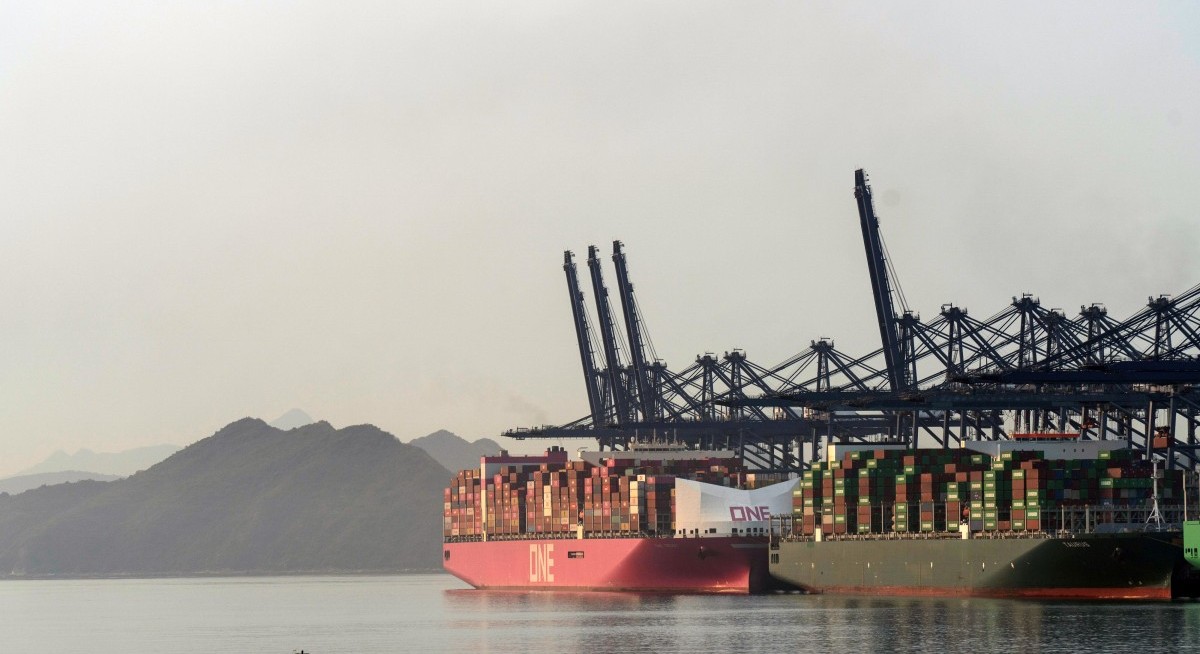


This Li Ka-shing-backed entity operates deepwater container ports in Yantian in Shenzhen, and Hong Kong. Proportionately, Yantian is the increasingly major contributor to volume, with 15 million TEUs (twenty-foot equivalent units) versus Hong Kong’s 7 million TEUs.
As observed by Lopez and Tan, HPH Trust’s revenue and volume have only been “mildly” affected by the trade war, supported by growth at Yantian. More interestingly, HPH Trust has been able to maintain its ebitda margin at around 60% in the last five years, which suggests a certain level of pricing power and cost control.
Yantian is considered one of China’s major ports. According to Macquarie, the larger, more efficient ports are enjoying greater demand, as various shipping lines, in their search for greater efficiency, form alliances and help one another move cargo on increasingly large vessels. “Yantian has gained from this trend as its ability to handle mega-ships fully laden —thanks to deep berths and cranes — makes it a port of call for Asia-Europe and trans-Pacific services employing ultra-large vessels,” says Macquarie. Fundamentally, Yantian’s growth is underpinned by Shenzhen’s critical role as China’s tech and manufacturing hub.
Structural limitations
Despite all the optimism around Yantian, HPH Trust will not realise the full upside due to its structure. HPH Trust owns 50%–100% of its lower-growth Hong Kong operations through HIT (Hongkong International Terminal) and Cosco-HIT, a joint venture between Cosco and HIT. At the same time, it accounts for only 41.3%–56.4% of Yantian Port’s throughput, via YICT (Yantian International Container Terminal) and HICT (Hongkong International Container Terminal), which is its primary growth driver.
See also: Sats’ rally to above pre-war levels prompts divergent views
“As Yantian continues to outperform Hong Kong in both volume and revenue growth, this structure has driven a disproportionate accumulation of minority interests. Despite this imbalance, we believe the market over-penalises HPH Trust relative to its underlying outlook,” state Lopez and Tan.
According to their “most severe stress test”, which assumes a full write-off of the Hong Kong assets against equity, HPH Trust’s valuation expands from 0.6 times P/B to 1.94 times 2026 P/B, which still implies a 56% discount to peers.
Macquarie acknowledges that, thus far, investors do not seem particularly optimistic about HPH Trust’s outlook. The analysts point out that HPH Trust is fairly exposed to interest-rate changes. It carries a net debt of HK$15.5 billion ($2.5 billion) and has to fork out some HK$800 million a year in interest payments. “This capital-intensive nature links its operations to changes in interest rate direction,” says Macquarie.
See also: SGX enjoys higher target prices again with volume surge
Disparity in valuation
Also, they note that HPH Trust’s valuation of just 0.6 times FY2026 P/B is a far cry from the peer average of 4.5 times. Macquarie suggests that this disparity reflects HPH Trust’s low return on equity of just 2.5%, compared with 19.4% for its peers. Also, HPH Trust’s share price has been largely flat since 2021. In contrast, other port operators have gained 57%–343% in the last five years. One reason is the gradual decline in Hong Kong’s volume, as the former British colony has been subject to numerous adverse events.
Macquarie believes this headwind will turn into a tailwind in the FY2026 to FY2028 period. The weakness in Hong Kong is largely reflected in current financials, while growth at Yantian is expected to pick up further, thanks to favourable policies. “We project throughput to deliver positive growth over FY2026 to FY2028, compared with relatively flat performance over 2021–2025,” says Macquarie.
Also, in a nod to the trend of shipping alliances, Lopez and Tan observe that leading liners Maersk and Hapag-Lloyd, which control 22% of world volume between them, have formed a partnership that uses Yantian as its main port of call in southern China and will presumably drive volume growth ahead.
Macquarie expects HPH Trust to deliver both 5% revenue CAGR and 5% ebitda CAGR growth over the FY2026 to FY2028, along with steady ebitda margins of around 60%. The target price of 29 US cents implies a 2026E EV/Ebitda of five times. At this level, HPH Trust remains among the lowest-valued in terms of multiples among other Asian port operators.




