


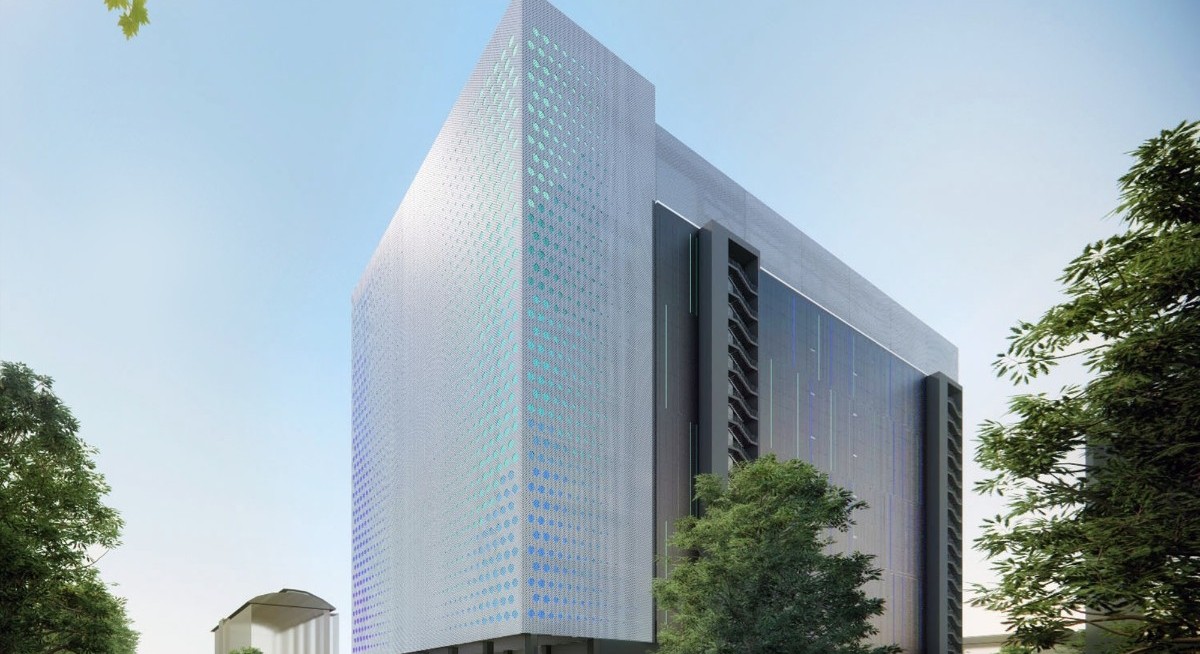


Kathy Chan of Morningstar has maintained her three-star rating on Hongkong Land Holdings and slightly raised her fair value to US$7.40 ($9.55) from US$7.10 after it announced plans for its Singapore Central Private Real Estate Fund, as part of ongoing capital-management moves.
The fund, slated to launch in the first quarter of 2026, will have initial assets under management of approximately US$6.2 billion.
Assets to be part of this fund include One Raffles Link, a 33.3% interest in MBFC Towers 1 and 2 and One Raffles Quay, totalling US$3 billion.
“We are positive about this development, as Hongkong Land demonstrates its ability to generate a recurring stream of fee income through its fund management business,” says Chan in her Dec 12 note.
See also: RHB expects ‘decent’ 2QFY2026 from OCBC, lifts target price to $29.80
The company, which has reiterated its target of increasing overall assets under management (AUM) to US$100 billion by 2035, is in advanced talks to raise funds from third-party capital partners, which will be deployed into mature commercial assets in Singapore’s key business districts.
According to Chan, Hongkong Land has also indicated it will explore other opportunities, including a potential fund in China. “We believe the timing of this initiative will depend on the execution of the Singapore Central Private Real Estate Fund, which could influence the appetite of third-party capital partners,” she adds.
The company will likely provide further updates when it launches the fund, including its portfolio composition and investment strategy.
See also: Price retreat offers buying opportunity for CNMC Goldmine: Lim and Tan
“Additional guidance on share buybacks is also anticipated once capital recycling of the Singapore portfolio is completed following fund formation,” she adds.
Just before Hongkong Land announced the fund, news broke that it is selling its 33.3% interest in MBFC Tower 3 to Keppel REIT at a 2% premium to its end-June total attributable carrying value.
Net proceeds of US$0.7 billion from the sale — after accounting for asset-level debt and liabilities — will be used to reduce debts and lower interest expenses.
Chan expects the transaction to be initially earnings-neutral, as fee income and lower financing costs are offset by reduced profit from the Singapore joint-venture assets.
However, she has raised her 2027–2029 net income forecasts by 1%, with higher fee income anticipated from further AUM growth.
Her higher fair value of US$7.40 reflects the premium from the sale of the MBFC3 stake and the accretion of future earnings.
The shares, while deemed fairly valued, will benefit from support under the ongoing US$150 million buyback programme. — The Edge Singapore
For more stories about where money flows, click here for Capital Section
HRnetGroup
Price target:
RHB Bank Singapore ‘buy’ 85 cents
Improving outlook, growth anticipated
RHB Bank Singapore analyst Alfie Yeo has maintained his “buy” call and 85-cent target price for the Asia-based recruitment agency, HRnetGroup. Yeo says HRnetGroup is attractive because of its “strong cashflow generation abilities and net cash balance sheet”.
“With growth anticipated on the back of improving economic outlook driven by firm GDP growth regionally, we expect HRnetGroup to benefit from more permanent and flexible staffing placements,” Yeo says in his Dec 11 note.
HRnetGroup is the largest recruitment agency in the Asia Pacific, excluding Japan. It operates 11 brands across 10 Asian cities: Singapore, Kuala Lumpur, Bangkok, Hong Kong, Taipei, Guangzhou, Shanghai, Beijing, Tokyo and Seoul. The company is headquartered in Singapore. In his note, Yeo says the economies of most of HRnetGroup’s operating markets in Asean and China will do well next year. This will result in more job placements and hiring activity, thus driving business.
The labour market in Singapore continues to be healthy, says Yeo, citing the results from the Ministry of Manpower’s (MoM) latest Labour Market Advanced Release for 3Q2025. According to MoM, total employment growth for 3Q2025, at 24,800 employees, is 11% higher y-o-y than 3Q2024, at 22,300 employees. Singapore’s retrenchment rate is largely unchanged, at 3,500 employees in 3Q2025, compared with 3,540 in 2Q2025.
Yeo expects hiring to pick up in 4Q2025, given that a higher proportion of companies (44.1%) indicated in MoM’s business expectation polls for 3Q2025 that they are looking to hire, as compared to 43.7% in 2Q2025.
RHB’s economists forecast “firm economic growth” in China, with GDP expected to rise 4.8% in 2026. Indonesia and Malaysia’s GDP growth rates rising to 5% and 4.7% next year, up from 4.8% and 4.2% in 2025, respectively.
HRnetGroup’s expansion into Vietnam will support the company’s growth, Yeo writes. In addition to leveraging Vietnam’s fast-growing economy, HRnetGroup will gain access to a wider talent pool to staff its IT, data science, and product teams.
HRnetGroup’s counter is trading slightly above its historical mean forward P/E multiple of 13 times, which Yeo describes as undemanding. He last raised his target price for HRnetGroup to 85 cents, up from 84 cents, on Oct 27. — Kwan Wei Kevin Tan
LHN
Price targets:
CGS International ‘add’ 88 cents
PhillipCapital ‘buy’ $1.13
UOB Kay Hian ‘buy’ 84 cents
Room for growth ahead
Analysts are upbeat on LHN’s outlook and expect the newly listed Coliwoo to drive growth. In a Dec 8 report by CGS International (CGSI), analysts Tan Jie Hui and Lim Siew Khee say: “We believe Coliwoo will remain a significant driver of LHN’s FY2026 earnings despite the spin-off, supported by new and existing properties.”
“We expect the upcoming 141 Middle Road (141MR, 212 keys, 2Q2026) and 159 Jalan Loyang Besar (159JLB, 382 keys, 3Q2026) to see strong take-up; Coliwoo is currently in talks with Singapore Management University for occupancy at 141MR while management projects strong aircrew demand at 159JLB,” add Tan and Lim, who also note that FY2026 will see a full-year contribution from Kampong Glam and Fire Station Bukit Timah.
Analysts project Coliwoo to contribute about 40% of LHN’s FY2026 net profit, below FY2025’s 70%. They kept their “add” call on LHN. Still, they lowered their target price to 88 cents from $1.20 previously, reflecting higher minority interest following Coliwoo’s listing and stripping out income from subleased assets, where gains were front-loaded in FY2025.
Coliwoo will focus on master leases and management contracts, says LHN, targeting 800 new keys over the next three years and aiming to reach 4,000 rooms by the end of 2026. Its pipeline is robust, with active bids or negotiations for about 300 rooms at Phoenix Park, a 320-room Cleantech Park hotel pending approval from the Urban Redevelopment Authority (URA) and the potential acquisition of a 360-room joint-venture (JV) hotel in eastern Singapore.
Coliwoo is also pursuing two JV hospitality projects (100 and 300 rooms) and a contract for 800 healthcare accommodation beds, giving management confidence it can hit its FY2026 growth targets.
Beyond Coliwoo, the two analysts are optimistic about LHN’s Work+Store segment, as the group is in advanced talks to acquire a Work+Store building in Ang Mo Kio. It also plans to convert more existing facilities into air-conditioned storage units, which could increase rents by around 20% upon completion.
Overall, the analysts say: “We expect Coliwoo to add 800 keys and LHN to acquire 300 self-storage units in FY2026.”
Similarly, PhillipCapital has maintained its “buy” call and lowered its target price to 85 cents from $1.13 previously.
Analyst Paul Chew says: “Post-Coliwoo’s listing and a stronger balance sheet, we expect LHN to pay a higher dividend yield and to deploy capital into new areas of growth, namely storage space and facilities management businesses. Valuations remain attractive at a dividend yield of almost 6% and an adjusted P/B of 0.9 times.”
Chew refers to the group’s 2HFY2025 ended Sept 30, which saw revenue increase 13% y-o-y to $22 million (excluding one-off facilities services), driven by a 15% rise in rooms. Profit before tax for Coliwoo spiked 67% y-o-y to $9.8 million due to the prior year’s upfront cost in healthcare accommodation and new properties.
However, he is cautious about the slower sales of food factory units. Property development revenue of $2 million in 2HFY2025 was a sharp deterioration from the $12 million in 1HFY2025. In FY2025, seven of the 49 unit 55 Tuas South Avenue 1 food factories have been sold. “Sales have been weaker than expected. There remains an opportunity for bulk purchases,” says Chew.
Overall, Chew expects stronger earnings growth for LHN in FY2026, driven by Coliwoo’s room expansion, new storage facilities, lower interest expense, and higher facilities management earnings from growth in the car park and absence of Hong Kong losses. But he notes that lumpy sublease gains will impact underlying earnings on a y-o-y basis.
UOB Kay Hian has also maintained its “buy” call, while lowering its target price to 84 cents from $1.12. Analysts Heidi Mo and Tang Kai Jie see several growth pathways for the group, as it is driving growth across its industrial and commercial space-optimisation, co-living and facilities management businesses.
In its space optimisation segment, the group is growing its portfolio and attracting more tenants by acquiring additional Work+Store properties and upgrading its current facilities with new air-conditioned storage units. LHN added two new master leases at 6A/6B Jalan Papan and 10 Raeburn Park.
Its co-living business continues to scale with the launch of Coliwoo Bukit Timah Fire Station, putting LHN on track to reach 4,000 rooms by the end of FY2026.
In facilities management, the group is enhancing technology and automation, broadening services into new sectors, and adding clients and car park assets, securing 14 new contracts and five new car parks in 4QFY2025, bringing its industrial & commercial facilities management portfolio to 121 clients and total car park capacity to over 27,700 lots.
“At around 10 times adjusted FY2026 P/E, LHN trades at a steep 40% discount to peers’ average of 18 times. LHN’s sustained core earnings growth amidst a valuation discount should underpin share price performance and re-rating potential,” say Mo and Tang. They have also lowered FY2026/FY2027 revenue forecasts by 5% due to lower-than-expected revenue in LHN’s residential segment, despite uplifts from other business segments. Subsequently, FY2026/FY2027 earnings forecasts are lowered by 15% due to a lower contribution from the higher-margin residential segment. Core patmi is still expected to grow, supported by strong underlying business fundamentals. — Samantha Chiew
Singapore Telecommunications
Price target:
DBS Group Research ‘buy’ $5.71
‘Sharp’ upside from data centre and stabilising mobile ARPU
DBS Group Research analyst Sachin Mittal has maintained his “buy” call on Singapore Telecommunications (Singtel) and lifted his target price from $5.04 to $5.71.
In his Dec 11 report, Mittal explains that Singtel’s Singapore operation is expected to benefit from sector consolidation soon, while Australia, India, Indonesia and Thailand have benefited from earlier rounds of consolidation.
“Singapore mobile’s average revenue per user (ARPU) is likely to stabilise in mid-2026 once sector consolidation is approved by the end of 2025,” says Mittal.
The analyst notes that Singtel’s Indian associate Bharti is experiencing explosive growth driven by rising ARPU, while the Australian subsidiary Optus and the Thai associate AIS are also seeing solid growth.
Meanwhile, its Indonesian associate, Telkomsel, is the latest player to begin experiencing a rise in ARPUs.
In his view, the potential catalysts for Singtel will be the sharp rise in data centre ebitda in early 2026 and mobile ARPU stabilisation in Singapore in the middle of 2026.
“Singapore data-centre capacity is set to double to 120MW with the opening up of AI-ready Jurong DC in early 2026,” adds Mittal.
Hence, Mittal is maintaining his “buy” call on Singtel with a higher target price of $5.71, as he raises Singtel’s core business valuation multiple to the regional average to seven times the 12-month forward EV/Ebitda, up from five times.
This is supported by a 5% ebitda CAGR in FY2026 to FY2028, compared against its peers of an average of 4%. Associates are valued at $4.14 per share (previously $4.10), with a 10% holding company discount unchanged.
Mittal also states that a potential STT GDC acquisition could add a new high-growth associate alongside Bharti, which is positive for Singtel in the medium term. — Teo Zheng Long
Valuetronics Holdings
Price target:
UOB Kay Hian ‘buy’ $1.03
Upside from easing trade tensions
UOB Kay Hian analysts maintain their “buy” call and $1.03 target price for Valuetronics Holdings. According to analysts John Cheong and Heidi Mo, the company will see improved order flows and new customers amid easing trade tensions between the US and Vietnam, the latter of which is where Valuetronics’ main manufacturing plant is situated.
The analysts say the reduction of US tariffs on Vietnam to 20% in July 2025, from 46% in April 2025, should support the company’s order recovery. The reduced tariff rates will enhance Vietnam’s competitiveness as a manufacturing base when compared to other Asean economies, such as Indonesia, Malaysia and Thailand, whose tariff rates range from 19% to 20%.
Valuetronics’ “Vietnam manufacturing base not only serves as tariff diversification, but also captures new orders from global customers seeking a reliable, cost-competitive alternative to China,” they write, noting that the company’s newly expanded capacity in Vietnam could help boost output by around 30%.
UOB Kay Hian expect Valuetronics “to reap earnings growth in FY26 and beyond” due to the successful diversification of its customer base. New customers have contributed significantly to 1H26, Cheong and Mo note, and include a Canada-based industrial and commercial electronics company providing network access solutions and a consumer electronics company supplying to a leading global entertainment conglomerate.
Cheong and Mo also see Valuetronics’ high net cash position of HK$1.1 billion, equivalent to 50% of the company’s market cap, as a potential catalyst. The cash can be used to finance share buybacks or dividends, thereby boosting shareholder returns.
UOB Kay Hian’s target price of $1.03 is based on 13 times P/E for FY2027 earnings, which is at +1 standard deviation above the mean. Cheong and Mo raised Valuetronics’ target price to $1.03 in their Nov 14 note, a 24% increase from their previous target price of 83 cents.
Valuetronics is “currently trading at 12 times FY27F/PE, a significant 35% discount to Singapore peers’ 19 times P/E,” Cheong and Mo write. The company’s dividend yield of around 6% is attractive and more than 100% higher than the peer average of 1.4%. “We believe valuations remain undemanding, given Value’s defensive earnings profile and strong cash generation,” they add. — Kwan Wei Kevin Tan
Centurion Corp
Price target:
RHB Bank Singapore ‘buy’ $1.86
Lift from Perth PBSA development
RHB Bank Singapore analyst Alfie Yeo has increased his target price to $1.86 on Centurion Corp after the company’s 25% stake acquisition of a 472-bed purpose-built student accommodation (PBSA) development in Perth, Australia, for A$6 million ($5.1 million).
The project is located at 37–43 Stirling Highway in Nedlands, within 500m of the University of Western Australia’s Crawley campus and within walking distance of Queen Elizabeth II Medical Centre. The PBSA is also near a rail network and high-frequency buses serving the city’s central business district (CBD). The PBSA development will be put under Centurion’s premium PBSA brand Epiisod and funded with internal resources.
To Yeo, the Perth acquisition supports Centurion’s strategy to move into developmental projects and grow them into mature assets before monetising them. However, the project is scheduled to be completed in December 2027; as such, any contributions are likely to come in from 2028 onward.
That said, Yeo believes the contributions — to be recorded under joint ventures and associates — are unlikely to be significant.
The analyst has maintained his “buy” call as the company’s new growth focus on property development, REIT management for Centurion Accommodation REIT (CAREIT) and acquisitions remains intact.
“Centurion’s remaining assets (which have not been spun off to CAREIT) will continue to drive growth, with improved occupancy, bed capacity expansion (especially in Malaysia), and asset enhancement initiatives (AEIs),” he adds. “It will look to make strategic acquisitions, including in the Middle East, and receive new REIT management fees from third-party asset owners and CAREIT to supplement growth.” — Felicia Tan
Seatrium
Price targets:
DBS Group Research ‘buy’ $2.96
CGS International ‘buy’ $2.67
BalWin5 contract brings Christmas cheer
In their research notes issued on Dec 12, DBS Group Research and CGS International (CGSI) reiterated their “buy” call for Seatrium with target prices of $2.96 and $2.67 respectively, after the company announced the previous day that it had bagged a contract with partner GE Vernova to deliver a “major part” of the BalWin5 offshore wind project.
With BalWin5, Seatrium’s contract wins for the year crossed the $4 billion mark. Both DBS and CGSI estimate the size of the new contract to be around $2 billion.
BalWin5 is a new 2.2 GW offshore high-voltage direct current (HVDC) grid connection that will transmit electricity from offshore windfarms in the German North Sea to the onshore transmission network in Germany. It is the fourth project awarded to the GE Vernova-Seatrium consortium under the five-year collaboration agreement with TenneT announced in March 2023. Seatrium will design and construct the offshore converter platform and manage its transportation and installation in the German North Sea.
Seatrium’s share price had declined around 16% from October’s $2.48 peak, weighed down by the Maersk Offshore Wind’s cancellation of a US$475 ($613) million contract for a wind turbine installation vessel (WTIV) and underwhelming order wins for the first 10 months of the year. The order book of $16.6 billion as at Sept 30 implied revenue coverage of roughly two years, notes DBS.
DBS suggests that the pair of major contract wins — this and the Tiber floating production unit, estimated at around $1.3 billion — in the span of two weeks indicates a “strong uptick” in order momentum, which is likely to “boost confidence” and the company’s share price. It notes that the order book of $16.6 billion as at Sept 30 implied revenue coverage of roughly two years.
For 2026, DBS seems confident that Seatrium will achieve an $8 billion annual contract-win target. It believes the O&M player is well positioned to win more contracts, including TenneT HVDC contracts worth around $2 billion each, Petrobras Seap 1 and 2 worth $1 billion each, and projects ranging from $300 million to $1 billion in the Americas and the Middle East.
DBS is also optimistic about achieving mid-teens margins and cost savings from streamlining operations, including divestments of non-core facilities. Coupled with the removal of cost overruns from the US yard and projects, Seatrium is one of DBS’s “top picks” for 2026.
While CGSI analysts Lim Siew Khee and Meghana Kande have faith in Seatrium’s prospects, they are slightly more conservative in their report.
Instead of DBS’s $8 billion estimate, Lim and Kande forecast Seatrium to win about $6 billion in new contracts for 2026. They also estimate BalWin’s margins to be high single digits. Project-wise, they see similar potential wins as DBS.
Lim and Kande note re-rating catalysts include the resolution of Seatrium’s arbitration with Maersk Offshore Wind over the WTIV contract termination, “higher-than-expected margin improvements” and potential monetisation of non-core assets.
On the back of higher-margin projects and new contracts that support earnings growth from FY2025 to FY2027, CGSI values Seatrium at 1.3 times 2026 forecast P/B, giving a 10% discount to the counter’s historical P/B of 1.5 times. — Lin Daoyi
Delfi
Price target:
RHB Bank Singapore ‘buy’ 94 cents
UOB Kay Hian ‘hold’ 82 cents
Lower cocoa prices to drive margins and growth
In a Dec 10 report, RHB Group Research maintains its “buy” call on chocolate maker Defi, with a target price of 94 cents, down from $1.33 previously.
Analyst Alfie Yeo says: “We remain upbeat on Delfi, as cocoa prices are easing, which should strengthen margins. Despite lowering our projections, its FY2025–FY2027 earnings CAGR remains sturdy, at 16%. We still value the stock at 13 times forward P/E, pegging to FY2026 earnings and at close to +1 standard deviation from its post-pandemic historical mean P/E.”
“We believe Delfi remains a long-term takeover target, on its strong market share and extensive distribution network across Indonesia,” he adds.
In Delfi’s 9MFY2025 ended Sept 30, revenue of US$384 million ($495.7 million) was below Yeo’s estimates. The slight growth was driven by stronger regional sales, offset by a slight decline in Indonesia, which was dragged by a dip in agency brand sales due to reduced promotional support from certain agency partners in 1HFY2025.
However, the strong 3QFY2025 performance by its key brands in Indonesia helped to mitigate the overall sales decline to just 1.7% y-o-y. Strong regional market sales were led by Malaysia and the Philippines, particularly in 3QFY2025. Gross profit margin (GPM) for 9MFY2025 was 26.8% (–1.3 percentage points) due to a weaker Indonesian rupiah, increased promotion spending for own brands, and lower margins from agency brands.
Delfi has operated through a period of high cocoa prices since January 2024. “We believe the FY2024 GPM decline (27.4%) from the average of about 30% annually over the prior five years is reflective of the higher cocoa price environment,” says Yeo.
However, since May, cocoa prices have eased significantly (by about 47%) to under US$6,000 per tonne currently. This should help to lift the pressure on its input costs and gross product margins.
With that, Yeo has slashed FY2025–FY2026 earnings by 38% and 36%, respectively, to account for 1HFY2025’s earnings miss, but has imputed margin expansion for FY2026–FY2027 to reflect lower cocoa prices. “As a beneficiary of relatively lower cocoa prices henceforth, we expect earnings growth to accelerate into FY2027 as it depletes its higher-priced cocoa inventory over FY2026,” says Yeo.
UOB Kay Hian (UOBKH), on the other hand, is maintaining a “hold” recommendation with an 82-cent target price. While analysts Heidi Mo and Tang Kai Jie note that cocoa prices have corrected from US$12,000/tonne to US$5,000/tonne, the price still remains double the 10-year average, suggesting that markets will remain tight.
West African plantations remain aged and under-invested, swollen-shoot disease risks persist, while production remains highly concentrated in Ghana and Côte d’Ivoire (forming 60% of global output). Meanwhile, global chocolate demand continues to rise, led by Asia and premium segments. These suggest that cocoa markets, though off their peaks, will remain tight and volatile.
The UOBKH analysts also note that, despite stronger 3QFY2025 demand, profitability remained weighed down by the residual impact of elevated cocoa prices, a weaker Indonesian rupiah (–4% y-o-y), and heavier promotional investments. Ebitda for 9MFY2025 fell 17% y-o-y to US$35 million, forming 60% of the research house’s full-year estimate, while gross margin contracted to 26.8%.
While cocoa prices have eased from extreme levels, structural supply constraints, sustainability-linked cost increases and rising consumer preferences for premium chocolate are likely to keep upstream costs elevated. Delfi is focusing on productivity gains, selective pricing actions, supply-chain optimisation and product resizing to mitigate volatility. “Near-term profitability is expected to remain constrained, but Delfi’s strong brand equity, wide distribution network and improved balance sheet position it well for margin recovery once industry conditions stabilise,” say Mo and Tang. — Samantha Chiew




